
The pot you start a blueberry plant in isn’t the pot it finishes in. The right pots for blueberry plants change as the bush moves from rooted cutting to fruiting shrub to mature specimen – sizing up too early leads to waterlogged roots, and sizing up too late stalls growth. This guide maps that sizing sequence stage by stage, with repotting cues and India-specific growing notes.
Why Pots for Blueberry Plants Need to Change as the Bush Grows
Blueberries have shallow, fibrous roots and lack the fine root hairs most container plants use to pull water efficiently from the surrounding medium. That makes them more sensitive than most fruiting shrubs to a mismatch between plant size and container volume: too much soil mass around a small root system stays wet for too long, and blueberry roots don’t tolerate standing moisture well.
This is also where the acidity requirement compounds the sizing question. Blueberries need a growing medium at pH 4.5–5.5 – most Indian soils run more alkaline than that, which is why container growing with a dedicated acidic mix (typically cocopeat-based, given local availability) is the standard approach for Indian growers rather than planting in native soil. A pot sized to the plant, with a mix built for acidity and drainage, gives the root system the conditions it actually needs at each stage – rather than a large volume of media the roots won’t fill or drain fast enough to use.
Air pruning adds a second layer of protection against the same risk. Because root tips are pruned on contact with air rather than left to circle against a solid wall, the root system stays active and distributed through the container instead of concentrating in one wet, poorly aerated zone. For a plant this sensitive to root-zone moisture, that distinction carries more practical weight than it would for a less demanding species.
The Container Sizing Timeline: Cutting to Mature Bush
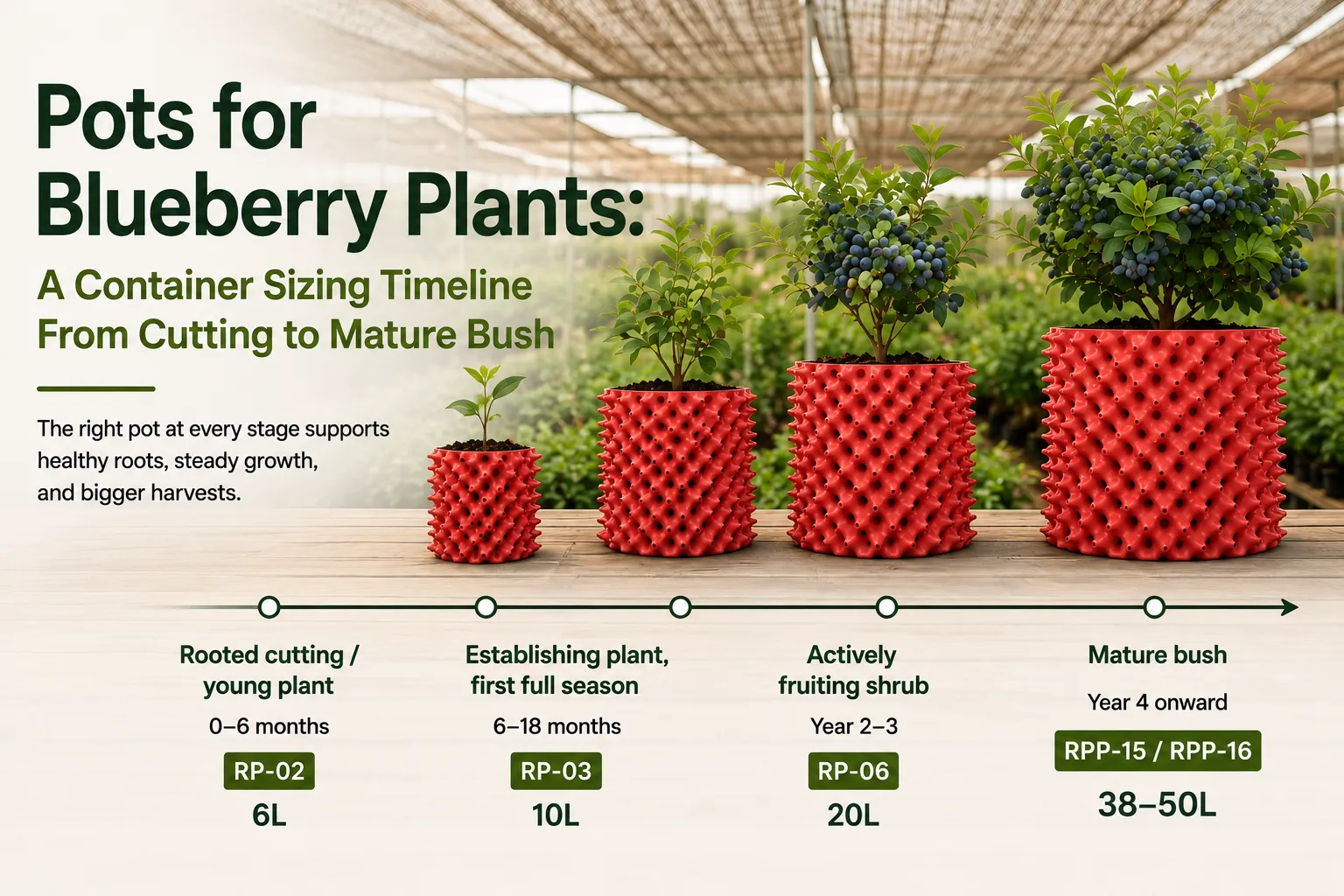
A blueberry plant typically moves through four sizing stages between propagation and full maturity. The table below maps each stage to a RightPot SKU, based on standard container-growing progressions adapted to RightPot’s RP and RPP Series capacities.
| Growth Stage | Typical Age | RightPot SKU | Capacity |
| Rooted cutting / young plant | 0–6 months | RP-02 | 6L |
| Establishing plant, first full season | 6–18 months | RP-03 | 10L |
| Actively fruiting shrub | Year 2–3 | RP-06 | 20L |
| Mature bush | Year 4 onward | RPP-15 / RPP-16 | 38–50L |
This progression is gradual by design. Home growers in Indian cities commonly report that a 20–30 litre container is enough for a young shrub to fruit on a terrace or balcony – which is why RP-06 (20L) marks the point most growers see their first meaningful harvest, well before the plant reaches full maturity. Full-sized mature bushes, particularly vigorous highbush varieties, eventually call for RightPot’s largest capacities (RPP-15 at 38L or RPP-16 at 50L); an especially large, decades-old specimen may outgrow even that, at which point in-ground planting or a custom container becomes the more practical option.
How to Repot a Blueberry Bush Without Setting It Back
Repot a blueberry plant just before its active growth period, not during flowering or fruiting – moving a plant while it’s setting fruit is what causes the growth check most growers are trying to avoid. In India, that generally means repotting during the dormancy-to-bud-break window (roughly December to early February) for chill-hour varieties grown in hill regions, or during the cooler months (November to January) for zero-chill and low-chill varieties grown in the plains, to minimise heat stress on disturbed roots.
An air-pruned root ball makes this step considerably lower-risk. Because the root system has developed as a dense, fibrous mass close to the container wall rather than a tight spiral, the root ball holds its shape when lifted out – there’s less root damage from teasing apart circled roots, and less transplant shock as a result. Step up one size at a time (per the table above), refresh the acidic growing medium rather than reusing spent mix, and water thoroughly immediately after repotting.
Signs Your Blueberry Has Outgrown Its Pot
- Roots visible at the container’s drainage or aeration points.
- Soil drying out noticeably faster than it used to, even with the same watering schedule.
- Reduced fruit set or smaller berries compared to the previous season.
- Leaves yellowing between the veins despite soil pH testing correctly in the 4.5–5.5 range – a sign the issue is root space, not acidity.
- Visibly stalled canopy growth going into a new growing season.
Regional Notes for Growing Blueberries in Pots Across India
Variety choice affects the sizing timeline as much as it affects flowering. Zero-chill varieties suited to plains cities (Mumbai, Chennai, Bengaluru) fruit on a shorter, less dormancy-driven cycle, while high-chill varieties grown in hill regions (Himachal Pradesh, Uttarakhand, the Nilgiris) follow a more distinct seasonal rhythm tied to winter chill accumulation. Either way, the container sizing sequence itself doesn’t change – the growth calendar around it does.
Growers in hot plains cities should also weigh pot colour into the sizing decision: a darker container absorbs more heat around the root zone in peak summer, which matters more for blueberries than for most container plants given their sensitivity to root-zone conditions. RightPot’s White and Silver options reduce that heat load without any change to the air pruning mechanism itself.
Frequently Asked Questions
- What size pot should I start a blueberry cutting in?
A rooted cutting or young blueberry plant does best in a small container – RP-02 (6L) is appropriate for the first 0–6 months. Starting in an oversized pot holds excess moisture around a small root system, which works against the plant’s sensitivity to waterlogging.
- When should I repot a potted blueberry plant?
Repot just before active growth begins, not during flowering or fruiting. For Indian growers, this typically falls in the dormancy-to-bud-break window (December–February) for chill-hour hill varieties, or the cooler months (November–January) for zero-chill plains varieties.
- How do I know my blueberry has outgrown its pot?
Common signs include roots visible at drainage points, soil drying faster than usual, reduced or smaller fruit, leaf yellowing despite correct soil pH, and stalled canopy growth. Any of these signal it’s time to step up one container size.
- What’s the best potting mix for blueberries in India?
An acidic, well-draining mix at pH 4.5–5.5 is essential, since most Indian soils are too alkaline for blueberries untreated. A cocopeat-based mix is the standard approach in India, given local availability, compared to the peat-and-pine-bark mixes commonly used elsewhere.
- Can I skip pot sizes to save on repotting?
It’s not recommended. A container too large for the current root system holds excess moisture the roots can’t use, which works against blueberries’ low tolerance for waterlogging. Sizing up gradually, matched to root development, keeps drainage and growth on track.
- Do blueberries grow well in pots in hot Indian cities?
Yes, with the right variety. Zero-chill cultivars are bred to tolerate high temperatures and don’t require winter dormancy to fruit, making them suited to container growing in cities like Mumbai, Chennai, and Bengaluru.
- How often do mature blueberry bushes need repotting?
Once a blueberry reaches its final container size (RightPot’s RPP-15 or RPP-16 for most home and terrace growers), repotting shifts from sizing up to refreshing the growing medium every 2–3 years, since acidity naturally drifts upward over time with regular watering.
- Should I move from the RP Series to the RPP Series as my blueberry matures?
Many growers do. RP Series covers the cutting-to-fruiting stages (RP-02 through RP-06) well. As the bush approaches maturity and needs more root volume than the RP Series’ 36L ceiling allows, RPP-15 (38L) and RPP-16 (50L) extend the same air pruning system into the capacity range a full-sized bush eventually needs.
Sizing Your Blueberry Pot Correctly From the Start
Getting the container right at each stage – not just the final size – is what keeps a potted blueberry bush on a predictable growth and fruiting timeline. Air pruning adds a practical advantage at every step up: a root ball that holds together at each repot, instead of one that has to be untangled.
Talk to our product specialists to plan your blueberry’s sizing sequence, from cutting to mature bush.
Request a trial order or sizing consultation:
Contact RightPot at info@rightpot.in or WhatsApp (+91) 9996665430.
No minimum order.
Our team will recommend the right aeration container size for your specific crop and cultivation timeline.