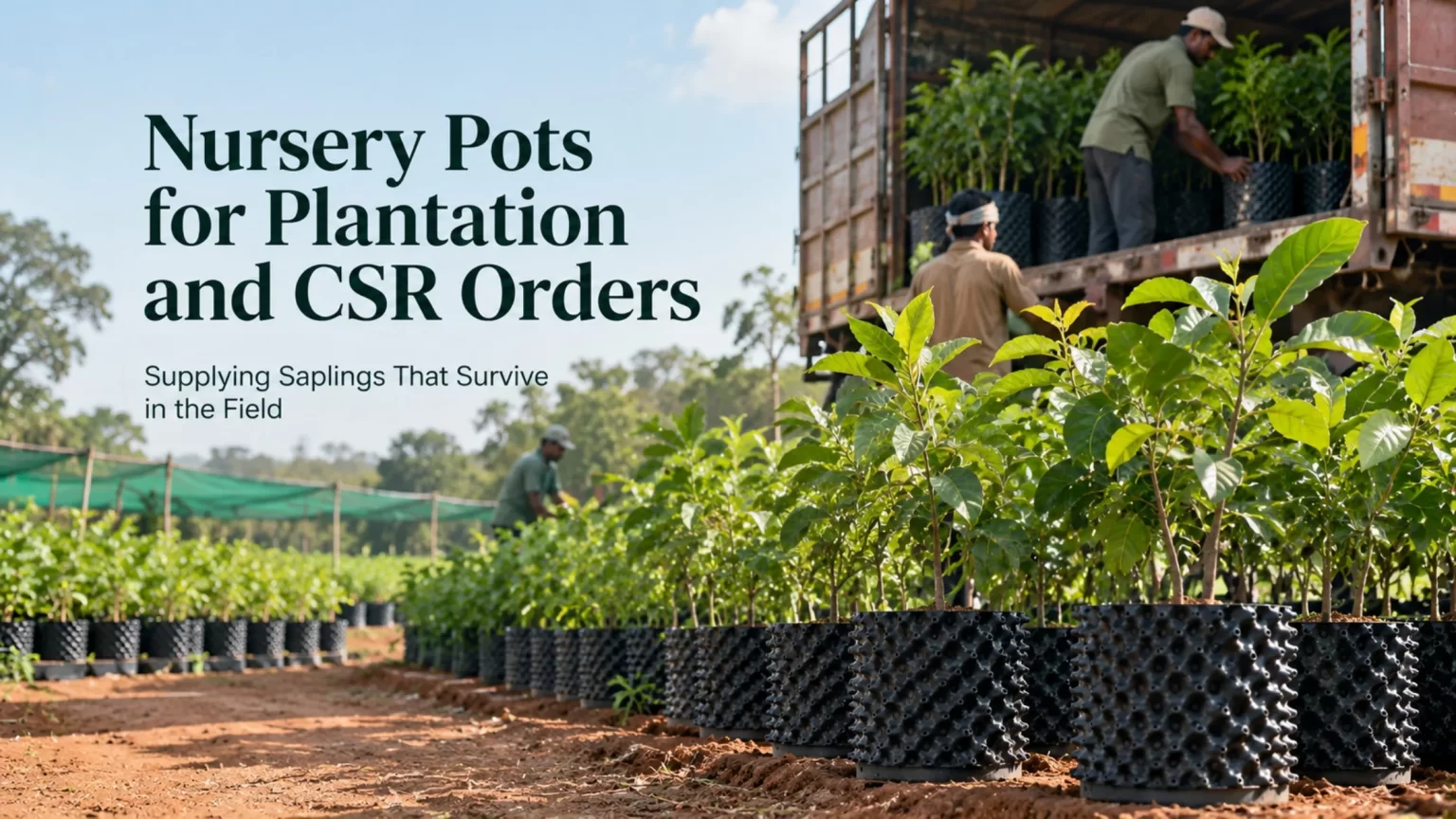
Plantation orders are among the largest a nursery can win, and they are increasingly won or lost on what grows in its nursery pots.
Companies fund tree planting under their CSR budgets. Forest and municipal bodies organise planting drives, particularly around the monsoon, while NGOs implement projects on behalf of corporate and public organisations.
These buyers are changing what they ask for. A count of saplings planted is no longer the only measure of a successful plantation project. Funders may also want geotagged trees, post-planting care records and survival figures a year or more later.
That shifts part of the responsibility back to the nursery and puts nursery pots at the centre of the supply decision.
This guide is for nurseries supplying plantation and CSR orders. It explains what bulk buyers need, how container design can influence root development and how to make root quality more visible in a plantation proposal.
Who Buys Saplings in Bulk, and What Do They Need From Nursery Pots?
Tree planting can qualify as CSR spending under Schedule VII of the Companies Act, 2013, which includes environmental sustainability, ecological balance, protection of flora and fauna and agroforestry.
This provides a framework for eligible corporate plantation projects and the organisations implementing them.
Different buyers have different requirements when purchasing nursery pots and plantation saplings.
| Buyer | Typical order | What they measure |
|---|---|---|
| Corporate CSR programmes | Hundreds to thousands of native saplings | Survival audits, geotagging and impact reports |
| Implementing NGOs | Mixed native species for multiple sites | Establishment rates and aftercare costs |
| Forest and municipal bodies | Avenue trees and large planting drives | Sapling grade and field survival |
| Urban forest projects | Dense planting of multiple native species | Establishment in small planting areas |
The common requirement is survival after planting.
A dead sapling can mean replacement costs, gaps in project reports and additional work for the implementing team. That is why buyers increasingly need suppliers who can explain how their saplings are grown, handled and prepared for dispatch.
For more information about eligible CSR activities, refer to the Government of India’s Schedule VII of the Companies Act.
Why Field Survival Starts in the Nursery Pot
The first few weeks after planting can be challenging for a sapling.
The plant needs to develop new roots in unfamiliar soil while adjusting to different moisture levels, sunlight and local site conditions.
How quickly it establishes depends partly on the root system it brings from the nursery.
A sapling grown in a conventional poly bag may develop roots that spiral around the bottom and sides of the container. When planted, these roots may continue growing in a circular pattern instead of spreading efficiently into the surrounding soil.
Container design therefore matters.
Research published in Current Forestry Reports on container effects on forest seedlings discusses how container depth can influence root development, particularly in large-seeded, taproot-forming broadleaf species. Deeper containers may also improve survival after planting in certain conditions.
For nurseries supplying plantation projects, choosing the right container is an important part of preparing saplings for field conditions.
How Air-Pruning Nursery Pots Build a Field-Ready Root System
Air-pruning nursery pots have openings across their walls. When a growing root tip reaches an opening and encounters air, its growth at that tip stops.
The plant can then develop new lateral roots behind it instead of allowing the root to continue circling around the container.
The result is a more branched root system with fine roots distributed throughout the growing medium.
When the sapling is ready for planting, this root structure can help provide a better starting point for establishing in the surrounding soil.
Read our detailed air pruning pots guide to understand how this mechanism works.
Three practical differences can be useful during dispatch and planting:
- The root ball holds together. A well-developed, branched root system can help the growing medium retain its shape when the container is removed.
- No cutting at the planting pit. Rightpot’s panels unclip, allowing planting teams to remove the container without slashing a poly bag with a blade.
- No root mat to tease apart. Air pruning helps reduce the formation of tangled, circling roots at the base.
These features can make handling easier for nurseries and plantation teams.
Matching Nursery Pots to Plantation Species
Plantation projects often include a variety of native broadleaf trees. Some species develop strong taproots and need containers with sufficient depth.
The container should match the species, sapling size and expected time in the nursery.
Here are suggested Rightpot sizes for different plantation requirements.
| Sapling type | Example species | Suggested Rightpot size |
|---|---|---|
| Young native seedlings | Neem, pongamia, jamun | RP-01 · 3L or RP-02 · 6L |
| Taproot species for harsh sites | Tamarind, mahua, neem | RP-04 · 15L (15″ tall) |
| Avenue and landscape trees | Rain tree, peepal, banyan | RPP-13 · 22L (16.5″ tall) |
| Fruit trees for community planting | Mango, jamun, jackfruit | RP-06 · 20L |
| Larger saplings for urban sites | Mixed native species | RP-10 · 36L |
The right size depends on the sapling height specified by the buyer and how long the stock will remain in the nursery.
Rightpot’s team can help map container sizes against a plantation species list and the required sapling specifications.
Plan Nursery Stock Around the Plantation Window
Plantation schedules are closely connected to regional rainfall patterns.
In many parts of India, planting takes place during the southwest monsoon from June to September. In Tamil Nadu and coastal Andhra Pradesh, many plantation drives are also planned around the northeast monsoon from October to December.
This creates a familiar challenge for nurseries.
Stock needs to be ready before the planting window, but project approvals, site preparation and delivery dates can change.
A sapling held in a conventional poly bag for additional months may continue developing circling roots, making later handling and establishment more challenging.
In air-pruning nursery pots, roots can continue developing branches instead of forming the same tight spiral.
This can give nurseries more flexibility when a buyer’s dispatch or planting schedule changes, provided the saplings receive suitable watering, nutrition and growing conditions.
Make Root Quality Part of Your Plantation Proposal
Plantation buyers may compare suppliers primarily on the price per sapling. Nurseries can make their proposals more informative by showing how their growing and container practices support plant quality.
Root quality is an important part of that conversation, but buyers need evidence.
Include the following details in every bulk proposal:
- Species list with container size and sapling height: Specify each species, its growing container and the expected sapling grade.
- Photos of lifted root balls: Use photographs of your actual nursery stock rather than generic stock images.
- Dispatch schedule: Connect delivery dates to the buyer’s planting window and include reasonable scheduling flexibility.
- Planting guidance: Explain how to unclip the panel, lift the root ball, plant at the appropriate depth and water after planting.
- Container take-back offer: Explain how reusable containers can be collected and returned after planting.
This information helps buyers understand what they are receiving beyond the number of saplings supplied.
The Container Take-Back Advantage
Single-use poly bags are commonly cut away at the planting pit. Some may be collected, while others can be left behind at the site.
For a plantation project funded to support environmental goals, managing this waste is an important consideration.
Reusable nursery pots offer another approach.
Planting teams can unclip the panels, stack them and return them to the nursery. The nursery can then clean and prepare the containers for another growing cycle.
For nurseries, reusable containers can become a multi-season asset rather than a recurring purchase.
For buyers, a planned collection process can help reduce the amount of container waste left at plantation sites.
| Factor | Poly bags | Air-pruning nursery pots |
|---|---|---|
| Root system at dispatch | May have circling roots at the base | Designed to encourage a branched root system |
| Removal at the planting pit | Usually cut away with a blade | Panel unclips; root ball can be lifted out |
| Holding stock past schedule | Roots may continue circling | Roots can continue branching |
| Waste at the site | Bags need collection and disposal | Panels can be collected and reused |
| Use across seasons | Generally single use | Designed for multiple growing cycles |
A take-back arrangement works best when the nursery and buyer agree on collection, cleaning, transport and reuse responsibilities before the project begins.
Key Takeaways: Choosing Nursery Pots for Plantation Orders
- CSR and plantation buyers increasingly look beyond sapling counts and consider field establishment and survival.
- Root development in the nursery can influence how a sapling adjusts after planting.
- Air-pruning nursery pots are designed to encourage a dense, branched root system.
- Choose deeper containers for taproot species and match pot size to sapling height.
- Plan nursery stock around regional planting windows and possible project delays.
- Include actual root-ball photographs and container specifications in bulk proposals.
- Offer a container take-back arrangement to support reuse and reduce waste at plantation sites.
FAQs: Nursery Pots for Plantation and CSR Projects
1. What nursery pots are best for plantation saplings?
The right nursery pots should provide suitable root space, good drainage and a practical way to remove the sapling at planting.
Air-pruning nursery pots are designed to encourage root branching rather than circling. Choose deeper containers for taproot species and select the size according to the sapling’s growth stage and planting requirements.
2. Is tree planting an eligible CSR activity in India?
Yes. Schedule VII of the Companies Act, 2013 includes environmental sustainability, ecological balance, protection of flora and fauna and agroforestry among the activities that may be included in corporate CSR policies.
However, each project must meet the applicable CSR provisions and implementation requirements.
3. Can nursery pots be reused after a plantation project?
Yes, provided the containers are designed for reuse and the project includes a collection process.
Rightpot’s panels can be unclipped from the root ball at the planting site, stacked and returned to the nursery. After suitable cleaning and sanitation, they can be prepared for another growing cycle.
4. How deep should nursery pots be for native tree saplings?
The required depth depends on the species, root habit and sapling growth stage.
Taproot species such as neem and tamarind may benefit from deeper containers. Research on forest seedlings indicates that container depth can influence root development in taproot-forming broadleaf species.
Rightpot’s RP-04 and RPP-13 containers are 15 inches and 16.5 inches tall respectively, making them options to consider when planning suitable container sizes.
5. Do air-pruned saplings need different planting methods?
The basic planting process remains similar, but removable panels can make container removal easier.
Unclip the panel, lift the root ball carefully, position the sapling at the appropriate planting depth and water it thoroughly after planting.
The container does not need to be cut away, and the root ball can be handled without unnecessarily disturbing its structure.
Win Plantation Orders With Nursery Pots Built for the Field
Plantation buyers are investing in trees that can establish and grow after planting.
Nursery pots that encourage healthy root development give your saplings a better starting point and help your proposal demonstrate how you prepare stock for field conditions.
Rightpot designs and manufactures nursery pots in India, with volume pricing starting from 100 units and custom pricing available for orders above 5,000 units. Mixed sizes count towards the applicable pricing tier.
Request a bulk quote with your species list, sapling sizes and expected planting window.
Call or WhatsApp: +91 9996665430
Email: info@rightpot.in
Bulk orders: Sizing consultation and trial orders available.