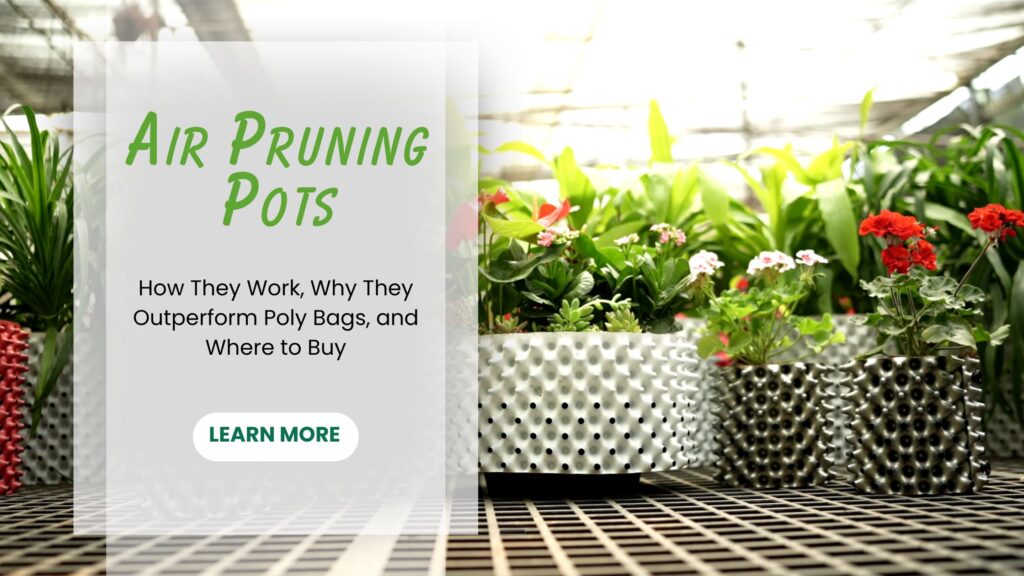
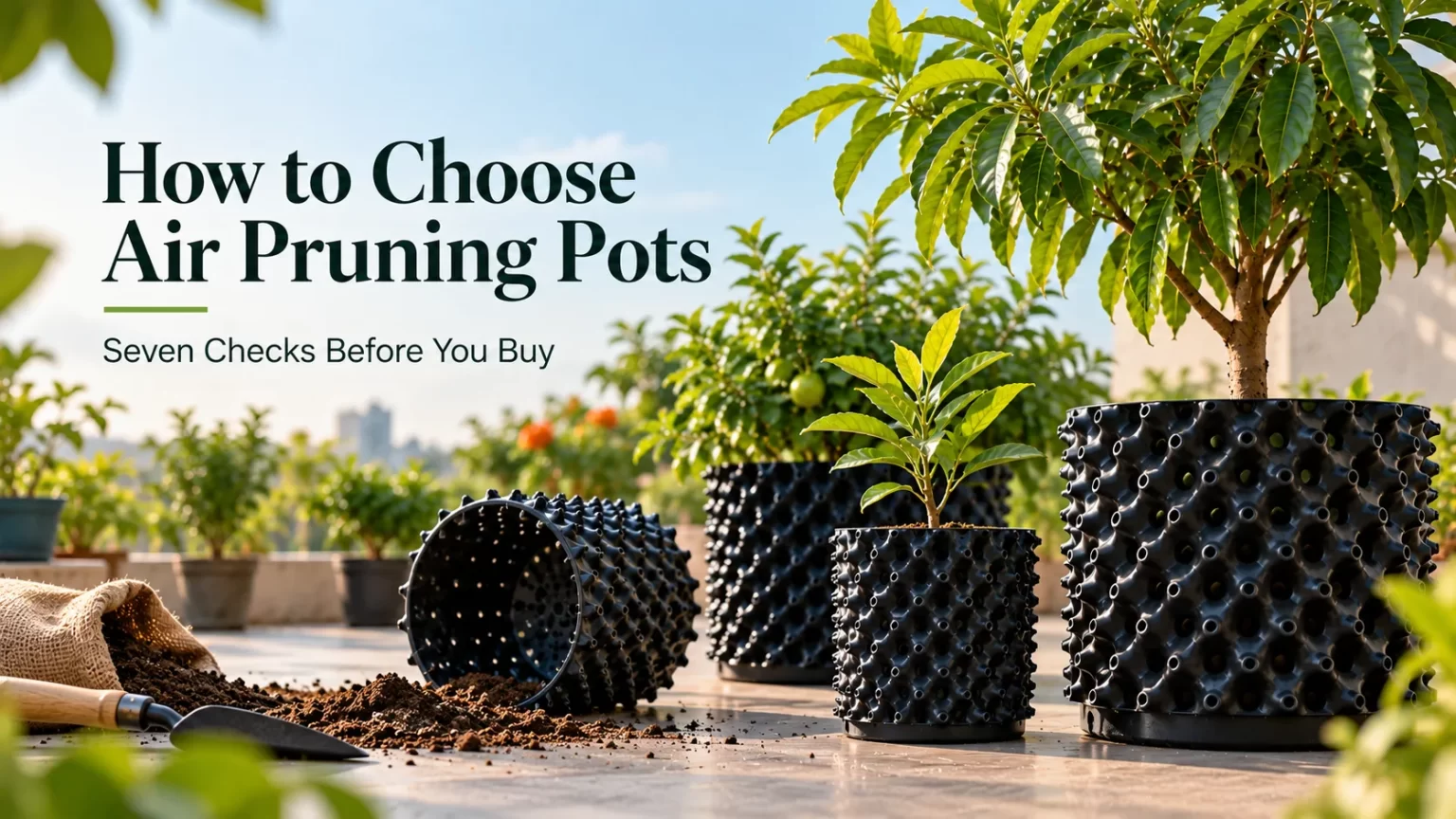
A pot with holes in its wall is not automatically an air pruning pot. Many containers sold under this name still allow roots to circle because the openings are positioned incorrectly or the wall between them is flat.
If you are planning to buy air pruning pots for a terrace garden, home nursery or commercial growing operation, a few simple checks can help you assess whether a pot is designed to do the job.
These seven checks take only a couple of minutes per pot and require no special tools.
They work whether you are comparing a product page, inspecting a sample or evaluating a bulk delivery. Use them to compare different air pruning pots, including the options available from Rightpot.
What Air Pruning Pots Have to Get Right
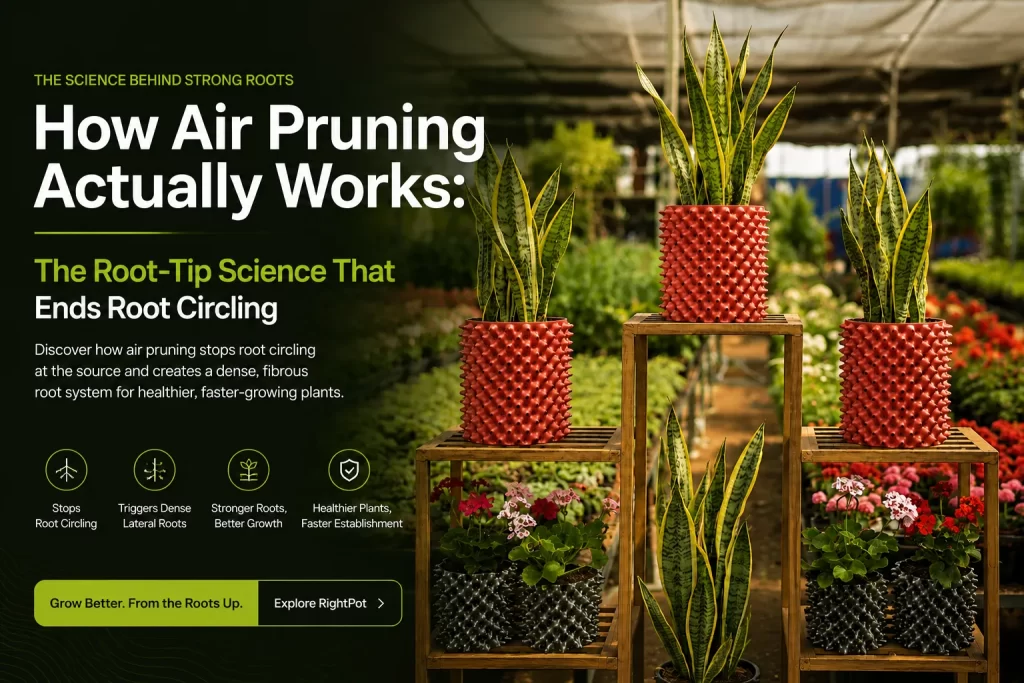
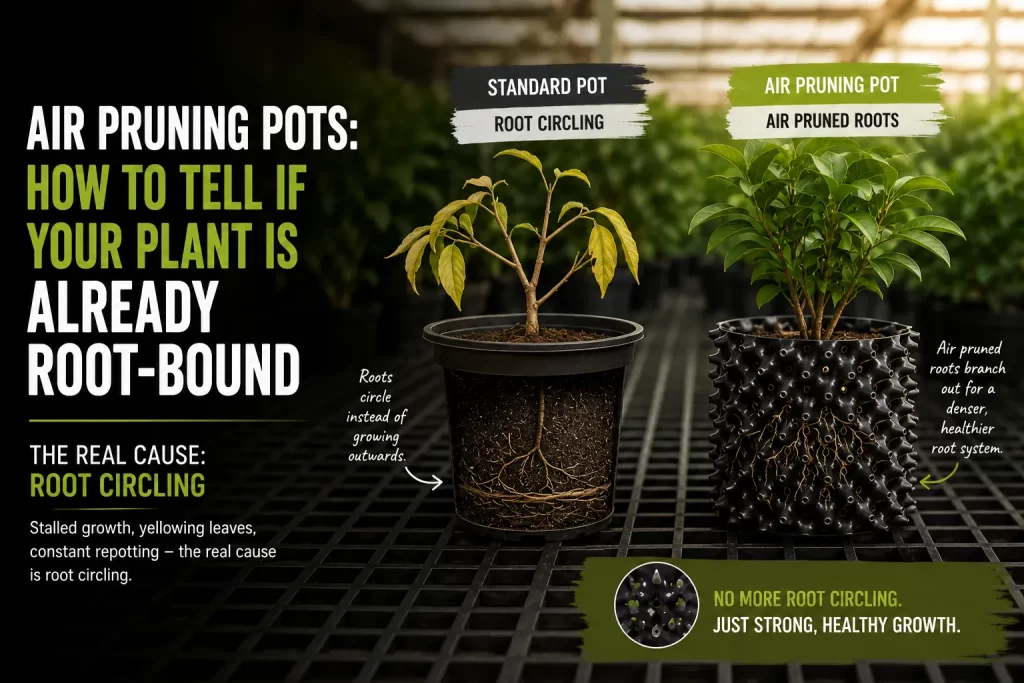
The mechanism is simple. When a root tip reaches an opening and encounters dry air, its growth at that tip stops. The plant can then develop new lateral roots behind it instead of allowing the root to continue circling.
Our guide to how air pruning actually works explains the root science in more detail.
The job of air pruning pots comes down to one important requirement: exposing root tips to air across as much of the root ball as possible.
The wall design, opening coverage and base all contribute to how effectively a container supports this process.
The Seven Checks Before Buying Air Pruning Pots
1. Wall Shape: Does It Guide Roots Towards the Openings?
Start by looking at the inside of the wall.
Cone-shaped or raised openings help guide root tips outward towards the air. In contrast, a flat stretch of wall between holes can give roots a smooth surface along which to grow sideways and begin circling.
The more consistently the wall directs roots towards the openings, the better the design supports air pruning.
What to check: Look for shaped openings rather than simply counting the number of holes.
2. Opening Coverage: Does It Extend From Rim to Base?
Openings should run across the full height of the pot.
If they stop halfway up, the upper section of the root ball behaves more like an ordinary container. This limits the area where roots can encounter air.
Hold the pot up to the light and inspect the wall.
You should see evenly distributed openings from the rim down to the base ring.
What to check: Make sure the openings are not restricted to only the lower half of the container.
3. The Base: Where Roots Can Get Trapped
The base deserves as much attention as the side wall.
Roots that grow downwards eventually meet the bottom of the pot. A solid, flat base can allow roots to mat together or spiral along the floor.
A well-designed base should allow excess water to drain freely without trapping standing water.
What to check: Inspect the underside of the pot, not just the visible side panels. Confirm that the base provides suitable drainage and does not create a flat area where roots can accumulate.
4. Material: Is It Suitable for Indian Sun?
Outdoor containers in India are exposed to strong sunlight and prolonged UV exposure.
Plastic without suitable UV stabilisation can become chalky and brittle over time. Panels may weaken or crack after repeated exposure.
Ask the manufacturer whether the material is UV-stabilised for outdoor use.
If you are inspecting a sample, gently flex a panel by hand. It should bend and recover rather than creak, crack or turn white at the fold.
What to check: Ask for material specifications and confirm that the product is designed for outdoor use.
5. Assembly and Rigidity: Does It Hold Its Shape?
Many air pruning pots arrive as flexible wall panels that wrap around a base and lock into position.
A good design should assemble without complicated tools and maintain its shape when filled with growing medium.
The panel should not bulge excessively or spring open at the joint.
This design can also make repotting easier. You can unclip the panel and release the root ball without pulling the plant out by its stem.
What to check: Assemble a sample, inspect the locking points and check whether the structure remains secure.
6. Size Range and Shape: Does It Suit Different Root Systems?
Different plants have different root habits.
Seedlings need smaller containers. Tap-rooted fruit trees benefit from additional depth, while spreading plants such as strawberries need more width.
A manufacturer with only one or two generic sizes may not offer the right shape for every growing requirement.
Look for a range that allows you to move from a starter container to a larger pot as the plant develops.
What to check: Compare volume, diameter and height rather than choosing a container by litre capacity alone.
7. Reuse and Storage: Can You Use It for Multiple Growing Cycles?
Air pruning pots are designed for repeated use, so cleaning and storage matter.
Panels that unroll or nest can save space between growing cycles. Smooth inner surfaces can also make washing easier.
Our guide on how long air pots for plants last explains cleaning and season-to-season reuse.
What to check: Ask how the pot can be dismantled, cleaned, stored and reused.
Good Air Pruning Pot or Red Flag? A Quick Comparison
Use this table when comparing different air pruning pots before purchasing.
| Check | What good looks like | Red flag |
|---|---|---|
| Wall shape | Shaped openings across the wall | Plain holes in a flat wall |
| Opening coverage | Openings from rim to base | Openings only on the lower half |
| Base | Free drainage without standing water | Solid flat floor where roots can mat |
| Material | UV-stabilised, flexible material | Chalky surface or cracks at folds |
| Assembly | Tool-free and holds its shape when full | Bulges or opens at the joint |
| Size range | Small, tall, wide and large options | Only one or two generic sizes |
| Reuse | Unrolls or nests and washes easily | Difficult to clean or store |
Matching Air Pruning Pots to What You Grow
Once a pot passes the basic design checks, choose its size and shape according to the plant.
Rightpot recommends considering root habits and how long a plant will remain in the container rather than automatically selecting the biggest pot available.
The following table maps common growing requirements to sizes from Rightpot’s RP and RPP series, which range from 3L to 50L.
| What you are growing | Shape needed | Rightpot size |
|---|---|---|
| Seedlings and cuttings | Small, compact | RP-01 · 3L · 7.5″ × 7″ |
| Chillies, basil and compact herbs | Compact | RP-02 · 6L · 10.5″ × 7″ |
| Strawberries and spreading plants | Wide and shallow | RP-05 · 12L · 13.5″ × 7″ |
| Shrubs and deep-rooted plants | Tall | RP-04 · 15L · 10.5″ × 15″ |
| Fruit tree saplings (2–3 years) | Balanced | RP-06 · 20L · 13.5″ × 11″ |
| Tap-rooted fruit trees | Tall, long-term | RPP-13 · 22L · 10.5″ × 16.5″ |
| Permanent terrace trees | Large | RPP-16 · 50L · 15.5″ × 16.5″ |
The correct size depends on the plant’s root system, growth stage and growing requirements.
For more general guidance on growing plants in containers, see the Royal Horticultural Society’s container gardening guide.
Compare Cost per Season, Not Just Price per Pot
A poly bag or thin plastic pot may look cheaper when you first compare prices. However, the overall value changes when you consider how long each container lasts and how it supports the plant.
Consider these points:
- Repeated use: A reusable pot spreads its cost across several growing cycles, while a bag may need to be discarded after one use.
- Root development: Circling roots can lead to restricted growth, difficult repotting and slower establishment after transplanting.
- Repotting convenience: A panel that unclips can make it easier to release the root ball without disturbing the plant unnecessarily.
For nurseries purchasing in volume, Rightpot offers pricing by order tier, starting from 100 units, with custom pricing available for orders above 5,000 units.
Questions to Ask Before You Order
Before placing an order for air pruning pots, ask the manufacturer these questions:
- Who manufactures the pot, and will the same sizes be available next season?
- What are the exact volume, diameter and height measurements of each size?
- Is the material UV-stabilised for outdoor use?
- Can a damaged panel or base be replaced separately?
- Is bulk pricing available, and can different sizes be combined in one order?
Rightpot designs and manufactures its pots in India. This supports consistent product sizing and makes future restocking independent of overseas shipping.
Key Takeaways: Choosing the Right Air Pruning Pots
- Holes alone do not make an air pruning pot. Wall shape and opening coverage matter.
- Inspect the base as carefully as the side wall because roots can accumulate along the bottom.
- UV-stabilised material is an important consideration for outdoor use in India.
- Choose the container size and shape according to the plant’s root habits.
- Compare cost per growing season rather than looking only at the initial price.
- Check assembly, cleaning and storage before purchasing in bulk.
FAQs: Air Pruning Pots
1. Is every pot with side holes an air pruning pot?
No. A true air pruning pot is designed to guide root tips towards openings and expose roots to air across the container wall.
Plain holes in a flat wall may prune roots that reach them, but other roots can still circle between openings or along the base.
2. Do air pruning pots need a special potting mix?
They do not require one specific mix, but the growing medium should drain freely.
A mix that stays waterlogged works against the airflow needed around the openings. Many growers use combinations of cocopeat, compost and coarse materials such as perlite or bark to improve drainage and aeration.
3. Does pot colour change how well air pruning works?
No. Pot colour does not change the air-pruning mechanism, but it can affect how much sunlight the container absorbs.
Pearl White and Sterling Silver reflect more sunlight and may be useful on hot terraces. Slate Black may be more suitable for shaded locations or cooler conditions.
Choose the colour according to where the pot will be placed.
4. Can I use air pruning pots indoors?
Yes. However, plan for the water that drains through the openings and base.
Place the pot on a suitable tray with a raised grid or pebbles so drained water does not remain in contact with the base or floor.
5. Which size should a first-time buyer start with?
Start with the plant rather than choosing the largest available pot.
For a fruit tree sapling from a nursery, Rightpot’s RP-06 (20L) is a recommended starting option. For chillies, basil and compact herbs, RP-02 (6L) is a suitable starting point.
Move up in size as the roots develop and the plant’s requirements change.
Buy Air Pruning Pots That Do the Whole Job
The right air pruning pots are easier to identify when you know what to inspect.
Look for shaped walls, openings from top to bottom, a freely draining base and material designed to withstand outdoor conditions.
Run through all seven checks, then match the container size to the plant you intend to grow.
Rightpot’s 16 sizes across the RP and RPP series are designed and manufactured in India for home growers and commercial nurseries.
Browse the full range of Rightpot products on Rightpot.in or Amazon.in, or contact our team for a sizing recommendation.
Call or WhatsApp: +91 9996665430
Email: info@rightpot.in
Bulk orders: Quotes available from 100 units.