Rightpot Science
The Science That's Changing Indian Agriculture
Air pruning isn’t magic. It’s physics, biology, and smart engineering working together to solve the root circling problem that’s plagued container cultivation for decades.
Rightpot harnesses a natural plant response – turning it into the most powerful tool for building superior root systems.
The Problem
Root Circling: The Silent Killer
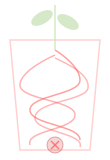
Every grower knows this frustration: You pull a plant from its pot and find roots coiled in tight spirals, wrapping around themselves like tangled rope.
This isn’t just ugly. It’s deadly. Traditional pots — whether plastic, terracotta, or poly bags — all share the same fatal flaw: solid walls that trap roots and force them to circle.
The plant doesn’t circle because it wants to. It circles because it has no choice.
- Strangles the plant's own vascular system
- Blocks nutrient and water uptake
- Creates weak anchor points that fail after transplant
- Stunts top growth permanently — even after planting in open soil
- Root-bound within 8–12 weeks in standard containers
Rightpot Science
How Air Pruning Breaks the Cycle
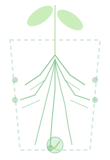
Rightpot’s design does something radically different: it lets roots reach air. Here’s the precise sequence that transforms root development forever.
Root Growth Begins
A young root extends through the soil, seeking water and nutrients. In a traditional pot, it would hit a solid wall and curve back inward.
Root Tip Reaches Air
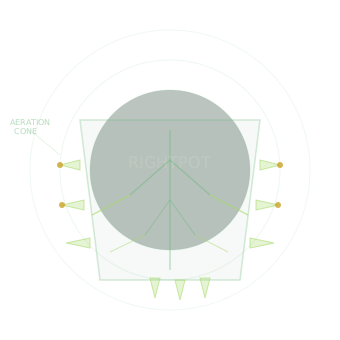
In Rightpot, the root tip grows through one of our strategically placed aeration cones into open air — an environment with zero moisture.
Natural Pruning Occurs
The root tip desiccates — a natural process called "air pruning." The tip burns off, signaling the plant that this direction is no longer viable.
Explosive Branching
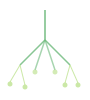
The plant responds by sending multiple new lateral roots from behind the pruned tip. Each branch repeats the cycle — creating 300+ active root tips.
Precision Engineering
The Rightpot Advantage: Where Biology Meets Design

Maximized Air Exposure
Every hole is strategically positioned to maximize air exposure while maintaining structural integrity of the container wall.

Cone Geometry Matters
Unlike flat holes, our raised cone geometry directs root tips precisely into the air current while keeping growing media secure and preventing soil loss..

Vertical Air Channels
Creates vertical air channels that oxygenate the entire root zone — preventing the anaerobic conditions that cause root rot.

Perfect Drainage
Prevents waterlogging while ensuring even moisture distribution, so every root tip gets exactly what it needs to thrive.

Optimal Pruning Geometry
Each cone guides roots outward at the ideal angle for natural air pruning — tested across hundreds of plant species and growing conditions.
What Research Proves
Validated by Science.Proven in the Field.
Air pruning technology has been validated by agricultural research institutions worldwide. The data is clear:
25% Faster Top Growth
Independent studies comparing air-pruned plants to traditional container cultivation show consistent acceleration in vegetative growth rates.
68% Faster Than Open Field
Dutch trials demonstrated that air-pruned container plants outpaced open-field specimens — a reversal of conventional wisdom.
0% Root Circling Rate
German horticultural research confirmed zero instances of root spiraling in air-pruning containers across multiple plant species.
40% Less Transplant Mortality
Commercial growers report 30–40% reduction in transplant mortality when switching from poly bags to air-pruning technology.
Side by Side
See the Difference
Thriving Naturally
- Roots reach air → Prune naturally
- 300+ lateral roots branch continuously
- Fibrous root mass fills entire container evenly
- Healthy root development for months
- Minimal transplant shock, 95%+ survival
Trapped & Struggling
- Roots hit solid wall → Circle back inward
- 3-5 main roots spiral repeatedly
- Dense root mat forms at container edge
- Root-bound within 8-12 weeks
- Transplant shock common, mortality high
System-Wide Benefits
Beyond Root Health: Every Metric Improves
Faster Nutrient Uptake
Fibrous roots have 10× more surface area than spiraled roots, absorbing fertilizers and minerals far more efficiently.
Better Water Management
Dense lateral branching prevents waterlogging while ensuring even moisture distribution throughout the entire root zone.
Reduced Disease Pressure
Air circulation through pot walls prevents anaerobic conditions that harbor root rot and fungal pathogens.
Stronger Plant Structure
Commercial growers report 30–40% reduction in transplant mortality when switching from poly bags to air-pruning technology.
Longer Productive Life
Plants that never experience root circling maintain vigorous growth throughout their lifespan — no recovery period needed.
Higher ROI Per Cycle
25% faster growth + 40% lower transplant mortality + 5+ year container life = dramatically better returns on every crop.
Built to Last
Engineered for Indian Conditions
UV-Stabilized PP Plastic
Resists degradation from intense sunlight exposure — critical for outdoor nursery operations across India's diverse climate zones.
Impact-Resistant Construction
Withstands rough handling during transplanting, transport, and daily nursery operations without cracking or deforming.
Chemical Resistance
Compatible with all standard fertilizers, pesticides, and soil amendments used in commercial Indian horticulture.
Multi-Cycle Reusability
Clean, sterilize, and reuse for 5+ growing seasons without performance loss — dramatically reducing per-plant container cost.
Ready to See It in Action?
The Difference Is Visible Within the First Growth Cycle
The difference between traditional pots and Rightpot isn't subtle. It's measurable in every metric that matters to your operation.
Explore our complete product range to find the perfect size for your cultivation needs, or request a trial order to test the technology in your own nursery.
Understanding How Air Pruning Works
Rightpot air-pruning containers are designed around the natural response of plant roots when they reach air. Instead of allowing roots to hit a solid container wall and circle inward, the aeration openings allow root tips to reach the air, where natural air pruning occurs. This encourages branching behind the pruned root tip and supports a more fibrous root structure.
Why Root Circling Happens in Traditional Containers
Traditional solid-wall containers can cause growing roots to encounter the container wall and redirect inward. Over time, this can lead to circling and root-bound conditions. Rightpot’s air-pruning design addresses this problem by providing openings that expose developing root tips to air.
How the Air-Pruning Cycle Works
The process follows a natural sequence: roots grow through the growing media, reach the aeration openings, encounter air, and the exposed root tip naturally dries back. The plant then produces new lateral roots behind the pruned tip. This cycle can continue throughout the root zone, supporting more evenly distributed root development.
Explore How Air Pruning Actually Works
For a deeper explanation of the root-development process, see our detailed guide on how air pruning pots work and our article explaining how air pruning works and why it helps reduce root circling.
Container Design and Root-Zone Aeration
Rightpot combines strategically positioned openings, raised cone geometry, vertical air channels and drainage design to support air exposure around the root zone. The design is intended to allow root tips to reach air while helping maintain the growing media within the container.
Air Pruning for Different Growing Applications
The same air-pruning principle can be used across different cultivation settings, including commercial nurseries, fruit tree sapling production and home or rooftop gardening. Explore our guides for commercial nursery applications, fruit tree saplings and home gardens and rooftop growing.
Choosing the Right Air-Pruning Container
Air-pruning performance depends not only on container design but also on selecting an appropriate container size for the plant’s growth stage and root characteristics. Rightpot offers different sizes and container formats for seedlings, saplings, fruit trees, ornamentals and longer-term container cultivation.
Learn More About Root Development
If you are comparing air-pruning containers with conventional options, our guide to root oxygen and aeration pots explains the importance of air within the root zone. You can also compare aeration pots, plastic pots and grow bags for different growing requirements.
air pruning pots, how air pruning pots work, how air pruning works, air pruning technology, air pruning containers, air pruning pots for plants, root pruning pots, root circling prevention, prevent root circling, air pruning root system, air pruning root development, root aeration pots, aeration pots for plants, root zone aeration, oxygen for plant roots, air pruning vs traditional pots, air pruning pots vs plastic pots, air pruning pots vs grow bags, how air pruning prevents root circling, natural root pruning, lateral root development, fibrous root system, healthy root development, container root development, root bound plant prevention, pots for healthy root growth, nursery air pruning pots, air pruning pots for commercial nurseries, air pruning pots for fruit tree saplings, air pruning pots for home gardens, air pruning pots for rooftop gardens, air pruning pots for blueberry plants, Rightpot air pruning pots, Rightpot aeration pots, air pruning pots, aeration pots, air pots for plants, how air pruning pots work, root tip science and air pruning, root oxygen and aeration, aeration pots vs plastic pots vs grow bags, which plants benefit from air pots, do air pots for plants actually work
How does air pruning work?
Air pruning occurs when a growing root tip reaches an opening in the container and is exposed to air. The exposed tip naturally dries back, encouraging the plant to produce new lateral roots behind the pruned tip.
How does Rightpot help prevent root circling?
Rightpot uses aeration openings and cone geometry that allow root tips to reach air instead of repeatedly hitting a solid container wall and redirecting inward. This is designed to interrupt the root-circling cycle.
What happens when a root tip reaches the air?
When the root tip extends through an aeration opening and reaches the air, the exposed tip naturally desiccates. The plant can then produce lateral roots behind the pruned tip.
Does air pruning encourage lateral root development?
Yes. The air-pruning process described on this page is intended to encourage new lateral roots behind naturally pruned root tips, creating a more branched root system.
What is the difference between air pruning and traditional pots?
Traditional solid-wall containers can cause roots to hit the container wall and circle inward. Air-pruning containers provide openings that expose root tips to air, interrupting that growth pattern.
Why is air important around plant roots?
Rightpot’s design uses aeration openings and vertical air channels to increase air exposure around the root zone. The page describes this as helping oxygenate the root zone and reduce conditions associated with poor aeration and waterlogging.
Can air-pruning pots be used in commercial nurseries?
Yes. Rightpot describes air-pruning containers for commercial nursery operations, fruit tree production and other professional cultivation applications.
Can air-pruning pots be used for fruit tree saplings?
Yes. Rightpot provides air-pruning container options for fruit tree saplings and has dedicated information covering their use in fruit tree production.
Can air-pruning pots be used for home and rooftop gardens?
Yes. Rightpot describes applications for home gardens and rooftop growing, making the air-pruning concept applicable beyond commercial nursery operations.
Does the container design affect air pruning?
Yes. Rightpot’s page explains that strategically positioned openings, raised cone geometry, vertical air channels and drainage are important parts of its container design for supporting air exposure and root development.
How long can Rightpot containers be reused?
The How It Works page states that Rightpot containers are designed for multi-cycle reusability and describes a reusable lifespan of 5+ years, subject to appropriate cleaning, sterilization and use.
Where can I learn more about Rightpot’s air-pruning technology?
You can explore the air-pruning pots guide, the detailed explanation of root-tip science and air pruning, and the guide to root oxygen and aeration.