Nursery pots do a different job at every stage of production. A propagation cell that’s right for a cutting is wrong for a two-year fruit tree sapling, and a grow-out container built for volume isn’t what a buyer wants to see at dispatch. Nurseries running ornamentals, fruit trees and forestry stock on one site need a size-and-stage map, not a single default pot, to keep transplant timing predictable across every crop line.
What Changes Across a Nursery’s Production Line
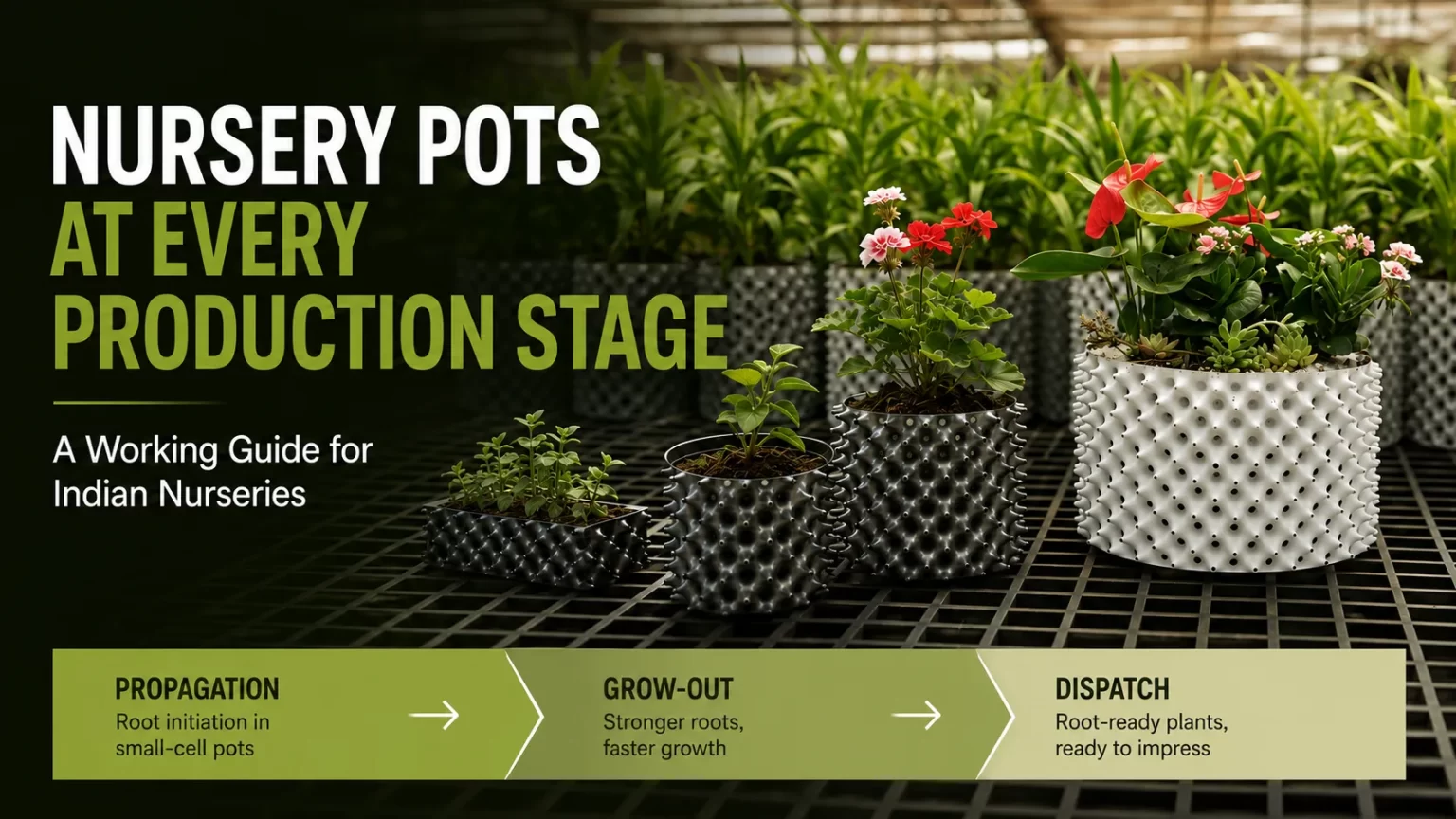
Nursery pots do three different jobs inside one operation: hold a cutting through root initiation, carry a sapling through its main growth window, and present a root-ready plant at the point of sale. Each stage has a different failure mode if the pot is wrong — weak strike rate at propagation, stalled growth at grow-out, or a root ball that falls apart when a buyer lifts it out at dispatch.
Most Indian nurseries run more than one crop line at once — commercial ornamentals alongside fruit tree saplings, sometimes forestry or landscape stock too. A container system that only works for one of those lines forces the nursery to either standardise on the wrong size for two of its three lines, or run parallel container systems that complicate stacking, storage and reordering. The stage-by-stage view below is built around running mixed crop lines on one system.
Propagation: Getting Root Initiation Right in Small-Cell Nursery Pots
At propagation, the job of a nursery pot is to get a cutting or seedling through root initiation without letting the first roots circle before the plant has even established. RP-01 (3L, 7.5″ diameter) is the standard propagation size across RightPot’s crop lines — small enough for efficient bench space, large enough to give the root system room before its first transplant up.
Air pruning matters more at this stage than growers often expect. A root that circles in the first six weeks sets a pattern the plant carries forward — later lateral branching has to work around, not instead of, that early spiral. Starting propagation in a container that air-prunes from the first root tip means the sapling moves to grow-out with a root architecture that hasn’t already been compromised.
Rooted cuttings for ornamentals typically move out of RP-01 within 8–12 weeks. Grafted fruit tree material and slower forestry seedlings often stay 3–4 months before the first transplant up, depending on species and season.
Grow-Out: Matching Nursery Pot Size to Crop Line
Grow-out is where crop lines diverge most. An ornamental destined for retail in under a year needs a different container than a mango sapling grown for 24 months before sale, and both differ from forestry stock grown for landscape delivery. The table below maps RightPot’s RP Series against three common Indian nursery crop lines, from propagation cell through to grow-out size.
| Crop Line | Propagation | Grow-Out | Typical Grow-Out Window |
| Ornamentals (hibiscus, bougainvillea, roses) | RP-01 (3L) | RP-03 (10L) | 6–12 months |
| Fruit tree saplings (mango, citrus, guava) | RP-02 (6L) | RP-06 (20L) | 18–30 months |
| Forestry / landscape stock (teak, neem) | RP-01 (3L) | RP-07 to RP-10 (28–36L) | 24–36 months |
The practical reason to stage up rather than start large: a cutting or seedling in an oversized container holds excess moisture around a small root mass, which works against the aeration benefit the container is meant to provide. Sizing up as the root system actually fills the container keeps drainage and air pruning working as intended at every stage.
Dispatch: Root Visibility as Part of the Sale
At dispatch, the nursery pot’s job shifts from growing the plant to showing the buyer what they’re paying for. A commercial buyer inspecting stock before a bulk order typically checks the root ball, not just the canopy — and a fibrous, air-pruned root mass that holds together when the plant is tipped out reads differently than a spiralled mass that falls apart in the buyer’s hands.
This is a mechanism-driven outcome, not a claim about survival rates: air-pruned roots form a dense network of lateral roots close to the container wall, so the root ball retains its shape on removal. A spiralled root system, by contrast, is often held together mainly by the pot’s shape rather than the roots themselves, and can loosen or shed soil once out of the container.
For nurseries selling on quality signals rather than price alone, this matters at the exact moment a sale is decided — before the plant leaves the nursery, while the buyer still has the root ball in hand.
Running Multiple Crop Lines on One Nursery Pot System
Standardising on the RP Series across propagation and grow-out means one cleaning protocol, one stacking system, and one reorder list — even when the nursery is running ornamentals, fruit trees and forestry stock in parallel. RP Series containers stack up to 15 units high when empty, so a multi-line nursery can store propagation and grow-out sizes for every crop line in the same footprint used for a single-line poly bag setup.
- Same-family reuse (e.g., ornamental cycle to ornamental cycle): basic wash and rinse between batches.
- Cross-family reuse (e.g., fruit tree line to ornamental line): sterilise with a 1:10 bleach solution before reuse.
- Mixed-size storage: propagation (RP-01, RP-02) and grow-out (RP-06 upward) sizes nest separately but store in the same covered area.
- Reorder planning: because containers are multi-cycle, reorder volume tracks expansion, not steady replacement — a different planning rhythm than poly bags.
Frequently Asked Questions
- What size nursery pot should I use for propagation?
RP-01 (3L, 7.5″ diameter) is the standard propagation size for most Indian nursery crop lines, including ornamental cuttings and grafted fruit tree material. It gives young root systems room to establish without excess container volume working against drainage and air pruning.
- Can the same nursery pot be reused across different crop types?
Yes, with sterilisation between crop families. Same-family reuse only needs a basic wash; moving a container from one crop family to another (for example, fruit tree to ornamental) calls for a 1:10 bleach soak to prevent disease carryover between batches.
- How long can a sapling stay in a nursery pot before dispatch?
It depends on the crop line and container size. Ornamentals in RP-03 typically reach dispatch readiness in 6–12 months; fruit tree saplings in RP-06 commonly run 18–30 months; forestry stock in RP-07 to RP-10 often takes 24–36 months, depending on species and target size at sale.
- Do nursery pots work for forestry species like teak and neem?
Air pruning is a container-level mechanism, not a species-specific one, so it applies to forestry species the same way it applies to ornamentals or fruit trees. Forestry stock generally needs the larger RP-07 to RP-10 range because of its longer grow-out window before landscape delivery.
- How does root visibility affect buyer decisions at dispatch?
Commercial buyers frequently inspect the root ball before finalising bulk orders. An air-pruned root system holds its shape when the plant is removed from the container, which gives buyers a clear look at root density — something a spiralled root mass, held together mainly by the pot’s shape, doesn’t offer in the same way.
- What’s the difference between RP Series and RPP Series for nursery production?
Both series use the same air pruning mechanism. RP Series (3L–36L) covers standard propagation-through-dispatch needs for most crop lines. RPP Series (12L–50L) adds extended-height options for operations running longer grow-out cycles or higher-value specimen stock within the same production system.
- Can propagation and grow-out run in the same nursery pot to save a transplant step?
It’s possible for fast-turnaround crops, but most Indian nurseries stage up rather than start large, because an oversized container holds excess moisture around a small root mass and works against the aeration benefit. Staging up as the root system fills the container keeps drainage and air pruning working as intended.
Building a Nursery Pot System Around Your Production Line
The container decision that matters most for a working nursery isn’t which single size to buy — it’s which sizes to run at each stage, for each crop line, so propagation, grow-out and dispatch all work the way they’re supposed to. A nursery running mixed crop lines gets more value from mapping that sequence once than from picking one size and working around it.
Talk to our product specialists to map RightPot’s RP Series across your specific crop lines and production stages.
Request a trial order or sizing consultation:
Contact RightPot at info@rightpot.in or WhatsApp (+91) 9996665430.
No minimum order.
Our team will recommend the right aeration container size for your specific crop and cultivation timeline.