
Blueberries are one of the most container-sensitive crops you can grow, which is why choosing the right pots for blueberry plants is so important. Get the pot wrong, and the plant will look healthy for months before silently failing—root-bound, waterlogged, or stuck in a pH the roots cannot use. Get the pot right, and a single bush in a 12L blueberry container will produce 1–3 kg of fruit annually for 10+ years.
Most guides treat pot choice as an afterthought – pick something with drainage holes and call it done. This guide is different. It covers exactly why each container variable (drainage, aeration, root space, material) affects blueberry performance, which pot for blueberry plants performs best across those variables, and how to match RightPot SKUs to specific Indian varieties and growing conditions.
The Three Non-Negotiables for Blueberry Container Success
Blueberries have three container requirements that are stricter than almost any other commonly grown fruit. Ignoring any one of them creates a problem the plant cannot self-correct. Understanding why each matters makes container selection straightforward.
1. Drainage – Non-Negotiable
Blueberry roots are unusually sensitive to waterlogging. Even 48 hours of standing water in the root zone causes oxygen starvation, triggering root rot within days in warm conditions. Standard plastic pots with 2–3 bottom holes are not enough. The entire container must allow excess moisture to escape continuously – not just drain slowly after saturation.
This is why drainage for blueberries is the first filter in container selection. Any pot that retains moisture against the root zone for more than a few hours after watering is a risk. In Indian summer temperatures of 35°C+, that risk becomes a near-certainty of root rot within a single growing season.
2. Aeration – What Standard Pots Cannot Provide
Blueberries have a shallow, fibrous root system that spreads laterally rather than growing deep. In a solid-walled container, those lateral roots hit the wall within 8–10 weeks and begin circling. Once roots circle, nutrient uptake drops – the plant cannot pull adequate nitrogen and iron from the growing medium, leaves yellow, and fruiting falls sharply. The plant does not die immediately; it declines slowly in a way most growers misattribute to soil mix or fertiliser problems.
Active aeration pots – those with cone-based openings that expose root tips to air – interrupt this cycle entirely. When a root tip reaches air through an aeration hole, it desiccates naturally (“air pruning”). The plant responds by branching laterally from behind that tip, producing multiple new feeder roots. Over time, the blueberry container fills with hundreds of short, fibrous roots absorbing nutrients efficiently across the entire growing medium – rather than 3–5 long roots circling the walls.
3. Root Space – Width Matters More Than Depth
Blueberries do not develop deep tap roots. Their root system spreads outward, typically staying within the top 20–30 cm of growing medium. A tall, narrow pot wastes volume and keeps the root zone wetter for longer. A wider, shallower geometry – like RightPot’s RP-05 (13.5″ diameter x 7″ height) – matches the plant’s natural root architecture and improves moisture management.
The minimum practical blueberry pot size for a mature bush is 40–45 cm diameter (approximately 12–15L). Smaller containers are acceptable for the first 12 months but require repotting as the plant establishes. Starting with the right root space from the beginning avoids the transplant stress of repotting an established blueberry – which can set the plant back by one full fruiting season.
Container Type Comparison for Blueberry Growing
Benchmarking the five most common container types against the three non-negotiables shows clearly why standard plastic pots underperform – and why active air pruning pots consistently produce the best blueberry results.
Container Performance: Drainage, Aeration, and Root Space for Blueberries
| Container Type | Drainage | Aeration | pH Control | Root Space | Verdict for Blueberries |
|---|---|---|---|---|---|
| Standard plastic pot | Poor (1–2 holes) | None | Difficult – soil pH drifts | Root circling starts in 8–10 weeks | Not recommended |
| Terracotta / clay pot | Good (porous walls) | Partial | Moderate – porous walls help | Circles within 12–16 weeks | Mediocre |
| Fabric grow bag | Excellent | Good (passive) | Moderate | Air pruning (soft walls) | Good – but degrades in 2–4 seasons |
| Air pruning pot (RightPot) | Excellent | Active (aeration cones) | Easiest to maintain – consistent drainage prevents pH drift | 300+ lateral roots, no circling | Best choice |
| Imported Air-Pot (UK) | Excellent | Active | Excellent | 300+ lateral roots | Equivalent to RightPot; 3–5x the cost |
Transplant survival and root health data based on air pruning technology research and RightPot commercial operation observations. pH control ease refers to the container’s drainage properties and their effect on soil pH stability over time.
The pH Advantage of Container Growing – and Why Pot Choice Affects It
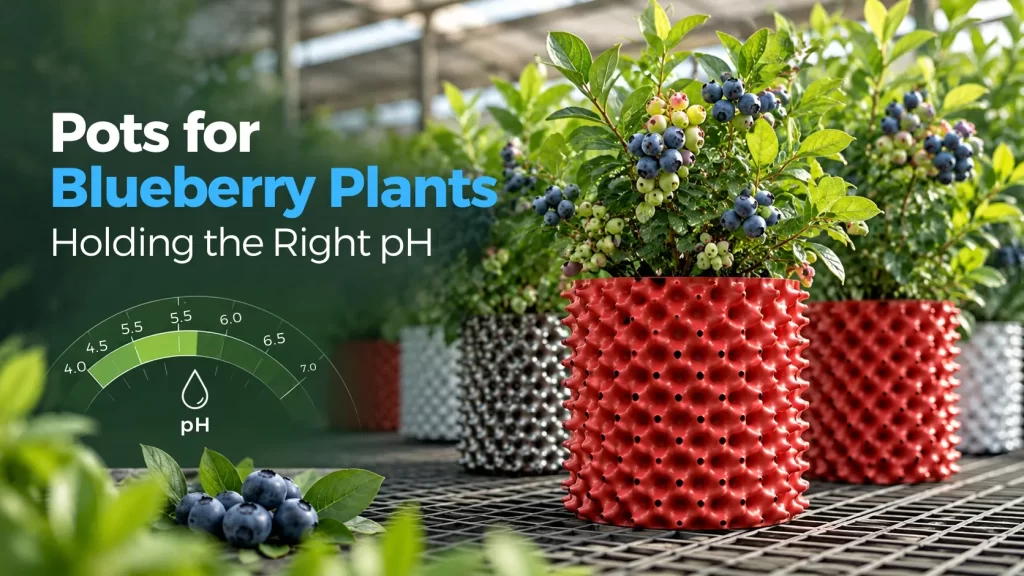
Blueberries require acidic soil at pH 4.5–5.5. Most Indian soils are neutral to alkaline (pH 6.5–8.0), making in-ground blueberry cultivation extremely difficult without ongoing pH amendment. Container growing solves this by giving you complete control over the growing medium – but only if the container manages drainage correctly.
In a poorly draining pot, water accumulates and begins chemically reacting with fertiliser salts, gradually raising pH over weeks. The grower notices yellowing leaves (iron chlorosis – a classic sign of pH above 5.5) and adds iron fertiliser, which temporarily helps but does not fix the root cause. In a well-draining blueberry container with active aeration, excess water exits freely, fertiliser salts flush out cleanly, and the acidic growing medium maintains its target pH with significantly less intervention.
RightPot’s aeration cone design ensures the growing medium never sits in standing water. Combine this with an acidic mix of equal parts cocopeat, pine bark, and perlite, and pH maintenance becomes a monthly test rather than a weekly correction.
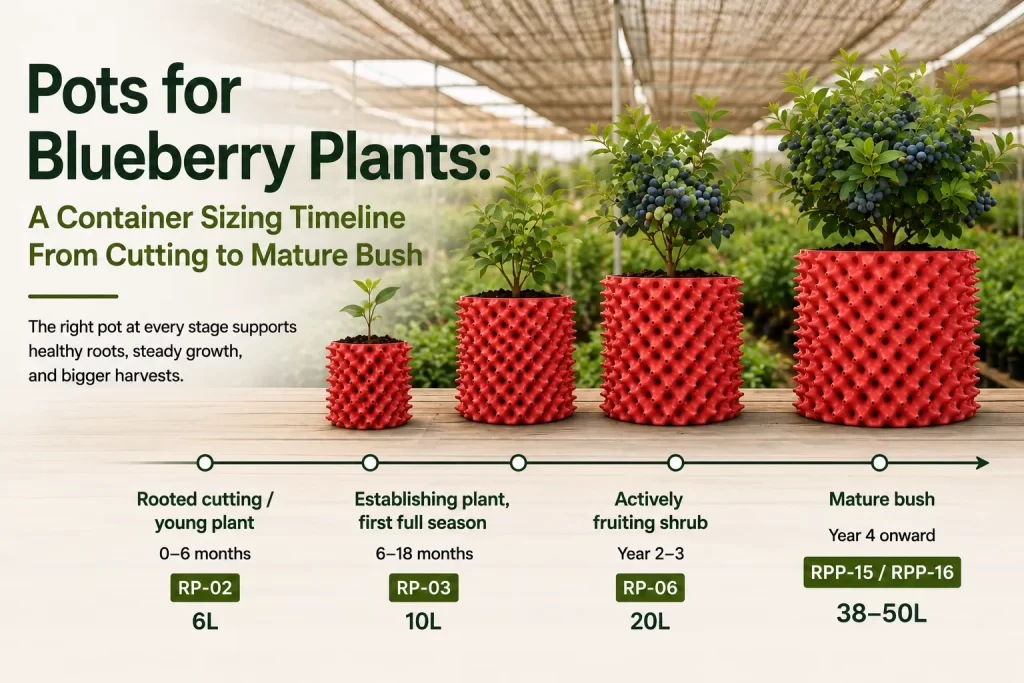
Blueberry Pot Size Guide: Matching RightPot SKUs to Plant Stage
The correct blueberry pot size depends on the plant’s age, variety compactness, and cultivation goal. The table below maps RightPot SKUs to each stage. Note the preference for wider, shallower geometries across all stages – this is deliberate, matching blueberry root architecture rather than generic size logic.
RightPot Size Guide: Pots for Blueberry Plants by Stage and Variety
| Plant Stage / Type | Recommended SKU | Capacity | Why This Size Works for Blueberries |
|---|---|---|---|
| Young plant (first season) | RP-03 | 10L | Enough root volume without waterlogging risk in young plants; allows immediate air pruning from the root tips |
| Established bush (Year 2) | RP-05 | 12L | Wide, shallow geometry (13.5″ dia x 7″ height) matches blueberry’s naturally spreading root architecture |
| Mature bush (Year 3+) | RP-09 | 26L | Large surface area supports full lateral root spread; 15.5″ diameter accommodates bushy canopy without tipping |
| Commercial production (high-value) | RPP-15 | 38L | Maximum root volume; justifiable for premium cultivars where berry yield over 3–4 seasons is the return metric |
| Low-chill / compact varieties (Biloxi, Sunshine Blue) | RP-05 | 12L | Compact varieties stay productive in this size for 2+ years with air pruning; avoids overwatering in smaller plants |
RP-05’s wide, shallow geometry (13.5″ x 7″) is the most recommended starting point for Indian growers. Its dimensions match blueberry root spread better than the taller RP-03 or RP-04 at comparable capacities.
Indian Variety Guide: Which Pot for Which Blueberry
Growing blueberries successfully in India depends on matching the variety to your city’s chill hours – the number of hours annually below 7°C that triggers the plant’s flowering cycle. Most Indian cities have limited chill hours, which is why low-chill and zero-chill varieties have transformed blueberry plant growing in urban India since 2022. The correct pot for blueberry plants varies by variety because compact varieties need less root volume and perform well in wider, shallower containers.
Variety-to-Container Guide: Blueberries in Indian Conditions
| Variety | Chill Hours | Suited For | Rec. SKU | Notes |
|---|---|---|---|---|
| Biloxi | Zero-chill | Mumbai, Chennai, Bengaluru | RP-05 (12L) | Most forgiving for Indian conditions; compact growth suits balcony growing |
| Sunshine Blue | ~150 hrs | Delhi, Lucknow, Pune terraces | RP-05 / RP-09 | Self-fertile; excellent for single-pot setups; wide pot prevents root circling |
| Misty / Sharp Blue | 100–300 hrs | Hyderabad, Pune, coastal zones | RP-09 (26L) | Larger bush needs wider container as it matures |
| Emerald | 250–300 hrs | Bengaluru, Coimbatore | RP-09 (26L) | High yield variety; deeper lateral root system benefits from wider geometry |
| Legacy / Robin Blue | 400+ hrs | Ooty, Shimla, Manali, Kodaikanal | RPP-15 (38L) | Best commercial yield; suited to hill station growers with reliable chill hours |
Chill hour data sourced from published varietal specifications. Local microclimate variations apply – consult your regional horticultural department for city-specific chill hour estimates. RightPot SKU recommendations are based on mature plant size and root architecture, not seedling stage.
Why RightPot Air Pruning Pots Outperform Fabric Grow Bags for Blueberries
Fabric grow bags are a popular choice for blueberries and do deliver air pruning through their breathable walls. For home and commercial blueberry growers in India, however, RightPot’s rigid air pruning pots offer three specific advantages that matter in practice.
- Structural integrity in monsoon conditions: Fabric bags collapse when wet and heavy, creating uneven root compression. RightPot’s rigid structure maintains consistent geometry through India’s monsoon season, ensuring aeration cones remain open and drainage stays unobstructed.
- Lifespan: A blueberry bush takes 2–3 years to reach full production. Fabric grow bags typically need replacing after 3–4 seasons. RightPot containers last 5–7 years – meaning your container investment spans the plant’s entire productive early life without replacement.
- Transplanting without root disturbance: When a blueberry plant needs to move to a larger container, the fibrous root ball from a RightPot air pruning pot slides out cleanly as a cohesive unit. Fabric bags require cutting or careful peeling, which risks disturbing the shallow root zone – a serious setback for a crop this sensitive to root disruption.
Frequently Asked Questions
Q: What is the best pot size for a blueberry plant?
A: For most blueberry varieties, a blueberry pot size of 12–15L with a wide, shallow geometry is ideal for established plants. Start young plants in 10L (RP-03) and move to 12L wide-format (RP-05) or 26L (RP-09) as the bush matures in Year 2–3. Compact varieties like Biloxi and Sunshine Blue stay productive in 12L containers for 2+ years.
Q: Can I grow blueberries in regular plastic pots?
A: You can, but results are consistently poor. Standard plastic nursery pots have inadequate drainage and no aeration mechanism, causing root circling within 8–10 weeks and pH drift as water accumulates. Blueberries are sensitive enough to container conditions that the container choice often determines whether the plant fruits at all – not just how much it produces.
Q: Do blueberries grow well in India in containers?
A: Yes, especially with low-chill varieties. Biloxi (zero-chill) and Sunshine Blue (~150 chill hours) grow well in Mumbai, Bengaluru, Chennai, and Pune. The critical success factor is the growing medium – cocopeat, pine bark, and perlite at equal parts – and a container with excellent drainage for blueberries that prevents pH drift. Air pruning pots make both of these easier to manage than any other container type.
Q: How often should I water blueberries in an air pruning pot?
A: Check the top 2–3 cm of growing medium daily in summer. Water when it feels dry. In RightPot’s well-drained containers, daily watering in peak summer (April–June) is typical for a mature bush. During monsoon, natural rainfall usually provides sufficient moisture – monitor to avoid waterlogging. Consistent moisture is critical; blueberries do not recover well from drought stress.
Q: What colour RightPot should I use for blueberries in a hot Indian climate?
A: White or Silver. Blueberry roots are heat-sensitive, and dark containers absorb significant solar radiation in Indian summers, raising root-zone temperatures above the plant’s comfort range. RightPot’s White and Silver options reflect heat and keep the growing medium cooler by approximately 4–6°C compared to Black containers in direct sun. The air pruning performance is identical across all colours.
Q: Can I use the same pot for multiple blueberry seasons?
A: Yes. RightPot containers last 5–7 years with normal use. Between seasons, remove old growing medium, sterilise with a 1:10 bleach solution, rinse thoroughly, and refill with fresh acidic mix. This annual refresh also resets pH, which naturally drifts slightly acidic or alkaline over a growing season depending on water quality and fertiliser type.
The Right Container Makes Blueberry Growing Predictable
Blueberries punish the wrong container and reward the right one. The variables are well understood: drainage prevents root rot, active aeration prevents circling, and the right root space lets a naturally spreading root system develop as it should. Air pruning pots are the only container type that addresses all three – and RightPot’s RP-05 and RP-09 specifically, with their wider geometry, are the closest match to blueberry root architecture available from an Indian manufacturer.
Whether you are growing one bush on a Bengaluru terrace or running a 500-plant commercial blueberry operation in Ooty, the container decision compounds over a 3–5 year timeline. Choose correctly at the start.
Request sizing guidance or a quote:
Contact RightPot at info@rightpot.in or WhatsApp (+91) 9996665430 .
Our team will recommend the right SKU for your variety, climate zone, and cultivation goal.
Additional Blueberry Growing Resources
For growers interested in learning more about blueberry cultivation, soil acidity management, and container-growing best practices, additional horticultural resources are available from the University of Florida Blueberry Extension Program, Oregon State University Extension, and the USDA Plant Database. These research-backed sources provide valuable guidance on blueberry varieties, irrigation, root development, and long-term plant health.