
Rightpot Science
Superior Roots Build Superior Orchards
Fruit tree saplings are long-term investments. The root system you develop in the nursery determines yield performance for the next 20–30 years. Root circling doesn’t just slow growth — it cripples lifetime productivity.
Rightpot eliminates this problem completely, giving your saplings the dense, fibrous root architecture that high-performing orchards demand.
20–25%
Faster Growth vs. poly bag production
95%+
Transplant Survival in customer fields
4–6
Months to Establish vs 12–18 with circled roots
300+
Active Root Tips
delivered
Why This Matters More for Fruit Trees
Great Orchards Start Underground
When a commercial orchardist invests ₹200-500 per sapling, they're not paying for the visible stem and leaves. They're paying for the invisible root system that will
- Establish quickly in field conditions
- Anchor the tree through decades of fruiting and monsoons
- Support heavy crop loads without structural failure
- Maximize nutrient uptake efficiency (reducing fertilizer costs)
Root-bound saplings fail on every metric
Spiraled roots never fully recover. Even after 5 years in open soil, trees grown in traditional containers consistently show:
- Stunted root spread and reduced canopy coverage
- Reduced fruit yield per acre throughout full productive life
- Higher drought-stress mortality in dry seasons
- Vascular strangulation reducing water transport efficiency
Air-pruned saplings establish like open-field seedlings - with one critical advantage: you control the timeline, quality, and delivery schedule.
The Rightpot Advantage for Fruit Tree Nurseries
Three advantages that change your entire business
01
Dense Lateral Branching = Faster Establishment
When orchardists transplant your saplings, they're losing productive time while roots establish. Traditional container-grown trees take 12-18 months to resume vigorous growth. Air-pruned saplings establish in 4-6 months. Why? Instead of 3-5 thick roots that must break their spiral and start over, you're delivering 300+ active root tips already primed for lateral expansion. The tree hits the ground growing.
Consistent Quality Across Batches
Traditional containers create quality deterioration — early-season sales get healthy plants, late-season buyers get root-bound problems. Rightpot delivers consistent root quality regardless of container time. A sapling can stay in RP-06 for 30 months or 36 months without degradation. This gives you inventory flexibility and eliminates the "sell fast or quality drops" pressure.
Premium Pricing Justification
Progressive orchardists pay premium prices for superior genetics, certified disease-free stock, and proven cultivars. They'll pay the same premium for superior root systems - if you can prove the difference.Rightpot gives you visual proof. Pull a sapling from the container and show them the fibrous root ball. Compare it to a poly bag spiral. The difference sells itself.
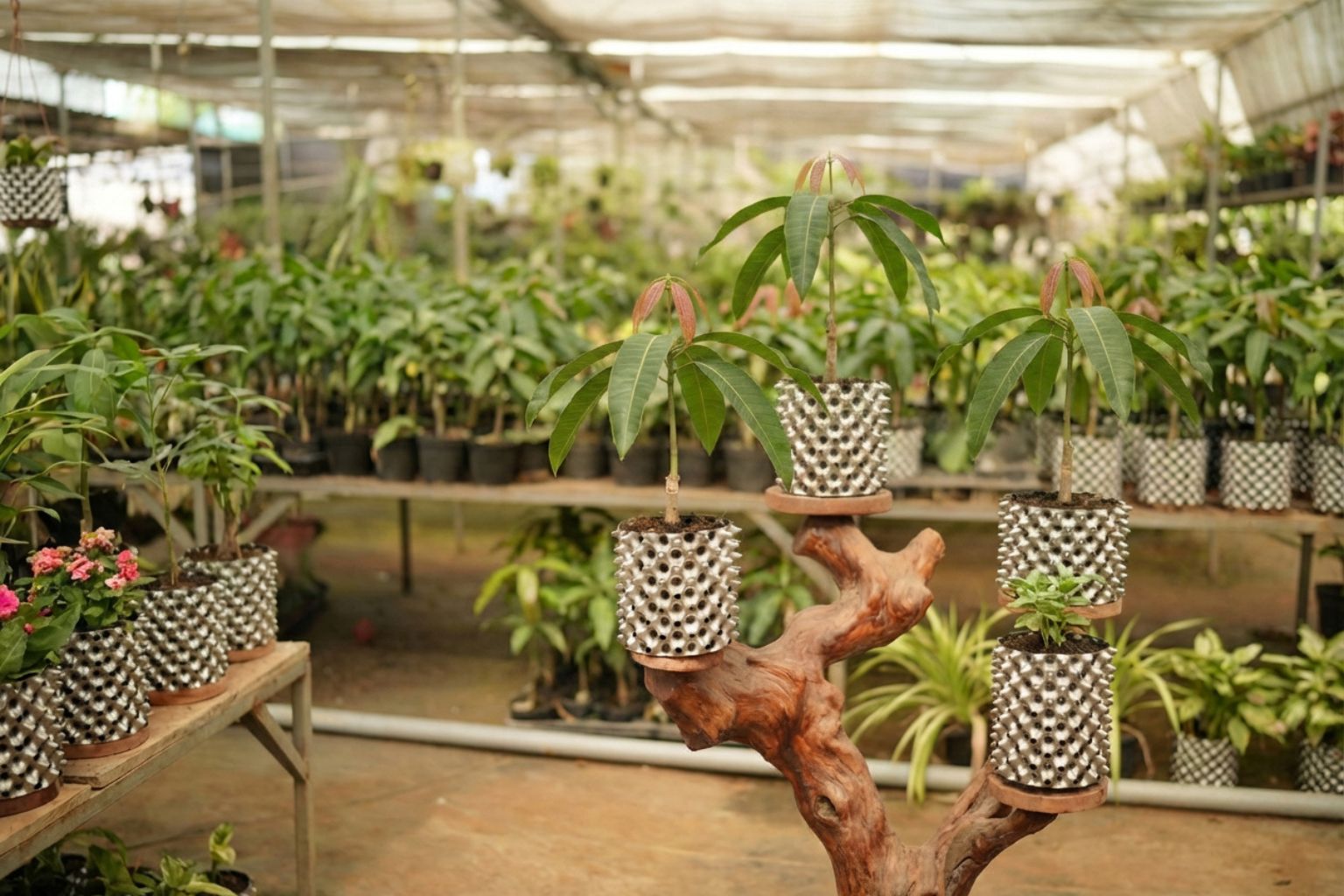
Mango Saplings
Mangifera indica — India's most commercial fruit tree
Why Air Pruning Matters for Mango
Mango develops a strong tap root with lateral feeders. Traditional pots force the tap root to circle, creating structural weakness that persists for the life of the tree. Rightpot allows full vertical tap root development while triggering dense lateral branching in the feeder root zone — exactly what commercial orchards need for high-yield, drought-resistant performance.
Commercial mango nurseries report 20–25% faster stem caliper development and earlier side-branch formation in Rightpot versus poly bags.
Recommended Pot Sizes
RP-03 - 10L
Grafted plants, 12-18 months
RP-06 20L
Standard 24-30 month saplings - most popular
RPP-15 - 38L
Premium 36+ month trees, exhibition stock
Regional Considerations
Maharashtra/Gujarat orchards: Prioritize drought-resistant root architecture Karnataka/Tamil Nadu: Focus on monsoon anchoring strength UP/Bihar: Cold-hardy varieties benefit from extended container time in controlled environments
Citrus Saplings
Orange · Lemon · Lime · Sweet Lime
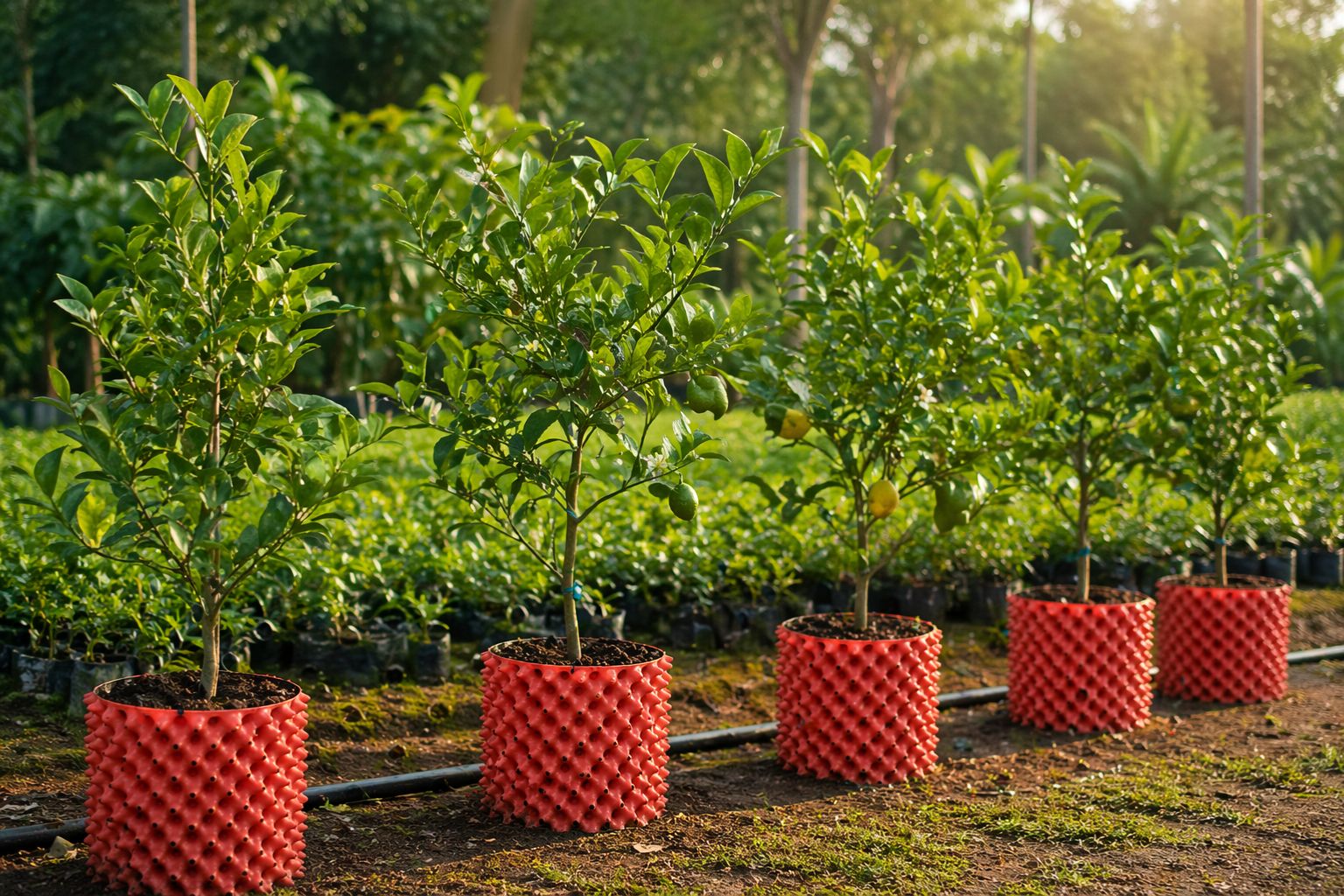
Why Air Pruning Matters for citrus
Citrus is particularly sensitive to root disturbance during transplant. Air-pruned roots establish with minimal shock, reducing the 6-12 month establishment lag common with spiraled root systems.
Citrus saplings in Rightpot show 30-40% reduction in post-transplant leaf drop and faster return to vegetative growth.
Recommended Pot Sizes
RP-03 - 10L
Budded plants, 12-18 months
RP-06 20L
Standard commercial production
RP-07 - 28L
Extended cultivation for larger rootstock varieties
Regional Considerations
Maharashtra citrus belt: Alkaline soil adaptation requires robust feeder roots Andhra Pradesh: High-density planting demands compact, efficient root systems Punjab citrus: Cold tolerance improved by healthy root-to-shoot ratios
Guava Saplings
PSIDIUM· GUAJAVA
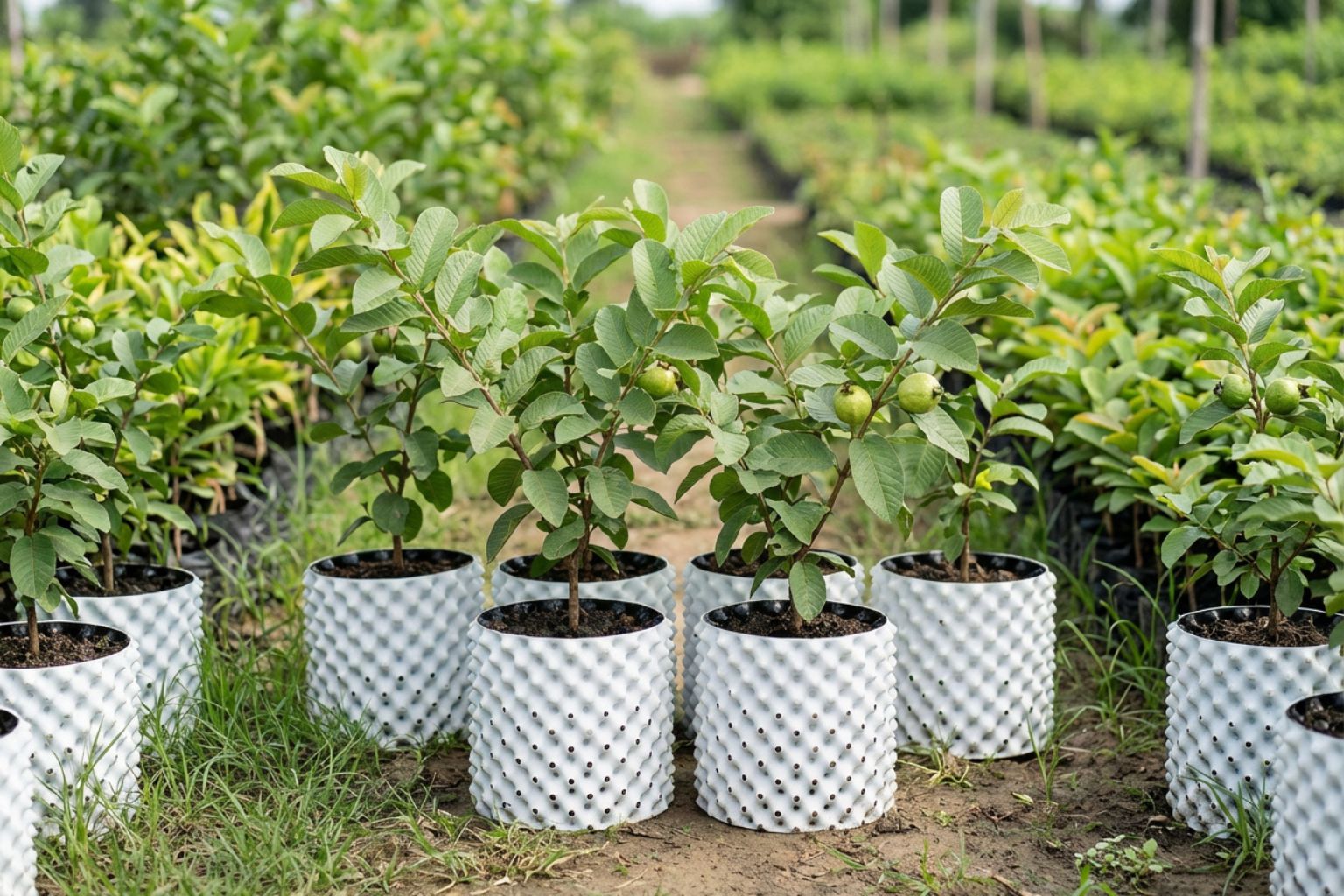
Why Air Pruning Matters for guava
Guava naturally produces aggressive lateral roots. In poly bags, this creates severe circling within 8-10 months. Air pruning channels this vigor into productive feeder root development.
Guava shows the most dramatic response to air pruning - up to 35% faster height gain and 50% increase in lateral branch formation.
Recommended Pot Sizes
RP-02 - 6L
Rooted cuttings, early development
RP-03 - 10L
12-18 month standard
RP-06 - 20L
24-30 month commercial grade
Regional Considerations
Allahabad/UP belt: Dense root systems support heavy fruiting in intensive orchards Maharashtra plateau: Drought resistance enhanced by deep lateral penetration Coastal regions: Air circulation prevents root rot in high-humidity environments
Pomegranate Saplings
Punica granatum — Wide, shallow root architecture
Why Air Pruning Matters for pomegranate
Pomegranate develops a shallow, spreading root system. Traditional deep pots waste volume and encourage excessive vertical growth at the expense of lateral feeders. Rightpot's aeration pattern optimizes for pomegranate's natural root architecture.
Guava shows the most dramatic response to air pruning - up to 35% faster height gain and 50% increase in lateral branch formation.

Recommended Pot Sizes
RP-3- 10L
Standard 18-24 month production
RP-06 20L
Premium quality, extended cultivation
RP-05 - 12L
Wide, shallow root preference varieties
Regional Considerations
Maharashtra pomegranate belt: Bacterial wilt resistance improved by healthy, aerated roots Karnataka: High-value export varieties justify premium container investment Rajasthan: Drought adaptation requires maximum root efficiency
Specialty & Emerging Fruits
Fig · Dragon Fruit · Avocado · Custard Apple · Sapota
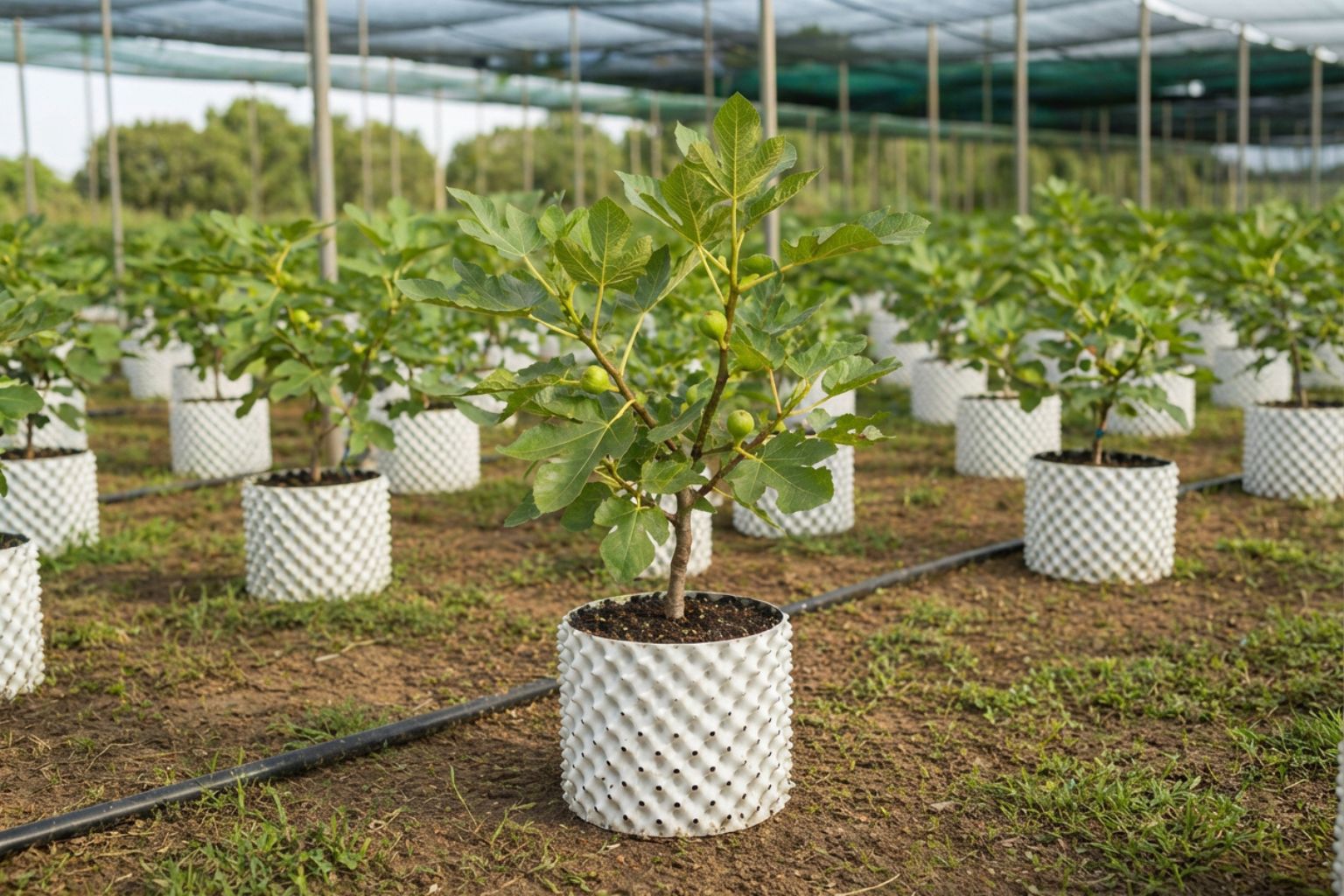
Why Air Pruning Matters for emerging
Rightpot works for any containerized fruit production. The air pruning mechanism is species-agnostic - it simply triggers the plant's natural branching response.
Start with RP-03 (10L) trials on any new species — scale to RP-06 (20L) for standard production once results are confirmed.
Recommended Trial Framework
RP-03 - 10L
Start here for 12–18 month trials on any new species
RP-06 20L
Scale to this for 24–30 month standard production
RPP-05 - 12L
Ultra-premium cultivars where quality is priority
Size Selection Framework
Three methods to choose the right size every time
Because until Rightpot, there was no better option at commercial scale pricing. Here’s what that’s costing you — in real terms
Cultivation Timeline Method
- 12–18 months in container RP-03 · RP-05
- 24–30 months in container RP-06 · RP-07
- 36+ months in container RPP-15
Rootstock Vigour Method
- Dwarfing rootstock Smaller volumes (RP-02, RP-03)
- Medium volumes (RP-06, RP-07)
- Vigorous rootstock Larger volumes (RPP-15, RPP-16)
Sale Price Method
- Commodity saplings ₹50–150 RP Series standard
- Premium saplings ₹200–500 RP-06 or RP-07
- Ultra-premium ₹500+ RPP Series professional
ROI Analysis — Rightpot vs. Traditional Containers
Three revenue levers. One investment.
Per 1,000 saplings, across a single growing season — here's what Rightpot changes in your economics with actual rupee values.
Mortality Reduction Value
Traditional Containers
30-35% transplant failure rate
1,000 saplings sold → 300-350 customer complaints/refunds
@ ₹250 average wholesale = ₹75,000-87,500 loss
Rightpot
5-8% transplant failure rate
1,000 saplings sold → 50-80 issues
@ ₹250 average = ₹12,500-20,000 loss
Net savings: ₹55,000–67,500 per 1,000 saplings sold
Growth Acceleration Value
20-25% faster growth = 4-6 months earlier sale-ready status
1,000 saplings reaching sale size 5 months earlier:
Land freed for next production cycle 5 months sooner
Capital returned 5 months faster
Opportunity to run additional crop cycle every 3-4 years
Equivalent to 20–25% increase in annual production capacity without expanding land
Premium Pricing Potential
Orchardists increasingly demand quality signals. Superior root systems visible at purchase justify ₹50-100 premium per sapling.
1,000 saplings @ ₹75 premium = ₹75,000 additional revenue
Combined with mortality reduction and growth acceleration, Rightpot delivers 150-200% ROI within 2 growing seasons.
₹75,000 additional revenue per 1,000 saplings — before mortality savings
Implementation for Fruit Tree Nurseries
Start small, scale fast
01
Convert Premium First
Convert your highest-value crop (premium mango, specialty citrus) to Rightpot. Run a side-by-side comparison with your existing poly bag production on the same crop type.
One full growing season (18-30 months)
Expand on Evidence
Expand to all premium fruit tree production based on your own Phase 1 results. Maintain traditional containers only for ultra-low-margin commodities where ROI doesn't justify Rightpot.
One full growing season (18-30 months)
Standardise as Default
Poly bags only for experimental varieties or ultra-short-term propagation
Ongoing
Why Fruit Tree Growers Choose Rightpot
Engineered for Six reasons.
Root Quality Visible at Sale
Demonstrate superiority before a word is spoken. The root ball comparison closes the premium pricing conversation.
Faster Time to Market
20–25% growth acceleration shortens production cycles and increases annual throughput on the same land area.
Reduced Warranty Issues
95%+ transplant survival eliminates refund calls, reputation damage, and relationship loss from failed saplings.
Inventory Flexibility
Plants maintain quality for extended container time. Sell when the market is right — not when the container forces you to.
Premium Pricing Justification
₹50–100 premium per sapling × your annual volume = real, measurable revenue impact every season.
Multi-Season Reusability
Lower per-unit cost than poly bags from year 2. 5–7 reuse cycles means one investment serves multiple seasons.
Get Started
Schedule a consultation for your fruit tree operation
Whether you're producing 5,000 mango saplings annually or running a 50,000-plant multi-crop operation, Rightpot delivers measurable performance improvements from the first growing season. Our horticultural specialists understand fruit tree production economics.
- Specific crop varieties and rootstock consideration
- Optimal pot sizing for your cultivation timelines
- Sample orders for side-by-side trials