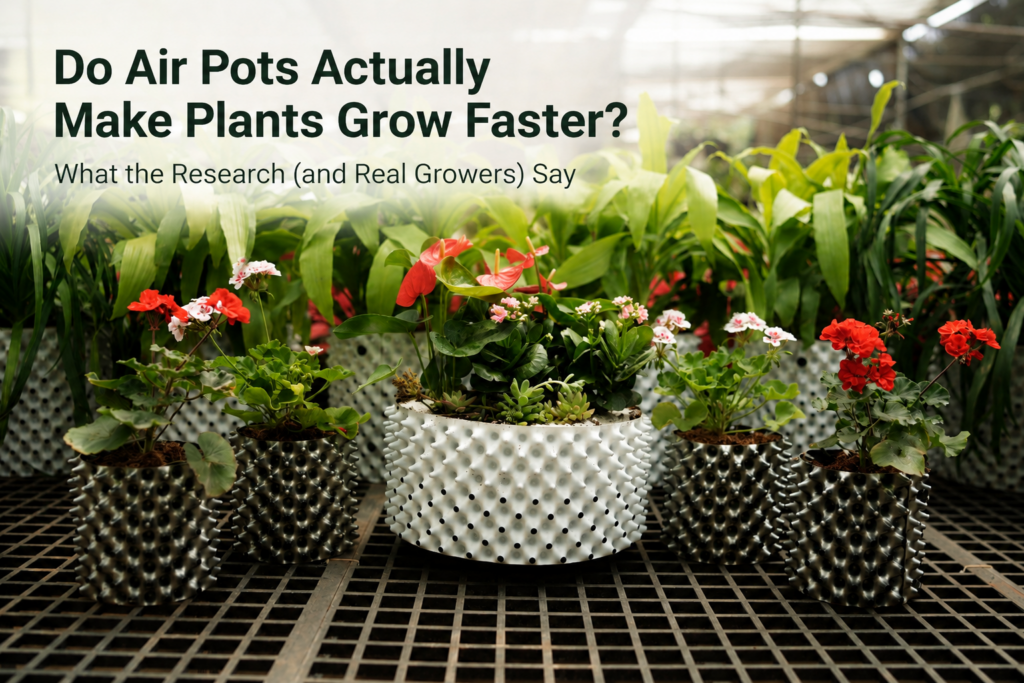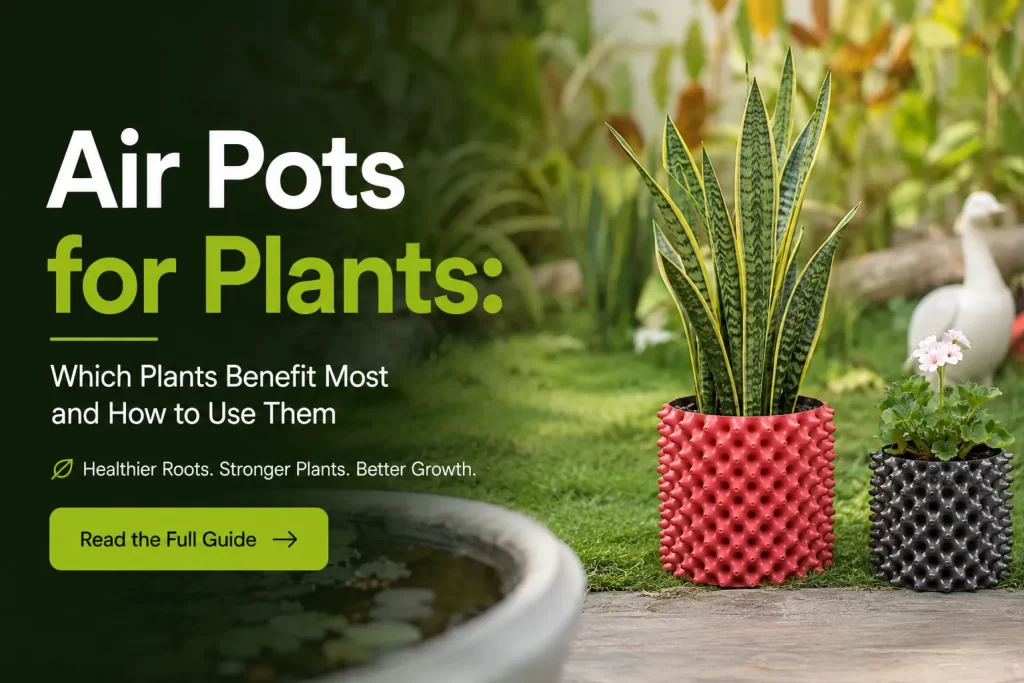
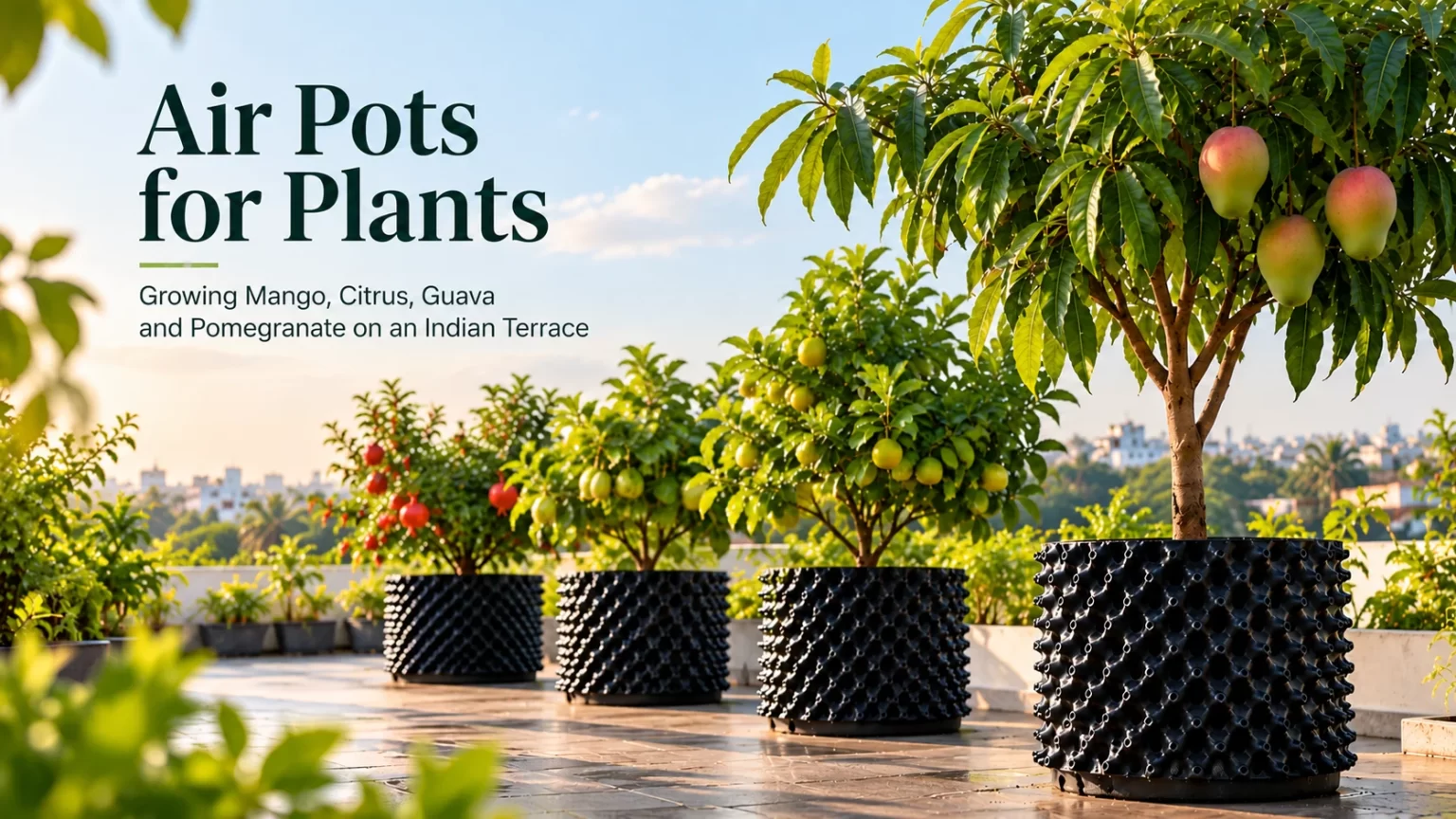
A mango tree on a city terrace sounds ambitious until you see one fruiting in a pot. The trick is not the variety alone; it is what happens to the roots in a container that has to support the tree for years.
That is where air pots for plants earn their place. In an ordinary pot, a fruit tree’s roots reach the wall, circle around it and gradually become root-bound. You may find yourself repotting the tree every year or two.
Air pots for plants help prevent this cycle by encouraging roots to branch rather than circle when they reach the container wall.
This guide covers four fruit trees that suit Indian terraces, the right air pot size for each growing stage, and how to place and care for them during the first year.
A quick note: by air pots, we mean air-pruning plant containers, not the vacuum flasks of the same name.
What Size Air Pot Does a Fruit Tree Need on a Terrace?
Start a grafted sapling in a 20L air pot, move it to a 36–38L pot once roots fill the first container, and eventually settle it in a 50L pot for long-term terrace growing.
Give the tree six or more hours of direct sunlight, raise the pot off the terrace floor and prune regularly to maintain a manageable size.
Why Fruit Trees Struggle Without Air Pots for Plants
A fruit tree is a long-term plant, and its roots continue growing throughout its life.
In a smooth-walled pot, roots that reach the container wall tend to turn and grow around it. Over time, the outer layer of the root ball can become a dense spiral of circling roots.
These roots can restrict healthy root development and, in severe cases, contribute to girdling. You may notice symptoms such as:
- Slow or stunted growth.
- Smaller leaves.
- Poor flowering or fruit development.
- A container that dries out unusually quickly.
For fruit trees growing in containers for several years, managing root development is an important part of long-term care.
How Air Pots for Plants Change a Fruit Tree’s Root System
Air pots for plants have openings across their walls. When a growing root tip reaches an opening and encounters dry air, its tip is naturally pruned.
The plant can then develop new lateral roots behind the pruned tip rather than continuing to circle around the container.
Repeated across the root system, this process encourages a denser, more branched network of feeder roots.
That is particularly useful for container fruit trees, where a healthy, well-distributed root system helps the plant make better use of the available growing medium.
Read our detailed air pruning pots guide to understand how air pruning works.
Four Fruit Trees That Do Well on Indian Terraces
Not every fruit tree is equally suited to container growing. Grafted and compact varieties are generally better choices than large, seed-grown trees.
Here are four options worth considering for an Indian terrace garden.
| Tree | Container-friendly choice | Starter pot | Long-term pot |
|---|---|---|---|
| Mango | Grafted dwarf varieties such as Amrapali | RPP-13 · 22L (tall) | RPP-16 · 50L |
| Citrus | Kagzi lime, sweet lime | RP-06 · 20L | RP-10 · 36L or RPP-15 · 38L |
| Guava | Grafted or air-layered plants | RP-06 · 20L | RPP-15 · 38L or RPP-16 · 50L |
| Pomegranate | Compact varieties such as Bhagwa | RP-06 · 20L | RP-10 · 36L |
Always buy grafted or air-layered plants from a reliable nursery. Seed-grown fruit trees can become larger, take longer to fruit and may not produce fruit true to the parent variety.
1. Mango
Mango develops a strong root system, so a taller container can be useful during its early growth.
A grafted dwarf variety such as Amrapali is a practical option for a terrace garden. Regular pruning helps maintain a manageable canopy.
2. Citrus
Lime and sweet lime have relatively fine feeder roots and do not tolerate waterlogged growing media.
The airflow and drainage provided by an air pot can help create more suitable root conditions, especially during the rainy season.
3. Guava
Guava is vigorous and responds well to pruning.
A grafted or air-layered plant can be a good choice for container growing. With suitable care and growing conditions, it may begin flowering within a year or two.
4. Pomegranate
Pomegranate tolerates heat and dry spells better than many fruit trees, making it a useful option for sunny terraces.
Choose a compact variety and prune it into an open shape so sunlight can reach the centre of the plant.
Stepping Up: The Right Air Pot at Each Stage
It can be tempting to place a small sapling directly into a 50L pot. However, a large volume of wet growing medium around a small root system may remain moist for too long.
This can slow root development and increase the risk of waterlogging.
Instead, increase the container size gradually as the root system develops.
- Year one – 20L to 22L: Plant the nursery sapling in a suitable starter air pot. Allow the roots to establish and fill the available space.
- Year two or three – 36L to 38L: Move up when the root system has developed sufficiently and the container begins drying out quickly.
- Long term – 50L: Move the tree into a larger container for continued growing. Once established, refresh the top layer of growing medium periodically rather than repotting unnecessarily.
Because air pots for plants can be unclipped, moving the plant to a larger container can be more convenient. The panel opens, allowing access to the root ball.
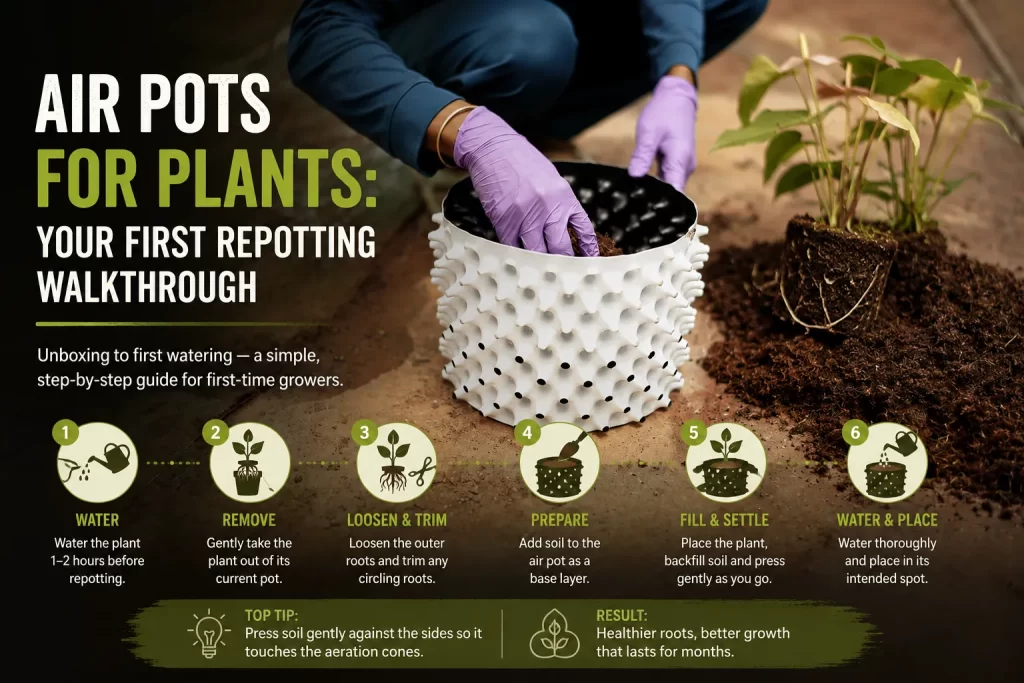
Our first-time repotting walkthrough explains the process step by step.
Placing Fruit Trees on a Terrace
Choosing the right pot is only part of the process. Sunlight, heat, weight and drainage all matter when growing fruit trees on a terrace.
Sunlight
Most fruit trees need at least six hours of direct sunlight to flower and fruit well.
East- and south-facing locations are often suitable, depending on surrounding buildings and shade.
Heat Management
A terrace slab absorbs heat, and a dark container exposed to strong afternoon sunlight can become very hot.
On west-facing terraces, consider Pearl White or Sterling Silver pots, which reflect more sunlight. You can also use a low screen to shade the pot wall without blocking airflow.
Weight and Structural Safety
A large container filled with wet growing medium can be extremely heavy.
Place large pots near load-bearing walls or columns where appropriate. If you plan to position several large fruit trees on an older building, consult a structural engineer about the terrace’s load capacity.
Waterproofing and Drainage
Avoid placing pots directly on the terrace floor.
Raise them using pot feet or suitable stands so water can drain freely. This also helps prevent prolonged contact between the pot and the terrace waterproofing layer.
First-Year Care for Terrace Fruit Trees
The first year is important for establishing a healthy root system and building a strong plant structure.
Follow these basic care practices:
- Growing medium: Use an open, well-draining blend of compost, cocopeat and coarse material such as bark or perlite. Avoid using heavy garden soil on its own.
- Watering: Water deeply when the top few centimetres of the growing medium feel dry. Allow excess water to drain. Air pots can dry faster than sealed containers, so check moisture regularly during summer.
- Feeding: Add compost or a balanced organic fruit feed during active growth. Avoid excessive feeding, particularly during periods of heavy rain.
- Pruning: Shape the plant during its early growth to encourage a low, well-branched structure.
- Flowering: Some growers remove the first flowers so a young tree can put more energy into developing roots and branches before carrying fruit.
Choosing a suitable fruit variety and providing the right growing conditions are important for container gardening. The Royal Horticultural Society’s fruit-growing guidance offers additional information about growing fruit.
Common Mistakes With Air Pots for Plants
Even a well-designed container cannot compensate for poor growing practices.
Watch out for these common mistakes when growing fruit trees on a terrace.
| Mistake | What happens | What to do instead |
|---|---|---|
| Pot too big for the sapling | Growing medium may stay wet and roots may develop slowly | Increase pot size gradually |
| Using garden soil alone | Growing medium can compact and drain poorly | Use an open, well-draining potting mix |
| Pot sitting on a saucer | Excess water can collect around the base | Raise the pot and allow free drainage |
| Watering on a fixed schedule | Plants may receive too much or too little water | Check the growing medium before watering |
| Skipping pruning | Tree may outgrow the available terrace space | Prune lightly and regularly |
Key Takeaways
- Fruit trees in ordinary pots can develop circling roots that restrict healthy root development.
- Air pots for plants encourage branching and help develop a dense, fibrous root system.
- Grafted dwarf mango, lime, guava and pomegranate are worth considering for Indian terraces.
- Start with a 20–22L pot, move to 36–38L and eventually consider a 50L container.
- Give fruit trees six or more hours of sunlight, raise pots off the terrace floor and prune to maintain a manageable shape.
- Always consider terrace load capacity and drainage before installing large containers.
FAQs: Air Pots for Plants
1. Can a mango tree really fruit in a pot?
Yes. A mango tree can fruit in a container if you choose a suitable grafted variety, provide enough growing space and sunlight, and prune it regularly.
A grafted dwarf variety such as Amrapali is one option for terrace growing. Seed-grown mango trees may become too large for a typical terrace container and can take much longer to fruit.
2. What size air pot does a fruit tree need on a terrace?
Start a nursery sapling in a 20–22L air pot. Move it to a 36–38L container once the roots have filled the first pot, and eventually consider a 50L pot for long-term growing.
Stepping up gradually helps avoid keeping a small root system in an unnecessarily large volume of wet growing medium.
3. Do air pots for plants need more watering?
They can dry faster than sealed plastic pots because air moves through the container wall.
This supports air pruning but also means you should check the growing medium more frequently in hot, dry weather. A layer of mulch on top can help reduce moisture loss without blocking airflow through the sides.
4. How often should I repot a fruit tree in an air pot?
It depends on the tree, its growth rate and the container size.
Air pruning encourages roots to branch instead of continuing to circle around the pot. This can reduce the need for frequent repotting.
Once the tree reaches its final container, you can refresh the top layer of growing medium periodically, provided the root system and plant remain healthy.
5. Will a large pot damage my terrace?
The main concerns are the weight of wet growing medium and prolonged moisture around the terrace surface.
Raise containers on suitable feet or stands to allow drainage. Place large pots in appropriate locations, and consult a structural engineer before arranging several large fruit trees on an older building.
Start Your Terrace Orchard With Air Pots for Plants
A fruit tree on a terrace is a long-term project, and its future is decided below the soil.
Air pots for plants encourage roots to branch instead of circle, helping create a healthy root system for container growing.
Rightpot’s air pots range from 20L sapling pots to 50L tree containers, designed and made in India.
Explore the full range of air pots on Rightpot.in or Amazon.in, or contact our team to find the right size for your tree.
Call or WhatsApp: +91 9996665430
Email: info@rightpot.in
Shipping: Ships pan-India