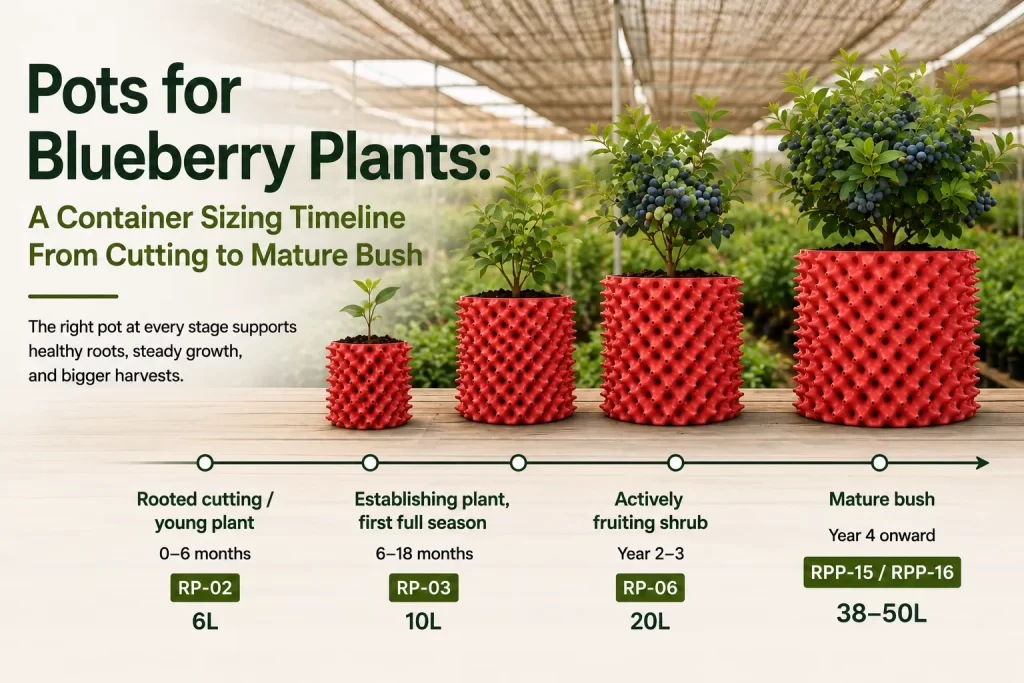

A potted blueberry rarely dies of a single mistake. It declines across two or three seasons: growth slows, new leaves yellow between the veins, fruit gets smaller, and the grower who set up the Pots for Blueberry Plants correctly cannot work out what changed.
Usually nothing changed. The acidic mix that started at pH 5.0 has been irrigated a few hundred times with water carrying dissolved bicarbonates, and each of those irrigations neutralised a little more acidity. Getting the setup right at planting is only half the job – holding it there is the other half, and it is the half almost nobody writes about.
This guide covers how to test the right thing, how to read the leaves before the meter tells you, how to feed without pushing pH the wrong way, and why free drainage is what makes long-term correction possible in Pots for Blueberry Plants. RightPot’s container sizing timeline handles the size question separately; this article is about what happens in years two through five.
The Slow pH Drift in Pots for Blueberry Plants That Nobody Tests For
Alkalinity is not the same thing as pH, and confusing the two is the most common error in container blueberry growing. Water pH tells you how acidic the water is right now; alkalinity tells you how much acid-neutralising capacity it carries – dissolved calcium, magnesium and sodium bicarbonates and carbonates.
Those bicarbonate ions neutralise hydrogen ions in the growing medium, which raises pH. Water can test at a reasonable pH and still carry enough alkalinity to wreck an acidic container mix over a season, which is exactly why testing pH alone gives false reassurance.
Container volume decides how fast it happens. Small Pots for Blueberry Plants have very little buffering capacity and shift quickly; a larger volume of medium resists change for longer but drifts just as surely.
Test Your Water, Not Just Your Media
Get an alkalinity figure in parts per million of calcium carbonate equivalent. Any agricultural laboratory will run it, and simple test kits are widely available.
Interpreting irrigation water alkalinity (ppm CaCO3)
| Alkalinity | What It Means for an Acid-Loving Container Crop | Action |
|---|---|---|
| Below 50 | Low risk; media pH should hold well with normal acidic feeding | Monitor media pH twice a year |
| 50–150 | Manageable in larger containers; small containers will drift noticeably | Use acidifying fertilisers; test media pH quarterly |
| 150–300 | Problematic for blueberries, particularly if water pH is above 7.5 | Acidify irrigation water or switch to a lower-alkalinity source |
| Above 300 | Unsuitable untreated for any acid-loving crop | Acid injection or an alternative water source is required |
Note that these thresholds are set for general container production. Blueberries sit at the sensitive end of the range because they need a narrower and lower pH band than almost anything else grown in a pot.
Reading the Leaves Before the Meter
The plant reports a pH problem well before most growers test for one. The signature is interveinal chlorosis: yellowing between the leaf veins while the veins themselves stay green, appearing first on the youngest leaves.
The important point is what this does not mean. Iron deficiency in blueberry leaves is usually the result of high pH rather than a shortage of iron in the medium – the iron is present but chemically unavailable. Adding iron without correcting pH treats the symptom and leaves the cause running.
- Yellowing between veins on new growth – pH has risen above the usable range; test media and water.
- Older leaves yellowing uniformly – more likely a nitrogen issue than a pH issue.
- Leaf margins browning and crisping – often salt accumulation; the container needs leaching.
- Reduced fruit size with healthy foliage – check container capacity and watering before assuming nutrition.
- Overall stunting with no clear leaf symptom – worth checking whether a nitrate-only fertiliser has been used.
Feeding: Ammonium, Not Nitrate
Blueberries evolved in acidic soils where nitrogen is present as ammonium, and they take it up in that form. Fertilisers containing only nitrate nitrogen, such as calcium nitrate, may cause injury or reduced growth and should be avoided outright.
This is one of the few genuinely hard rules in blueberry nutrition, and it catches out growers using general-purpose fertilisers that perform well on every other container plant on the terrace.
Nitrogen sources for potted blueberries
| Source | N Form | Effect on Media pH | When to Use |
|---|---|---|---|
| Ammonium sulphate | Ammonium | Lowers pH over time | The default where media pH sits at or above 5.0 |
| Urea | Converts to ammonium | Broadly neutral | Preferred when media pH has already fallen below 5.0 |
| Ericaceous / acid-loving blends | Ammonium-based | Mildly acidifying | Convenient for home growers; check the label states no nitrate-only N |
| Calcium nitrate | Nitrate only | Raises pH | Avoid – may cause injury or reduced growth in blueberries |
| General NPK with nitrate N | Mixed | Variable | Check the guaranteed analysis before use; many terrace fertilisers are nitrate-heavy |
Correcting Water Before It Reaches the Pot
If your alkalinity figure is high, treating the water is more effective than fighting it at the media end.
- Collect rainwater where you can. It is naturally low in alkalinity and the simplest correction available to a home grower.
- Acidify commercially with injection. Phosphoric acid is moderate, adds phosphorus and is comparatively safe; sulphuric acid neutralises more strongly but is considerably more hazardous; citric acid is the weakest and safest option and suits organic production.
- Always add acid to water, never water to concentrated acid. This is a safety rule, not a preference.
- Lean on acidifying fertilisers where alkalinity is only moderate – an ammonium-sulphate-based programme does useful work on its own.
- Use elemental sulphur for planning, not for rescue. It needs warm, moist conditions and typically six to twelve months to act, so it belongs in mix preparation rather than in an emergency.
- Re-test media pH quarterly for the first two years, then twice yearly once the programme is stable.
Why Free Drainage in Pots for Blueberry Plants Makes This Work
Leaching – running clean or acidified water through the container until it flows freely from the base – is how you reset accumulated salts and correct drifting pH. It is the most useful routine intervention available to a container blueberry grower.
It only works if the container actually drains fast enough to flush rather than flood. A root system sitting in a slow container during a heavy leach is exposed to precisely the waterlogging blueberries tolerate worst, which is why growers with poorly draining pots quietly stop leaching and let the salts build.
This is where the container type earns its place. Air-pruned Pots for Blueberry Plants drain quickly and stay oxygenated through a heavy flush, so leaching becomes a routine quarterly task rather than a risk. Colour is worth a thought too: in hot plains cities, lighter containers keep the shallow, heat-sensitive root zone cooler without affecting drainage.
Key Takeaways
- Test irrigation water alkalinity in ppm CaCO3, not just water pH – alkalinity is what drives the drift.
- Target and hold media pH at 4.5–5.5; smaller containers drift faster because they buffer less.
- Interveinal yellowing on young leaves means high pH locking out iron, not a shortage of iron.
- Feed ammonium-form nitrogen; avoid nitrate-only fertilisers such as calcium nitrate entirely.
- Use ammonium sulphate above pH 5.0 and urea below it.
- Leach the container quarterly – and choose a container that drains fast enough to make leaching safe
FAQs: pH and Water Quality in Pots for Blueberry Plants
1. Why are my potted blueberry leaves turning yellow between the veins?
That pattern on young leaves points to iron being chemically unavailable because media pH has risen above the usable range, rather than to a lack of iron in the mix. Test both media pH and irrigation water alkalinity; correcting pH restores iron uptake, while adding iron alone rarely holds.
2. Can I water blueberries with normal tap or borewell water?
Only if its alkalinity is low enough. Much Indian tap and borewell water carries dissolved bicarbonates that neutralise acidity with every irrigation and lift media pH over a season. Get an alkalinity figure in ppm CaCO3 before assuming your water is safe for an acid-loving crop.
3. What is the best fertiliser for potted blueberries?
An ammonium-based programme. Ammonium sulphate is the default where media pH sits at or above 5.0, and urea is preferred once pH has fallen below 5.0. Avoid nitrate-only fertilisers such as calcium nitrate, which may cause injury or reduced growth in blueberries.
4. How often should I test the pH of the growing medium?
Quarterly for the first two years while you learn how your water and feeding programme interact, then twice a year once results are stable. Test more often after any change of water source, fertiliser or container size.
5. Will adding vinegar or lemon juice lower the pH?
Both acidify briefly but neither holds, and repeated use adds organic material that can feed unwanted microbial activity in the container. Use a proper acidifying fertiliser programme, a low-alkalinity water source, or a horticultural acid intended for irrigation.
6. How do I flush salts out of a blueberry container safely?
Run clean or lightly acidified water slowly through the container until it flows freely from the base, ideally in the cool part of the day. It is only safe in a container that drains quickly – in a slow one, the flush leaves roots sitting in saturated medium, which blueberries tolerate poorly.
Set It Up Once, Then Hold It
Blueberries are not difficult in India. They are unforgiving about one variable, and that variable moves quietly in the wrong direction every time you irrigate with alkaline water.
Test the water, feed the right form of nitrogen, leach on a schedule, and choose Pots for Blueberry Plants that let you do all of it without risking the root zone. Our team can help you match capacity and colour to your variety and climate.
Request a trial order or sizing consultation:
Contact RightPot at info@rightpot.in or WhatsApp (+91) 9996665430.
No minimum order.
Our team will recommend the right aeration container size for your specific crop and cultivation timeline.