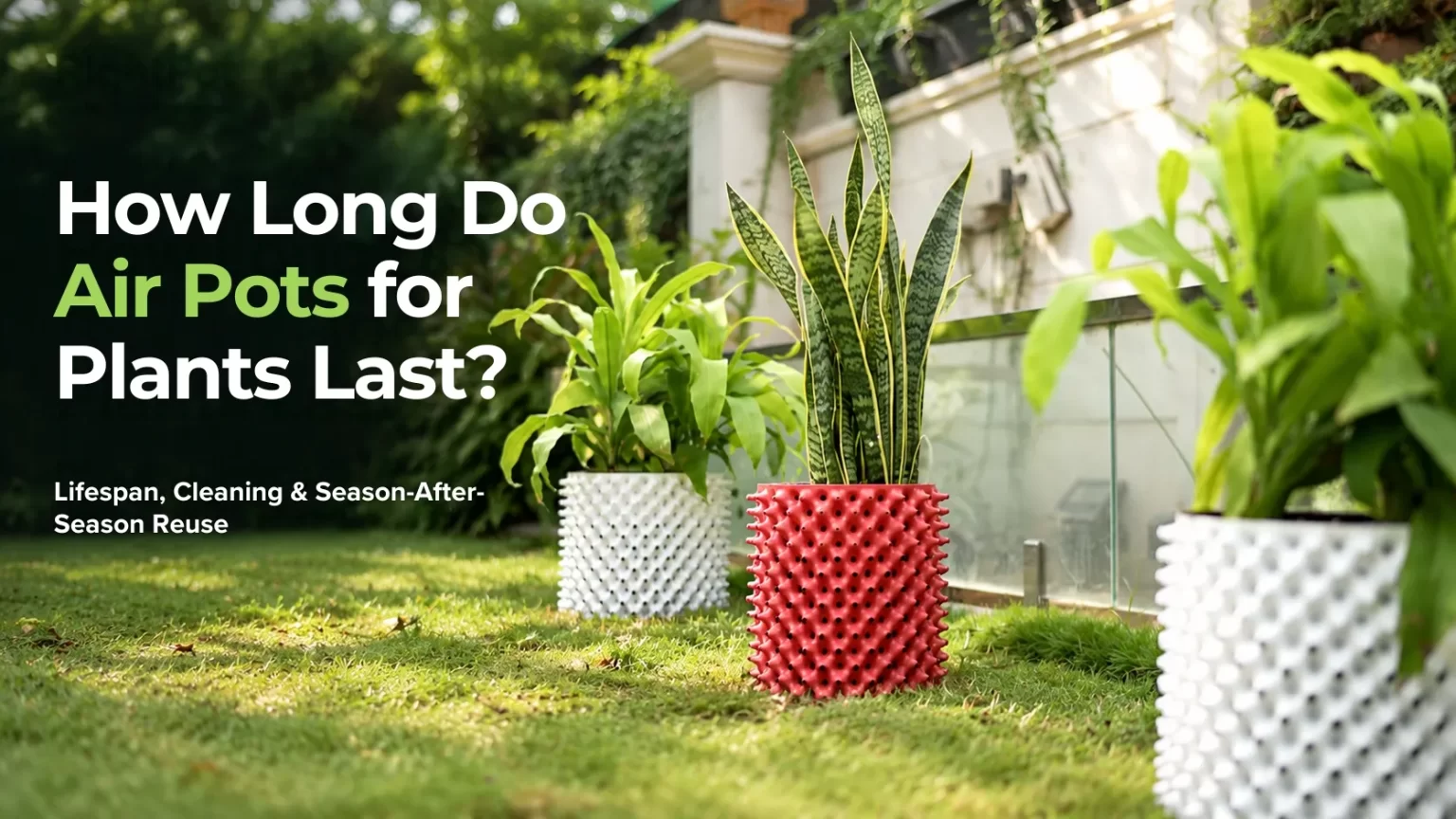
“How long will it last?” is the question people ask right before they buy, and almost nobody answers it properly. Air Pots for Plants sit in a different category from the thin nursery bags and disposable plastic containers most Indian growers replace every year or two — they are designed to be taken apart, cleaned and reassembled across many cycles.
That changes how you should treat them. A container you expect to keep for years deserves a between-crop routine and an off-season storage habit, in the same way secateurs or a sprayer do. Growers who apply that routine report Air Pots for Plants still in service long after the disposable containers bought alongside them went to landfill.
This guide covers what actually determines lifespan, the between-crop clean that protects both the pot and the next plant in it, how to store flat-packed containers through the off-season, and the honest signals that a pot has reached the end of its working life. If you are still choosing between container types, Air Pots for Plants and their plant-by-plant suitability are covered in RightPot’s separate usage guide.
A Reusable Asset, Not a Consumable
The conventional nursery container model is disposable by design. Thin poly bags are single-use in practice, bought fresh every season, and reviews of nursery production systems consistently list that annual repurchase and the resulting plastic waste among the model’s real costs.
Rigid reusable containers with internal ribs or slits sit at the other end of that spectrum — horticultural research on container systems describes service lives measured in years rather than seasons for well-made rigid containers used under normal nursery conditions. The exact figure depends heavily on climate, handling and material quality.
The practical implication for a home grower is that Air Pots for Plants outlive the plant cycle, so they become part of your kit rather than part of your consumables.
What Determines How Long Air Pots for Plants Last
The four lifespan variables
| Factor | What It Does | What to Do About It |
|---|---|---|
| UV exposure | Sunlight breaks polymer chains over time, causing colour fade, surface chalking and eventual brittleness | Choose UV-stabilised material; where possible, shade or group containers so pot walls are not fully exposed all day |
| Handling when full | Lifting a heavy filled container by the rim stresses the wall and the fasteners far more than the material itself ever will | Lift from the base, or use a trolley or pot mover for anything above 20 litres |
| Off-season storage | Containers left outdoors empty through a full summer accumulate UV damage while doing no work at all | Disassemble and store flat-packed in shade — the single easiest lifespan gain available |
| Between-crop hygiene | Old media and root residue in the cones harbour pathogens and make the next crop harder, without visibly damaging the pot | Clean and dry between crops rather than refilling over the old root ball |
Of these, off-season storage is the one growers most often skip and the one that costs the most. A container sitting empty in full sun for four months is ageing at close to its maximum rate for zero return.
The Between-Crop Clean
Do this whenever a container comes free, not once a year. It takes a few minutes per pot and it protects the next plant as much as the container.
- Disassemble the pot. Taking the wall apart gives you access to the cone interiors, which is where residue actually collects.
- Knock out and scrape off dry residue before wetting anything. Dry material comes away far more easily than wet.
- Soak in plain water for fifteen to twenty minutes to soften compacted media in the cones.
- Brush the cones individually with a stiff bristle brush. This is the step that matters and the step most people skip.
- Sanitise if the previous crop had any disease issue — a dilute household bleach or horticultural disinfectant soak, followed by a thorough rinse in clean water.
- Dry fully in shade, not direct sun. Drying in full sun adds UV exposure for no benefit; shade drying is just as effective.
- Reassemble, or store flat, depending on whether the pot goes straight back into use.
Avoid wire brushes, abrasive scouring pads and pressure washers. All three score the surface, and a scratched surface weathers faster and holds residue better than a smooth one.
Storing Air Pots for Plants Flat-Packed Between Seasons
The ability to disassemble is a storage advantage that rigid one-piece containers simply do not have. A season’s worth of containers collapses into a fraction of the space, which matters as much on a small balcony as it does in a commercial nursery.
- Store fully dry. Damp material stacked in a dark corner grows mould and stains.
- Store out of direct sunlight — a shed, garage, covered rack or under a bench.
- Keep fasteners together in a labelled bag rather than loose in the stack, so nothing goes missing between seasons.
- Stack flat rather than leaning, which prevents the wall panels taking a permanent curve.
- Keep sizes grouped so you are not sorting through mixed capacities at the start of the next cycle.
When to Retire a Pot
Rigid containers do not fail suddenly. They give warning, and the warning almost always appears at the same places.
End-of-life signals
| Signal | What It Means | Verdict |
|---|---|---|
| Surface chalking, colour heavily faded | Early-stage UV degradation of the surface layer | Still serviceable — move to a shadier position |
| Wall flexes but springs back | Normal behaviour for the material | Keep in service |
| Fine cracks radiating from cone edges | The material has become brittle and is failing at its stress points | Retire at the end of the current crop |
| Rim distorted or permanently deformed | Repeated lifting when full, or heat deformation | Retire — the pot will not hold shape when filled |
| Fasteners stripped or no longer holding | Hardware failure, often before material failure | Replace the hardware, not the pot |
A retired container still has uses — as a nursery liner, a media mixing bin, or a storage tub. It stops being a growing container once it can no longer hold its shape under a full load of wet medium.
Key Takeaways
- Treat an aerated container as equipment with a maintenance routine, not as a consumable to be replaced each season.
- UV exposure, handling when full, off-season storage and between-crop hygiene are the four variables that decide lifespan.
- Storing containers flat-packed in shade through the off-season is the cheapest lifespan gain available.
- Clean between crops with a soak and a bristle brush; skip wire brushes, abrasives and pressure washers.
- Dry in shade, never in direct sun — sun drying adds UV load for no benefit.
- Cracks radiating from cone edges are the true end-of-life signal. Fading and chalking are not.
FAQs: Lifespan and Reuse of Air Pots for Plants
1. How many seasons can the same air pot be reused?
Well-made rigid containers are designed for repeated use across many growing cycles rather than a single season, with the actual figure depending on UV exposure, handling and storage. Containers kept out of full sun when empty and cleaned between crops last considerably longer than those left outdoors year-round.
2. Do air pots crack in strong Indian sunlight?
UV-stabilised material resists degradation far better than untreated plastic, but no polymer is permanently immune. Expect gradual fading and surface chalking well before any structural problem, and treat fine cracks around the cone edges as the signal to retire the container.
3. How should I clean an air pot between crops?
Disassemble it, scrape off dry residue, soak in plain water for fifteen to twenty minutes, then brush each cone with a stiff bristle brush. Sanitise with a dilute disinfectant only if the previous crop had a disease problem, rinse well, and dry fully in shade.
4. Can I reuse the old growing medium along with the pot?
Reusing the container is straightforward; reusing spent medium is not recommended. Old media has depleted nutrition, altered pH and compacted structure, and may carry pathogens. Refresh the mix at each planting and compost the old material if the previous crop was healthy.
5. Is it necessary to disassemble the pot for storage?
Not strictly, but it is worth it. Flat-packed storage takes a fraction of the space and keeps the walls out of sunlight while the container is not in use, which is when most avoidable UV ageing happens.
6. What can I do with a container that has reached end of life?
A pot that no longer holds shape under a full load can still serve as a media mixing bin, a nursery liner or general storage. Rigid horticultural plastic is also more readily accepted by recyclers than thin film bags, which are rarely recycled at all.
Buy Once, Grow for Years
The case for Air Pots for Plants is usually made on root architecture, and rightly so. But the second half of the case is that the container itself keeps working long after the first plant has moved on — which is only true if it is handled, cleaned and stored like the piece of equipment it is.
A ten-minute routine between crops and a shaded corner for the off-season is the whole discipline. Talk to our team about sizing a set you will still be using several cycles from now.
Request a trial order or sizing consultation:
Contact RightPot at info@rightpot.in or WhatsApp (+91) 9996665430.
No minimum order.
Our team will recommend the right aeration container size for your specific crop and cultivation timeline.