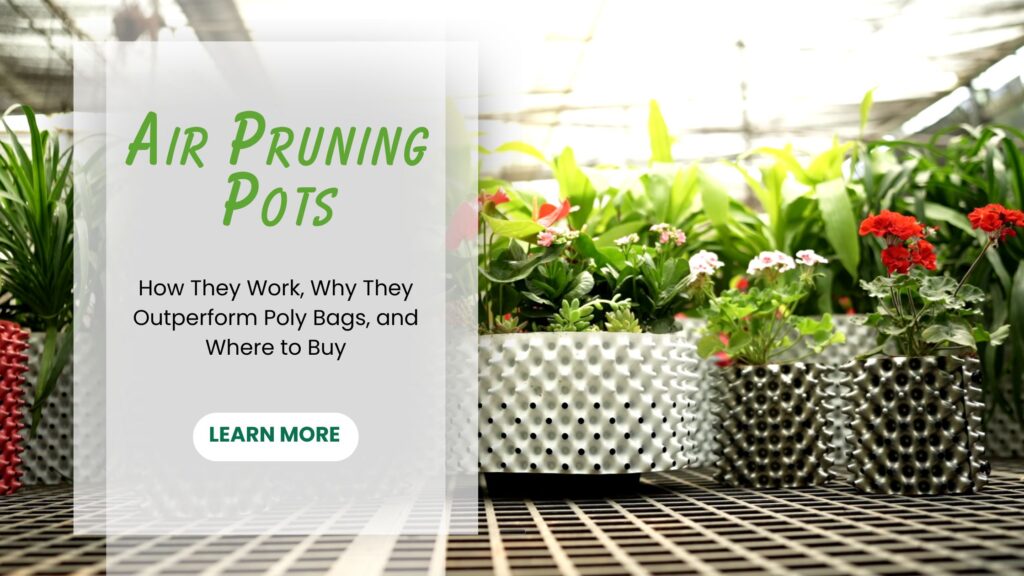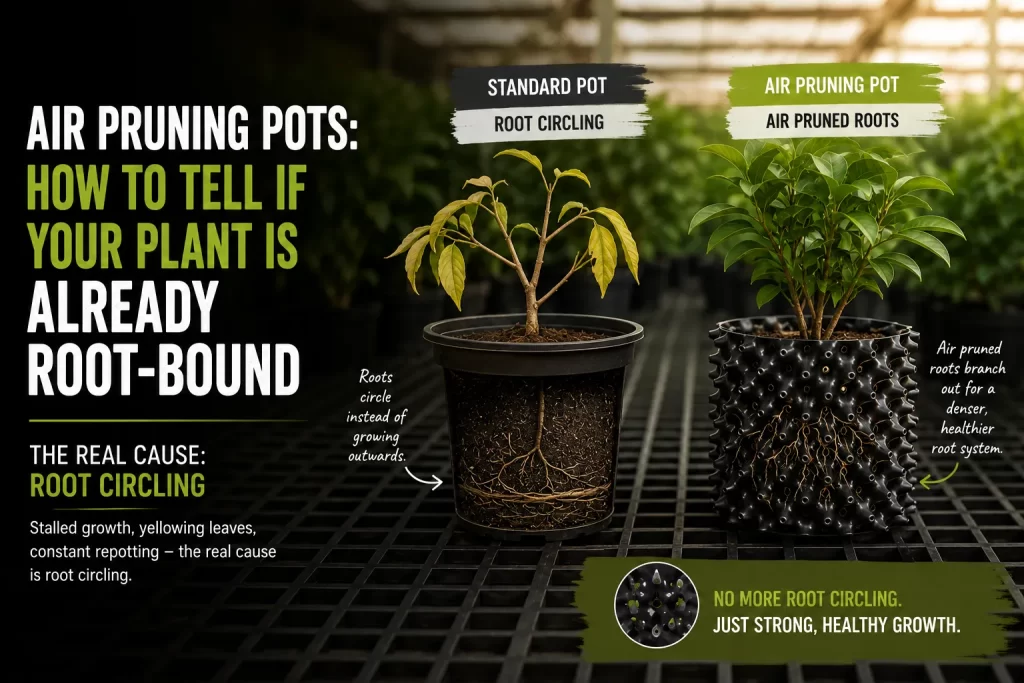
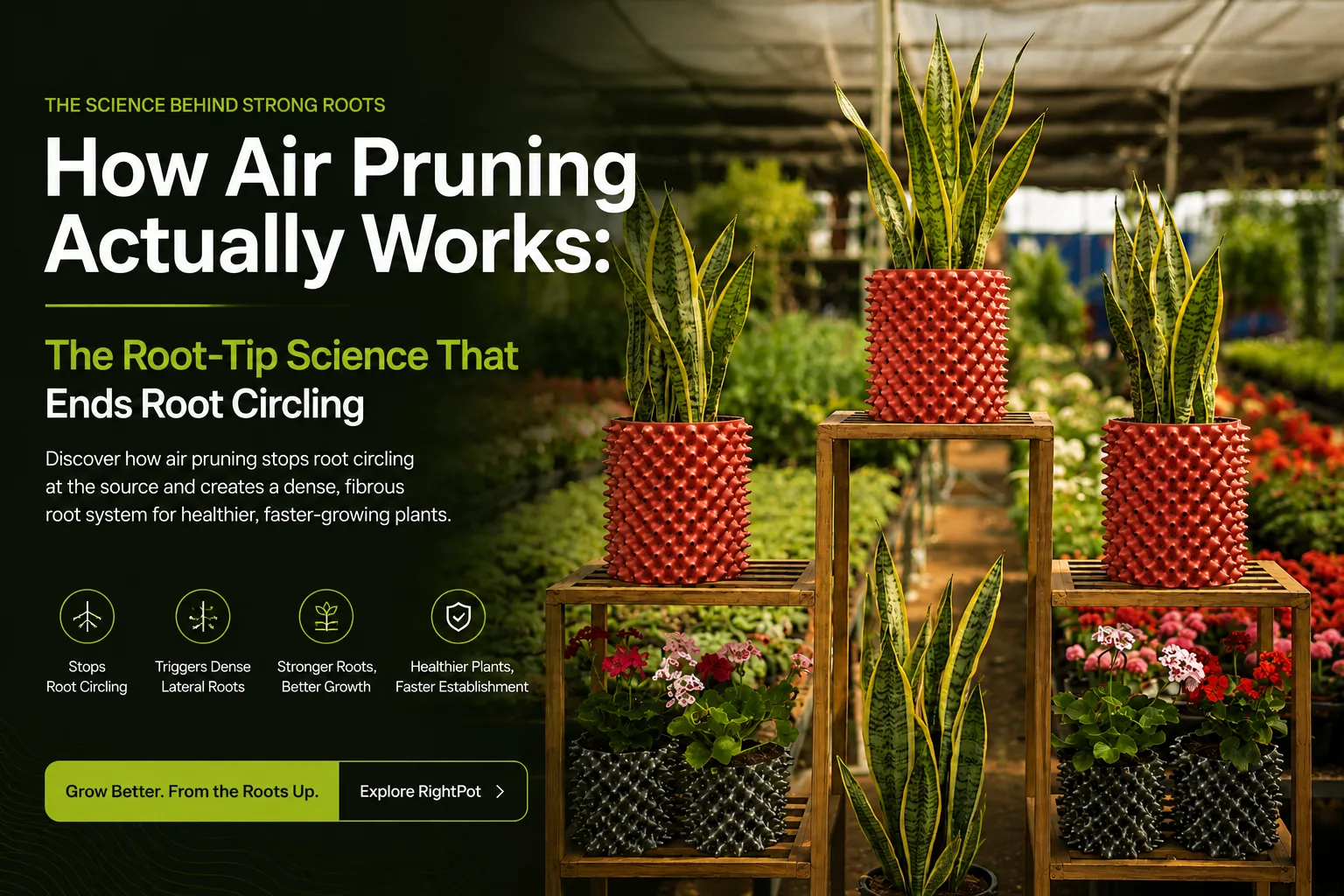
Pull a plant out of a standard nursery pot after a few months and you’ll often find the same thing: a mat of roots wound in tight circles around the bottom, following the wall they were never able to escape. That spiral is the quiet reason so much container-grown stock struggles after transplanting. Air pruning pots solve it at the source, not by trapping roots better, but by giving root tips somewhere to stop. This piece explains what air pruning is actually doing at the level of a single root tip, and why that one small event reshapes the entire root system.
What is air pruning?
Air pruning is a natural response where a root tip that grows into open, dry air stops extending and dies back slightly, prompting the plant to send out new roots further back along the root. In air pruning pots, this happens at every opening in the wall, so instead of a few long roots circling the pot, the plant builds a dense network of shorter, branching ones.
It isn’t a chemical, a coating, or an additive. It’s a structural idea: expose the growing tip to air at the right moment and the plant does the rest. Every other benefit growers associate with air pruning pots follows from this single mechanism.
What happens at the root tip when it meets air
A root grows from its very tip. That tip holds the actively dividing cells that push the root forward through the growing medium, and it releases hormones that keep the root growing in one direction. As long as the tip stays intact and moist, the root keeps extending.
In a solid-walled pot, the tip reaches the wall and turns, because the wall is moist and offers no reason to stop. In an air pruning pot, the tip reaches an opening and pushes into open air instead. Air has no moisture to draw on, so the tip desiccates and its growth stalls. Growers describe this as the tip being “burned off,” but nothing is burning; it simply dries out and loses its ability to lead.
Why one pruned tip becomes many roots
The moment the leading tip stops, the signal it was sending, the one that told the rest of the root “keep growing straight,” switches off. Freed from that dominance, dormant growing points further back along the root activate and push out as new lateral roots.
Each of those new laterals then grows toward the pot wall, meets air, and is pruned in turn. The result compounds. One pruned tip becomes several branches; each branch becomes several more. Over weeks, the plant fills the pot with a fibrous, well-divided root mass rather than a few long roots chasing the wall. This branching cascade is the whole point of air pruning pots, and it’s why the root ball that comes out of one looks so different from a conventional pot.
Why root circling stops completely
Circling needs an uninterrupted path. A root can only spiral if it can keep following the wall without anything stopping it. Air pruning removes that path by interrupting the tip every time it reaches the edge, so there is never a continuous surface for the root to wrap around.
| What the root does | Solid-walled pot | Air pruning pot |
|---|---|---|
| At the pot wall | Tip stays moist, turns, follows the wall | Tip meets air, dries back, stops |
| Direction of growth | Circles the base in a spiral | Branches inward and outward |
| Resulting root system | A few long roots, tangled at the edge | Many short roots, evenly distributed |
| Root tips at work | Few active tips | Many active tips throughout the medium |
This distinction matters beyond appearance. A circled root can eventually thicken and constrict the base of the plant it feeds, a slow structural problem that no amount of watering or feeding later can undo. Preventing the circle in the first place is far cleaner than trying to correct it after transplant.
What a dense fibrous root system does for the plant
A root system’s job is contact: the more fine root surface touches moist, aerated medium, the more water and nutrients the plant can take up. A handful of long, spiralled roots makes limited contact. A dense fibrous mass makes far more, spread evenly through the pot rather than crammed against one wall.
That’s why growers who switch to air pruning pots tend to report plants that settle in and get moving sooner after transplanting, because the plant isn’t spending its first weeks recovering from a damaged, circled root ball. The plant lifts out with its roots holding the medium together, goes into the ground or the next container, and carries on. RightPot’s aeration design is built around exactly this mechanism: enough openings, positioned to prune tips reliably, while keeping the growing medium secure and draining freely.
Key Takeaways
- Air pruning is structural, not chemical — an exposed root tip dries back in open air and stops leading.
- One stop triggers many starts — when the leading tip halts, the plant pushes out new lateral roots behind it.
- Circling can’t happen without a continuous wall to follow, so air pruning pots prevent it rather than manage it.
- Dense fibrous roots mean more contact with the medium, which is why air-pruned plants tend to establish faster after transplanting.
FAQs: air pruning pots
1. Do air pruning pots dry out faster than normal pots?
They can dry a little quicker because the open structure lets more air through, which is part of what keeps roots healthy. In practice you adjust watering frequency slightly rather than watering volume, and the improved drainage means over-watering is much harder to do.
2. Does the plant lose roots permanently when they’re pruned?
No. The plant sacrifices individual root tips and replaces them with several new branches, so total root activity increases rather than decreases. Pruning a tip is a trigger for growth, not a loss.
3. Will air pruning work in any growing medium?
Air pruning depends on the tip reaching air at the pot wall, so it works across most free-draining media. A medium that holds structure and drains well, rather than turning to sludge, lets the mechanism work cleanly.
4. Is air pruning only useful for large plants?
No. Starting young plants in air pruning pots prevents the first generation of circling roots from ever forming, which is often when the damage in conventional pots begins. The benefit applies from seedling stage upward.
See it in a root ball, not a brochure
The clearest proof of air pruning is the root ball itself. If you run a nursery or grow serious stock at home, the fastest way to judge RightPot is to trial a size against your current pot and compare the roots at transplant. Talk to the RightPot team about which size suits your crop and stage, and start with a small trial batch.
Contact RightPot at info@rightpot.in or WhatsApp (+91) 9996665430 .