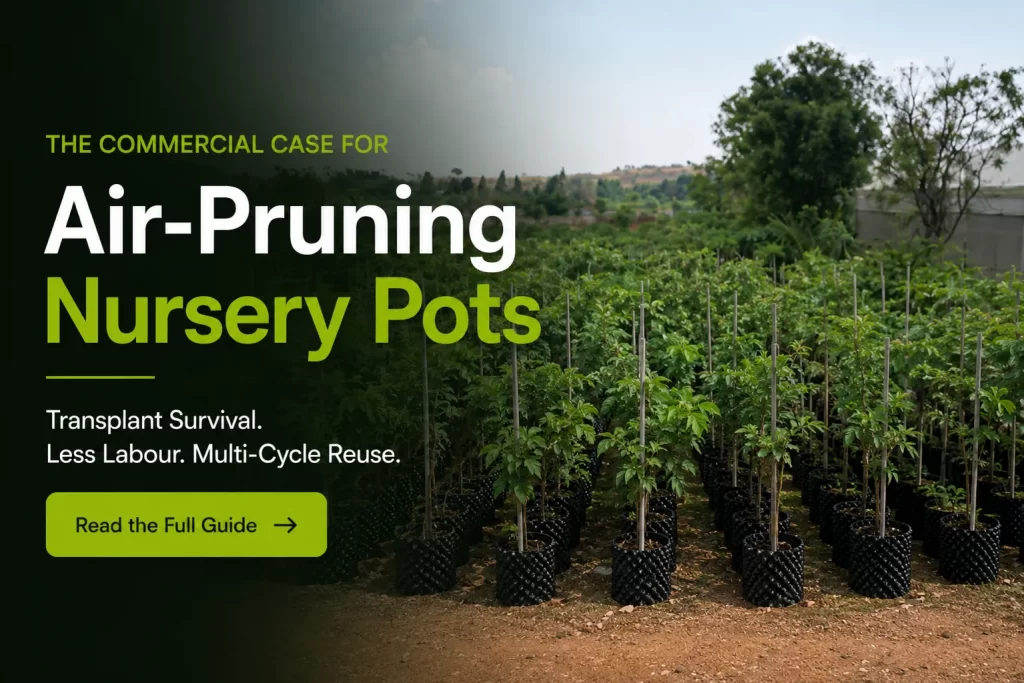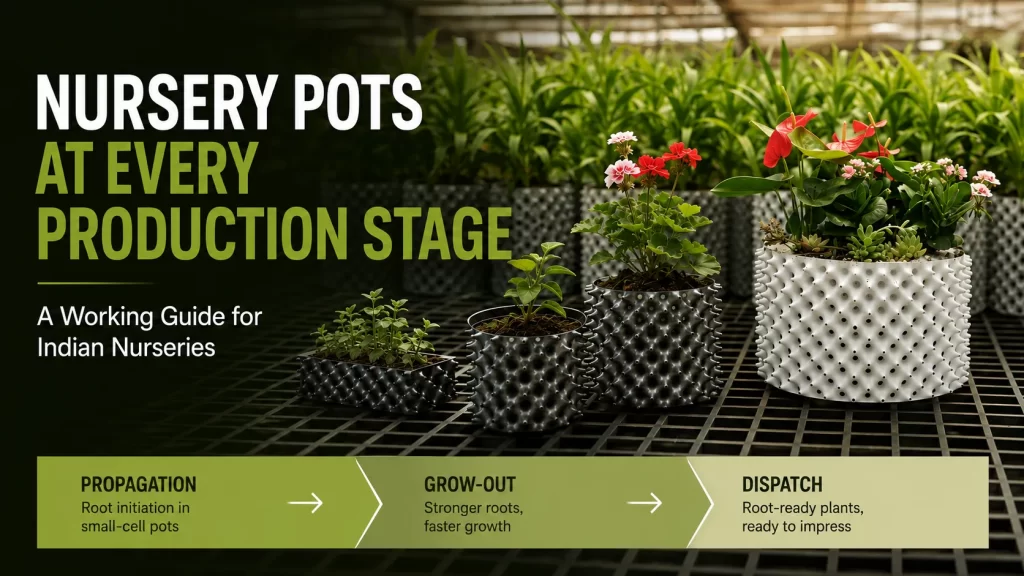
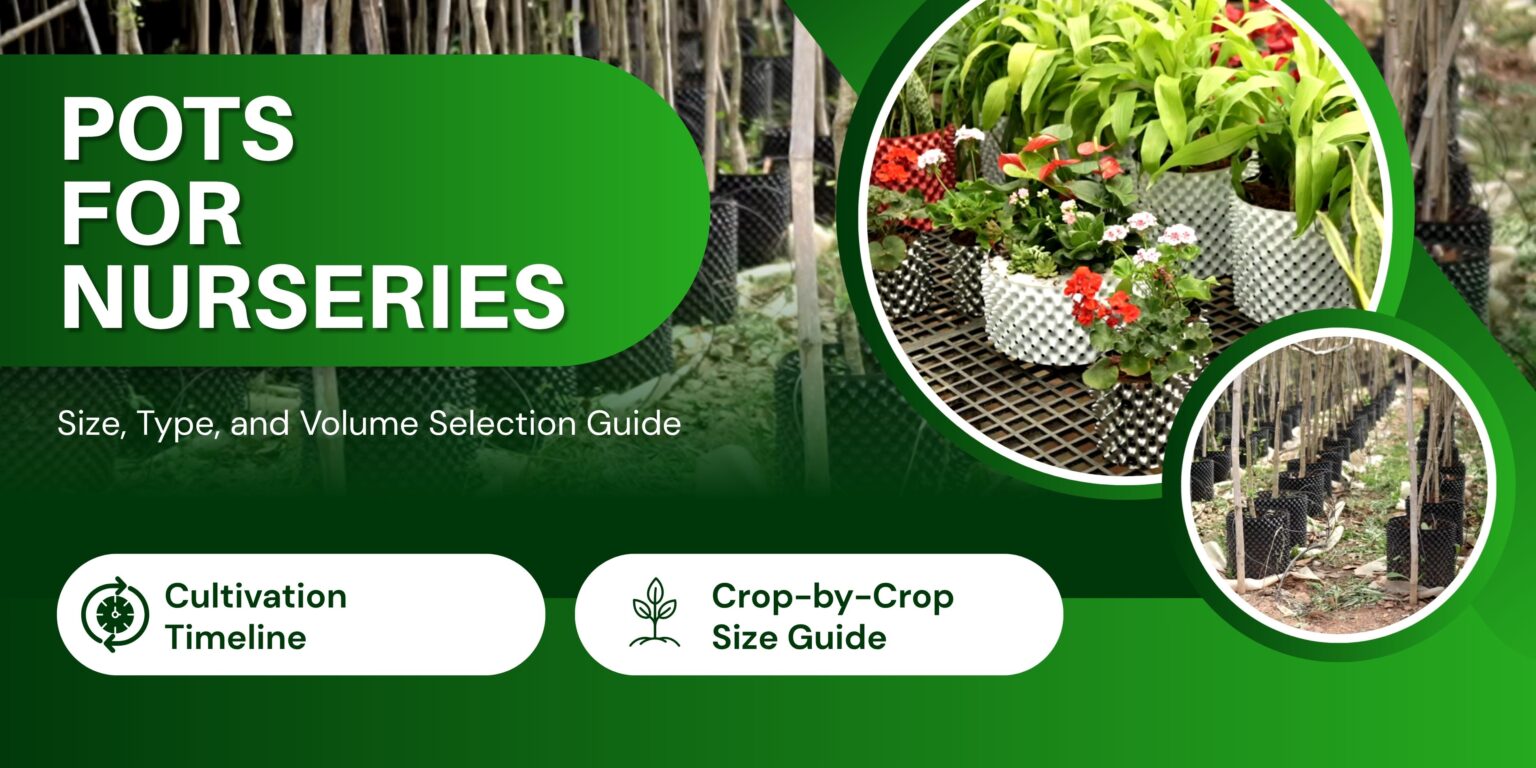
QUICK ANSWER: Choosing nursery pots for a large-scale operation involves matching container type, size, and volume to your crop, cultivation timeline, and total cost of ownership – not just unit price. Air pruning nursery pots deliver 95%+ transplant survival vs. 60–70% for poly bags, and become cheaper per cycle than poly bags by Year 2 when reusability is factored in. RightPot’s 16-SKU range (3L to 50L) covers every commercial crop from seedling propagation to 4-year fruit tree saplings.
When a nursery operates at 50,000 plants per cycle, a 10% improvement in transplant survival is worth more than the cost of upgrading the container. Most commercial nurseries in India are still optimising for unit price – the cheapest nursery pot per unit, ordered in the highest volume. That calculation ignores four factors that determine actual profitability: root quality at sale, transplant survival in the customer’s field, container lifespan across multiple cycles, and the operational cost of handling inferior containers.
This guide is for nursery managers and procurement leads who want the full picture: which container type to use, which size maps to which crop and cultivation timeline, and what volume thresholds unlock better pricing. All size and application guidance references RightPot’s RP and RPP series, manufactured in India for Indian growing conditions.
Why Container Type Determines More Than Root Health
The nursery pot you choose affects transplant survival rate, growth velocity, labour efficiency, storage space, and your professional reputation with buyers. Root quality is the primary variable – but it is not the only one. A poorly chosen container creates downstream costs that never appear in the unit price comparison.
Poly bags remain dominant in Indian commercial nurseries for one reason: purchase price. At Rs.6-8 per unit, they appear economical. The actual cost emerges later: 30-35% transplant failure rates, plants that take 24-30 months to reach a size achievable in 18 months, and the labour overhead of managing fragile, non-stackable containers that tear during handling.
Air pruning nursery pots solve the root problem that drives these downstream costs. When root tips encounter air through the aeration cones, they desiccate and trigger the plant to branch laterally. Instead of 3-5 spiralling roots that eventually strangle the plant’s vascular system, you get 300+ active root tips forming a dense fibrous network that absorbs water and nutrients at full efficiency. The visible difference at transplant time is striking – and commercially relevant.
The comparison below maps all major container types across the metrics that matter at scale.
Container Type Comparison: Commercial Nursery Perspective
| Factor | Poly Bags | Standard Plastic | Fabric Grow Bags | Imported Air Pots (UK) | RightPot Air Pruning |
|---|---|---|---|---|---|
| Root circling prevention | None | None | Partial (soft walls) | Full | Full |
| Air pruning mechanism | No | No | Passive (fabric) | Active (cones) | Active (aeration cones) |
| Structural rigidity | Very low | High | Low | High | High |
| Transplanting ease | Poor (tears) | Moderate | Poor (soil spill) | Good | Good (plant slides out cleanly) |
| Lifespan | 1 cycle | 2–3 years | 2–4 years | 10+ years | 5–7 years |
| Cost per cycle (approx.) | Lowest (1 cycle) | Medium | Low–medium | Very high | Low (amortised over 5+ cycles) |
| Stackability when empty | Poor | Excellent | Good (foldable) | Moderate | Excellent (15 units high) |
| Transplant survival rate | 60–70% | 65–75% | 80–85% | 95%+ | 95%+ |
| UV resistance | None | Low–medium | Low | High | High (UV-stabilised PP) |
| Available in India | Yes | Yes | Yes | Import only (3–5x cost) | Yes (manufactured in India) |
Note: Transplant survival rates based on commercial nursery data from RightPot client operations. Poly bag and plastic pot rates reflect common outcomes for root-bound plants in standard Indian conditions.
The True Cost of Nursery Pots: Total Cost of Ownership
Nursery pot procurement decisions made on unit price alone consistently understate actual cost. The correct metric is cost per plant per cycle – which accounts for container lifespan, mortality losses, and labour efficiency across multiple growing seasons.
Miracle Farm, a commercial nursery operation that transitioned from poly bags to RightPot RP-06 containers, documented a 40% reduction in transplant mortality in the first season. On a batch of 8,000 mango saplings sold at Rs.250 average wholesale price, that reduction represents approximately Rs.8 lakh in retained inventory value – plants that previously failed after leaving the nursery now establish successfully in the customer’s field. The result: fewer warranty claims, higher repeat orders, and a justified premium at point of sale.
The cost-per-cycle calculation below uses conservative estimates. Actual savings depend on crop value, mortality rates in your current operation, and number of cycles per year.
5-Year Total Cost of Ownership: 1,000 Containers
| Cost Metric | Poly Bags | Fabric Grow Bags | RightPot RP-06 |
|---|---|---|---|
| Approx. unit cost | ₹6–8 | ₹40–80 | [Contact RightPot for bulk pricing] |
| Usable cycles | 1 | 3–4 | 5–7 |
| Effective cost per cycle | ₹6–8 | ₹13–25 | Significantly lower from Year 2 |
| Transplant mortality (typical) | 30–35% | 15–20% | 4–8% |
| Mortality loss on 1,000 plants @ ₹250 | ₹75,000–87,500 | ₹37,500–50,000 | ₹10,000–20,000 |
| Net saving vs. poly bags (1,000 plants) | Baseline | ₹25,000–50,000 saved | ₹55,000–75,000+ saved |
| Storage (1,000 empty units) | High (bulky, non-stackable) | Low (foldable) | Compact (stackable, 15 high) |
| Professional appearance | Poor | Moderate | High |
Pricing shown is indicative. Contact RightPot for current bulk pricing. Mortality figures are illustrative based on commercial operation benchmarks.
How to Choose Nursery Pot Size: The Three-Factor Framework
Pot size selection for commercial operations follows three variables: plant type (which determines root architecture), cultivation timeline (how long the plant stays in the container before transplant or sale), and root system character (tap-root-dominant vs. shallow and spreading). Choosing too small restricts growth; choosing too large wastes growing medium and slows development in young plants.
Factor 1: Plant Type and Root Architecture
Fruit trees with strong tap roots (mango, citrus, guava) need vertical depth more than horizontal width. Pots in the RP-03 to RP-06 range provide the right balance for most commercial timelines. Pomegranate and strawberry develop shallow, spreading roots and benefit from wider, shallower geometries – RP-05 (13.5″ diameter x 7″ height) is often the better choice over RP-03 for these crops, even though RP-03 is more commonly used.
Factor 2: Cultivation Timeline
The single most important sizing variable. Under-potting accelerates root-bound conditions; over-potting creates waterlogging risk in young plants and wastes growing medium costs. The general rule: match container volume to the amount of root mass the plant will develop during its time in the nursery, not to the plant’s final transplant size.
12-18 months: RP-02 (6L) to RP-03 (10L) depending on vigour. 24-30 months: RP-06 (20L) for most fruit trees. 36+ months: RPP-15 (38L) or RPP-16 (50L) for premium specimens where container time directly justifies sale price.
Factor 3: RP Series vs. RPP Series
The RP Series (3L to 36L) covers the full range for standard commercial operations and is the appropriate choice for high-volume nurseries where cost efficiency is a priority alongside quality. The RPP Series (12L to 50L) offers extended height profiles not available in the standard RP range – critical for tap-root-dominant species in multi-year cultivation where vertical root space determines tree structure and long-term yield.
Both series use identical air pruning technology. The decision is driven by cultivation timeline, crop value, and root system requirements – not performance differences between the two lines.
Crop-by-Crop Nursery Pot Size Guide: RP and RPP Series
The table below maps RightPot SKUs to specific commercial crops and cultivation timelines. Use it as a starting point; your team’s observations on root development and sale-ready timelines should calibrate these recommendations to your specific varieties and local conditions.
| Crop / Plant Type | Stage | Rec. SKU | Capacity | Why This Size |
|---|---|---|---|---|
| Mango saplings | 12–18 months | RP-03 | 10L | Tap root develops downward; lateral feeders begin branching within 60 days |
| Mango saplings | 24–30 months | RP-06 | 20L | Most popular commercial size; optimal volume-to-cost ratio for 2–3 year production |
| Mango saplings (premium) | 36+ months | RPP-15 | 38L | Larger root volume supports premium sale price; keeps quality intact across extended cycles |
| Citrus (orange, lemon, lime) | 12–18 months | RP-03 | 10L | Air-pruned roots establish 30–40% faster post-transplant; critical for citrus shock sensitivity |
| Citrus (commercial) | 24–30 months | RP-06 | 20L | Standard commercial production across Maharashtra and AP belts |
| Guava (rooted cuttings) | Early development | RP-02 | 6L | Guava’s aggressive lateral roots benefit from immediate air pruning from rooting stage |
| Guava (commercial) | 12–24 months | RP-03 / RP-06 | 10–20L | Channels natural root vigor into productive feeder roots instead of severe circling |
| Pomegranate | 18–24 months | RP-03 / RP-05 | 10–12L | Shallow, spreading root system benefits from wider pot geometry (RP-05 for wide-root preference) |
| Ornamentals / hedge plants | 12–18 months | RP-03 | 10L | High-density layout; consistent quality across batches for landscape-ready buyers |
| Large ornamental trees | 24–36 months | RP-09 / RPP-14 | 26L | Sweet spot for landscape-ready material; buyers can visibly see root quality at purchase |
| Seedlings / rooted cuttings | Propagation stage | RP-01 | 3L | Air pruning from day one prevents early circling; easy transplant to grow-out containers |
| Forestry species (teak, neem) | 12–24 months | RP-06 / RP-07 | 20–28L | Deep tap roots need vertical depth; RP-07 provides extra height without excessive width |
Uncertain about the right size for a specific crop or rootstock? RightPot’s team provides complimentary sizing consultations for commercial buyers.
Full RightPot SKU Reference for Commercial Buyers
The complete RP and RPP range across 13 commercially relevant SKUs. All sizes are available in Black, Red, White, and Silver. Colour choice does not affect air pruning performance – White and Silver are recommended for hot-climate nurseries due to lower heat absorption; Black is preferred in cooler northern operations.
| SKU | Dimensions | Capacity | Series | Best Commercial Application |
|---|---|---|---|---|
| RP-01 | 7.5″ × 7″ | 3L | RP | Seedling propagation, rooted cuttings, starter plugs |
| RP-02 | 10.5″ × 7″ | 6L | RP | Small saplings, early guava development, compact herbs |
| RP-03 | 10.5″ × 11″ | 10L | RP | Most versatile: citrus (12–18 mo), guava, ornamentals, tomatoes |
| RP-05 | 13.5″ × 7″ | 12L | RP | Shallow-root species: pomegranate, strawberry, wide ornamentals |
| RP-06 | 13.5″ × 11″ | 20L | RP | Industry workhorse: mango/citrus saplings (24–30 mo) – most ordered SKU |
| RP-07 | 13.5″ × 15″ | 28L | RP | Mature plants, forestry species, long-term patio specimens |
| RP-09 | 15.5″ × 11″ | 26L | RP | Ornamental trees, hedge plants, landscape-ready stock |
| RP-10 | 15.5″ × 15″ | 36L | RP | Large saplings, urban forestry, intensive long-term cultivation |
| RPP-11 | 10.5″ × 8.5″ | 12L | RPP | High-turnover commercial ornamentals, premium herb cultivation |
| RPP-12 | 10.5″ × 12.5″ | 18L | RPP | High-value sapling production, extended cultivation cycles |
| RPP-14 | 15.5″ × 8.5″ | 26L | RPP | Large-scale operations, wide root system development |
| RPP-15 | 15.5″ × 12.5″ | 38L | RPP | Premium fruit tree standard: mango/citrus 3–4 year saplings |
| RPP-16 | 15.5″ × 16.5″ | 50L | RPP | Premium specimens, permanent container cultivation, exhibition trees |
RPP series rows shaded in green. All SKUs available in bulk volumes with delivery across India.
Operational Advantages at Scale: Storage, Handling, and Quality Signalling
Container choice affects nursery operations beyond the plant itself. At 10,000+ plant cycles, handling efficiency, storage footprint, and professional presentation to buyers are measurable cost and revenue factors.
Empty RightPot containers stack 15 units high, reducing storage space by approximately 40% compared to an equivalent volume of poly bags. For nurseries that warehouse 5,000-10,000 containers between cycles, this is material – particularly in constrained facilities. Rigid structure also means workers can move and space plants approximately 20-30% faster than with poly bags, which require careful support to prevent soil spillage and tearing.
On the buyer-facing side, container presentation affects sale price. Progressive orchardists and institutional buyers visiting a nursery read the container as a quality signal before touching a plant. DS Group, one of India’s largest agribusiness conglomerates, standardised on RightPot across their nursery operations partly because the root system visible at sale became a differentiating factor in buyer negotiations. Growers paying Rs.300-500 for a premium mango sapling increasingly expect evidence of that quality – and a dense fibrous root ball from an air pruning container is visible proof.
Volume Pricing for Commercial Operations
RightPot pricing scales with order volume. Mixed-size orders qualify for volume pricing based on total unit count – you are not required to order a single SKU to access volume tiers. This matters for nurseries that need 300 units of RP-06, 200 units of RP-03, and 100 units of RP-01 in the same order: total units count toward the pricing threshold.
| Order Volume | Pricing Tier | Typical Buyer Profile | Notes |
|---|---|---|---|
| 5–99 units | Trial / retail pricing | First-time buyers, pilot testing | No minimum; test before committing to bulk |
| 100–499 units | Standard commercial | Small nurseries, single-crop pilots | Mix sizes in one order, total units qualify |
| 500–1,999 units | Volume Tier 1 | Medium nurseries, facility-wide deployment | Volume discount applied; multi-crop standardisation |
| 2,000–4,999 units | Volume Tier 2 | Large commercial operations | Multi-crop standardisation; delivery scheduling available |
| 5,000+ units | Custom enterprise pricing | Large-scale / multi-facility operations | Custom quote; long-term supply agreements available |
Delivery is available pan-India with typical lead times of 3-5 business days to major metros and 5-10 business days to Tier 2/3 locations. Large orders (500+ units) can be scheduled to align with planting cycles – RightPot’s team coordinates delivery timing to match your nursery’s operational calendar.
Frequently Asked Questions
Q: What is the minimum order quantity for RightPot nursery pots?
A: There is no minimum order. You can order 5 units to test a specific size or 5,000 units for full-scale deployment. Trial orders of 50-100 units are common for nurseries running side-by-side comparisons with their existing containers before committing to bulk purchases.
Q: How do I decide between the RP Series and RPP Series for my nursery?
A: Start with RP Series for most commercial operations – it covers 3L to 36L and handles the full range of standard nursery crops. Choose RPP Series when your cultivation timeline exceeds 30 months, when tap-root depth is critical to tree structure, or when crop value justifies the additional investment in extended-height container geometry.
Q: Can I mix sizes in one order and still qualify for volume pricing?
A: Yes. Volume pricing thresholds are calculated on total unit count across all SKUs in the order. An order of 300 RP-06 units plus 200 RP-03 units qualifies as a 500-unit order for pricing purposes, accessing the Volume Tier 1 discount.
Q: How long do RightPot containers last in a commercial nursery environment?
A: Five to seven years with normal nursery use, including daily handling, seasonal transport, and repeated cleaning cycles. The UV-stabilised polypropylene is rated for continuous outdoor exposure across India’s temperature range. Some commercial operations with careful handling protocols report 8+ years from a single set of containers.
Q: What is the transplant survival improvement I can realistically expect by switching from poly bags?
A: Based on commercial nursery data from RightPot client operations, transplant survival improves from 60-70% with poly bags to 92-96% with air pruning containers. The exact improvement depends on crop type, transplant conditions, and how root-bound plants were in the original containers. Citrus and guava show the most consistent and dramatic improvement.
Q: Do different colours affect root temperature or plant performance?
A: Yes, slightly. Black containers absorb more heat and are better suited to cooler climates (northern and central India in winter cycles). White and Silver containers reflect solar radiation and are recommended for nurseries in high-temperature regions or for crops with heat-sensitive root zones. Air pruning performance is identical across all four colours.
Q: How should I clean RightPot containers between cycles?
A: For the same crop family: soap and water, air dry. After disease outbreaks or when switching to a different crop family: soak in a 1:10 bleach solution for 15-30 minutes, rinse thoroughly with clean water, and sun-dry for 24 hours before storage. Store stacked and dry, away from direct sunlight when not in use.
Q: What is the difference between RP-06 and RPP-15, and which is better for mango production?
A: RP-06 (13.5″ x 11″, 20L) is the standard commercial choice for mango saplings in 24-30 month cultivation cycles. RPP-15 (15.5″ x 12.5″, 38L) is for premium saplings in 36+ month production where extra root volume is justified by a higher sale price. Most commercial mango nurseries run RP-06 as their workhorse and use RPP-15 for their top-grade stock.
Choose the Container That Matches Your Operation
Nursery pot selection at commercial scale is a business decision, not just an agronomic one. The right container – matched to crop type, cultivation timeline, and true cost of ownership – improves transplant survival, accelerates inventory turnover, and builds the buyer relationships that sustain repeat orders. Poly bags remain the default because they are familiar. They are not optimal.
RightPot’s RP and RPP series cover every stage of commercial nursery production, from seedling propagation in RP-01 (3L) to multi-year premium fruit tree cultivation in RPP-16 (50L). All sizes are available for trial orders, with volume pricing that scales to enterprise operations.
Request a bulk quote or sizing consultation:
Contact RightPot at info@rightpot.in or WhatsApp (+91) 9996665430 .
Our team will recommend specific SKUs for your crop mix and calculate volume pricing for your order requirements.
Additional Nursery Management Resources
For nursery operators interested in improving plant production, root development, and commercial cultivation practices, additional horticultural resources are available from the National Horticulture Board (NHB) and the Indian Council of Agricultural Research (ICAR). These organizations publish research-backed guidance on nursery management, plant propagation, crop production, and best practices for Indian growing conditions.