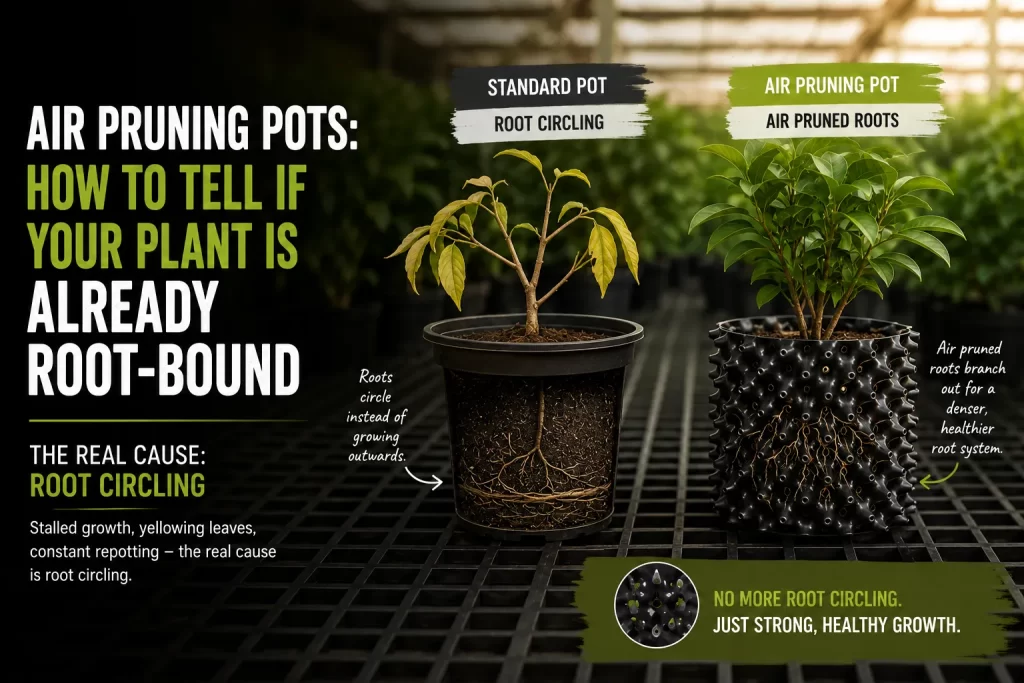
Most nursery owners who look seriously at air-pruning Nursery Pots already accept the agronomy. Circling roots in a smooth-walled bag produce a deformed root system, and reviews of nursery production systems link that deformation to reduced growth, poor stress resistance and early dieback after planting out.
What stops the switch is not the argument. It is the operational question nobody publishes an answer to: how do you actually move a working nursery from bags to rigid Nursery Pots without losing a season of saleable stock in the process?
This is that plan. Four phases, one production line at a time, with the measurements to record and the two operational changes that decide whether the conversion works. The commercial case for air-pruning Nursery Pots is covered separately in RightPot’s ROI analysis – this article assumes the case is made and deals with execution.
Why Not to Convert Every Line to Nursery Pots at Once
A full-nursery switch to rigid Nursery Pots changes your container, your growing medium, your irrigation regime and your handling routine in the same season. When something goes wrong – and in the first cycle something will – you have no way to isolate the cause.
A staged conversion also protects cash flow. You are buying durable containers that will serve for years, and spreading that across four seasons keeps working capital available while the first cohort proves itself.
Phase 1 – The Trial Batch
Pick one species you know well, ideally one with a production cycle short enough to give you an answer inside a year and a root system you already understand.
- Run a matched control. Same seed lot or cutting batch, same bench, same irrigation zone, same operator. Without a control you get anecdotes rather than data.
- Size the trial at 200–500 units per arm. Large enough for the differences to be real, small enough to absorb if the first cycle is imperfect.
- Fix the media question first. Use a made mix in both arms if you can, so you are testing the container rather than the container plus a media change.
- Assign one person to record. Split responsibility means missing data, and missing data means the trial proves nothing.
- Photograph root balls at the same points in both arms. This becomes your most persuasive sales asset later.
- Run it to field or customer, not just to saleable size. The biggest gains from air pruning show up after planting out, not on the bench.
What to measure in the trial
| Measure | How | Why It Matters |
|---|---|---|
| Time to saleable size | Weeks from potting to grade standard | Determines throughput and how many cycles the bench turns per year |
| Culling rate | Percentage rejected at grading | Directly changes cost per saleable plant |
| Root ball integrity | Photograph at lift; note whether it holds together | Predicts transplant performance and is what buyers inspect |
| Transplant survival | Percentage established at 60 and 180 days after planting out | The number that matters most to your customer |
| Labour per hundred units | Time filling, spacing, watering, lifting | Where a large share of the operating saving appears |
| Water applied per unit | Metered or estimated per irrigation zone | Changes materially after conversion – plan for it |
Phase 2 – Retune the Irrigation
This is the single biggest operational change, and the one most conversions get wrong. An aerated container exchanges air across its whole wall, so it dries faster than a sealed bag holding the same volume.
Overhead irrigation is inefficient here: a meaningful share of applied water passes the open wall rather than entering the medium. Drip or emitter irrigation delivers water where the medium can absorb it and is worth installing on the trial bench before the trial starts.
- Increase frequency, reduce volume per event. More, shorter cycles suit an aerated root zone better than fewer heavy soakings.
- Convert the trial bench to drip first, so the irrigation variable is controlled from the start rather than introduced mid-trial.
- Re-zone if capacities are mixed. Small and large containers on one valve will always leave one group wrong.
- Watch the first hot spell closely. The gap between bag and pot widens most under peak evaporative demand.
- Reverse the logic in monsoon. Free-draining containers are an advantage in heavy rain – resist the habit of watering on schedule.
Phase 3 – Change the Growing Medium in Your Nursery Pots
Excavated field soil is standard in bag production and unsuitable in rigid containers. It carries high clay content, high bulk density, poor drainage, and weed seed, insects and pathogens into what should be a clean system – and excavating it is a documented sustainability problem in its own right.
Move to a made mix based on buffered cocopeat with a deliberate coarse fraction. The coarse fraction matters more in an open-walled container than a sealed one, because fine media migrates out through the cones. RightPot’s guide to potting mixes for aerated containers covers the ratios in detail.
Phase 4 – Labour, Layout and Handling
The labour picture improves, but not in the places people expect. Comparative research on nursery container systems has found bag filling to demand several times the labour of tray and rigid container systems – one review reported filling labour around 5.3 times higher for poly bags than for a modern tray system, with subsequent nursery and planting operations also running two to three times higher.
Against that, rigid containers need assembly on first use and cleaning between crops. Both are new tasks. Budget for them explicitly rather than discovering them mid-season.
Four-season phasing plan
| Season | Scope | Focus |
|---|---|---|
| Season 1 | One species, 200–500 units plus control | Prove the agronomy; convert that bench to drip; record everything |
| Season 2 | One full production line | Retune irrigation at line scale; settle the media recipe; time the new labour tasks |
| Season 3 | Half the nursery, highest-value lines first | Establish cleaning and flat-pack storage routines; start selling the root ball story to buyers |
| Season 4 | Remaining lines | Standardise capacities across the nursery; retire bag stock as it runs out |
What to Tell Your Buyers
A fibrous, branching root ball that holds its shape when lifted is a quality signal your customer can see, and it is the easiest differentiation a nursery can offer without changing what it grows.
Landscapers and orchard buyers care about establishment, not bench appearance. If your trial data shows better survival at 180 days, that number belongs on your quotation, not just in your records.
Key Takeaways
- Convert one line per season, with a matched control, rather than the whole nursery at once.
- Retune irrigation before anything else – drip or emitter, higher frequency, lower volume per event.
- Change the growing medium at the same time as the container; field soil does not belong in rigid containers.
- Add assembly and between-crop cleaning to your labour plan; they are new tasks that bag production never had.
- Measure transplant survival at 60 and 180 days – that is the number your buyers actually pay for.
- Photograph root balls from the first trial. It becomes your strongest sales asset.
FAQs: Converting to Air-Pruning Nursery Pots
1. How long does a full nursery conversion take?
A staged conversion typically runs across four production seasons: a controlled trial, then one line, then the higher-value half of the nursery, then the remainder. Faster is possible, but compressing it removes your ability to isolate what caused any problem in the first cycle.
2. What is the biggest operational change to plan for?
Irrigation. An aerated container dries faster than a sealed bag of the same volume, and overhead irrigation loses a meaningful share of applied water past the open wall. Converting the trial bench to drip before the trial starts is the highest-return preparation step.
3. Can we keep using our existing field-soil growing medium?
It is not recommended. Field soil compacts, drains poorly and brings weed seed, insects and pathogens into the system, and excavating it is unsustainable at scale. A made mix based on buffered cocopeat with a coarse fraction performs far more predictably in rigid containers.
4. Does switching actually reduce labour?
Net labour generally falls, but the pattern changes. Comparative research has found poly-bag filling to require several times the labour of rigid and tray systems, with downstream handling similarly higher. Against that saving, budget for container assembly on first use and cleaning between crops.
5. What should the trial batch measure?
Time to saleable size, culling rate, root ball integrity at lift, transplant survival at 60 and 180 days, labour per hundred units, and water applied per unit – recorded identically in both the trial and the control arm by one assigned person.
6. How do we justify the change to buyers?
Show the root ball. A fibrous, branching root mass that holds together when lifted is a visible quality signal, and establishment data from your own trial carries more weight with landscapers and orchard buyers than any general claim about container technology.
Start With One Bench
Every successful conversion to air-pruning Nursery Pots that we have seen started the same way: one species, one bench, one control, one person recording. The data from that first cycle is what makes the rest of the decision straightforward.
We can help you size a trial batch for your species and cycle length, and specify the capacities your production stages actually need.
Request a trial order or sizing consultation:
Contact RightPot at info@rightpot.in or WhatsApp (+91) 9996665430.
No minimum order.
Our team will recommend the right aeration container size for your specific crop and cultivation timeline.