The scepticism is fair. Air pots for plants look unusual – a container full of holes, costing more than a standard pot or a fabric grow bag, with claims about root architecture that sound like marketing copy. If you have been growing plants professionally for ten years and your existing containers work adequately, the burden of proof is on the new technology.
This article makes that case honestly. It covers what the research actually shows, what Indian commercial nurseries have observed in practice, and – importantly – where air pruning pots do not justify the investment. The goal is not to sell a product. It is to give you enough information to decide whether the upgrade makes sense for your specific operation or garden.
What Air Pots Are and What They Actually Do
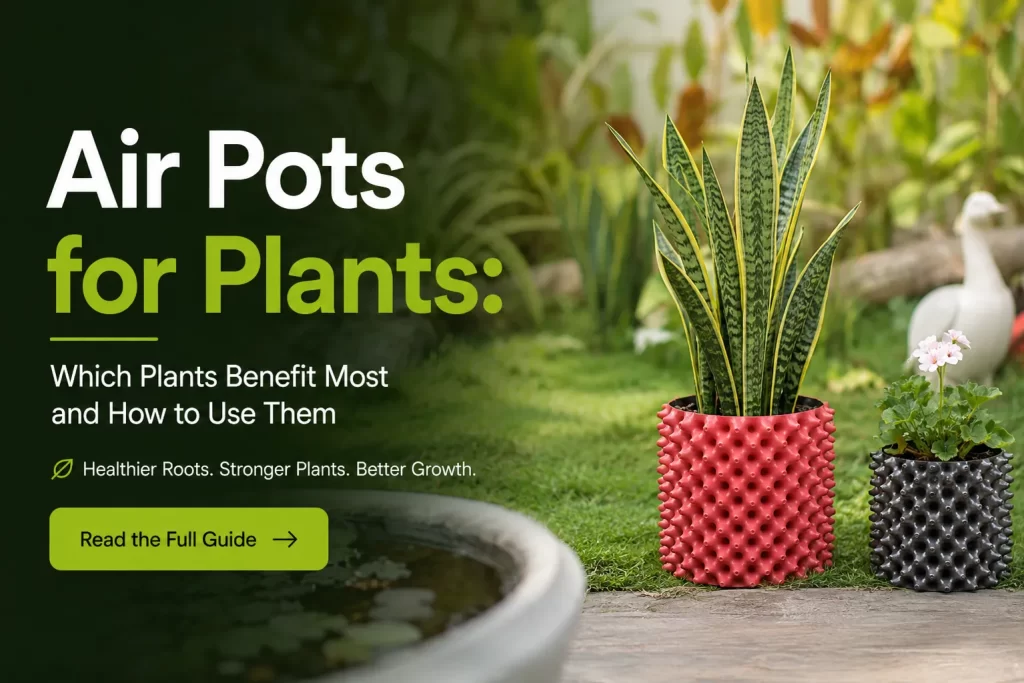
An air pot for plants is a rigid container with strategically placed aeration openings – typically cone-shaped – that expose root tips to air as they grow toward the container wall. When a root tip encounters air, it desiccates naturally. This is called air pruning, and it is a plant’s own biological response – not a chemical or artificial intervention.
Here is what happens step by step. A young root extends outward through the growing medium looking for water and nutrients. In a standard pot, it hits a solid wall, bends back inward, and begins circling. Root circling accumulates over weeks. The plant eventually has 3–5 long spiralling roots that cannot absorb nutrients efficiently and create structural weakness at transplant.
In an air pruning container, that same root tip reaches an aeration cone, emerges into open air, and dries out. The plant responds by branching laterally from directly behind the pruned tip – producing multiple new feeder roots. Each of those branches reaches air, prunes, and triggers more branching. Over a single growing season, the result is 300+ active root tips distributed evenly through the growing medium, absorbing water and nutrients at full efficiency, versus the 3–5 spiralling roots of a standard pot.
The visible difference at transplant time: Pull a plant from an air pruning pot and the root ball is dense, white, and fibrous – like a thick sponge. Pull a plant from a poly bag after the same period and you see a tight spiral of brown roots with compacted soil. One establishes in the field within weeks. The other spends months trying to recover from structural damage it may never fully undo.
What the Research Actually Shows
Air pruning technology has been studied and applied in European and North American horticulture for over 25 years. The research is not industry-funded marketing – it comes from independent horticultural institutions and has been replicated across multiple plant species and climate conditions.
Growth Rate Studies
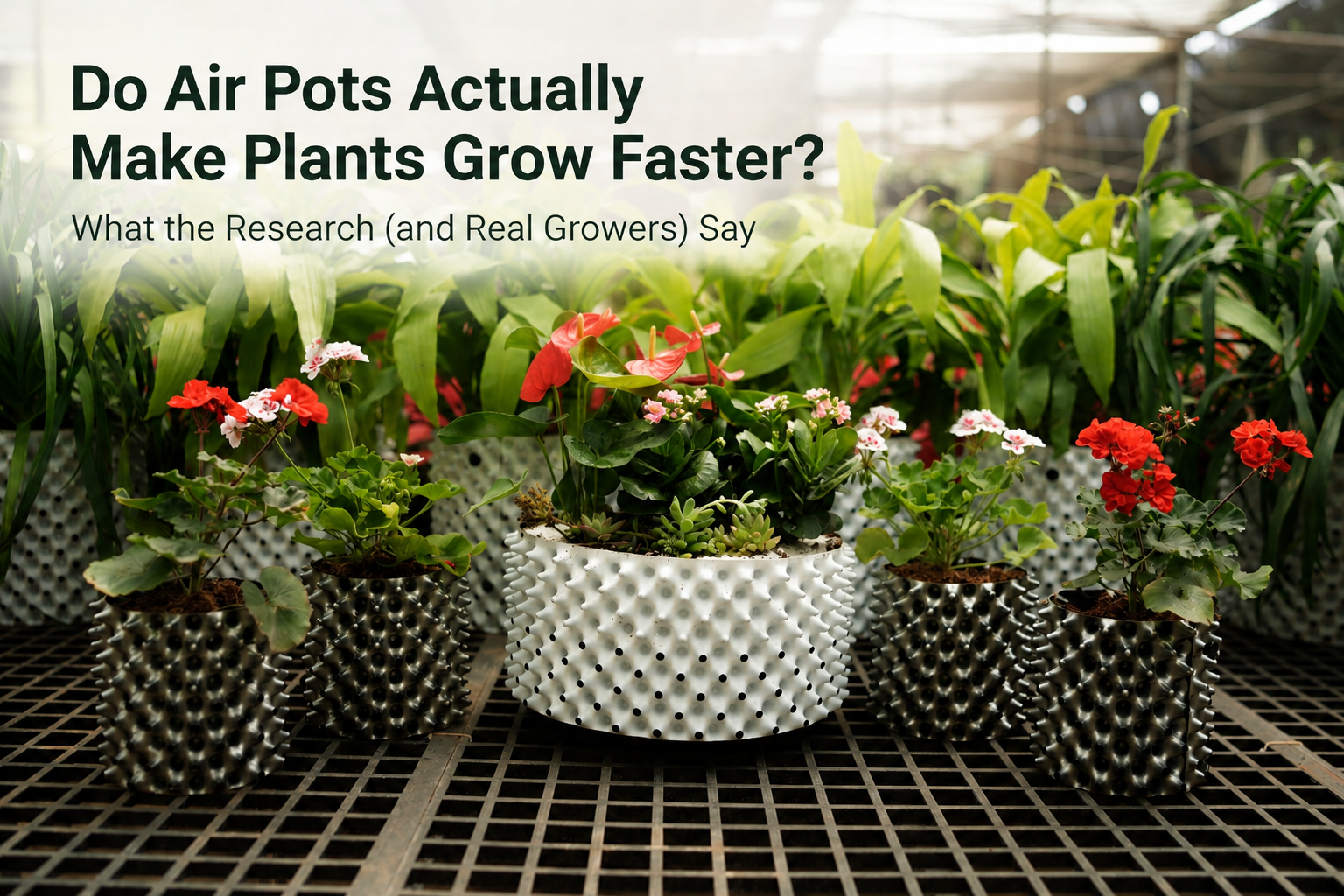
Independent comparisons between air pruning containers and standard plastic pots consistently show 20–25% faster top growth in the air-pruned group. The mechanism is straightforward: more root surface area absorbing more nutrients produces proportionally faster vegetative development above ground. This is not a marginal effect – it is the difference between an 18-month and a 22-month growing cycle for a commercial fruit tree sapling.
Dutch Open-Field Trial
In trials conducted at Dutch horticultural research facilities, air-pruned container plants outperformed open-field specimens in growth rate. This reversed the conventional assumption that container cultivation always restricts growth compared to in-ground planting. The explanation: fibrous root systems packed with active tips absorb nutrients more efficiently than even open-field roots growing through variable soil.
Transplant Survival Research
German horticultural research confirmed zero instances of root circling across multiple plant species grown in air pruning containers. Commercial growers using the technology report 30–40% reductions in transplant mortality compared to standard containers – a number that aligns precisely with what RightPot’s Indian nursery clients observe. The research and the on-ground results are consistent.
What Indian Growers Actually Report
Research from European conditions does not automatically translate to Indian growing environments – different climate, different soil, different crop varieties, different monsoon dynamics. So what do Indian commercial operations observe when they switch to air pots for plants?
- Miracle Farm: 40% Mortality Reduction
Miracle Farm, a commercial nursery operation that transitioned from poly bags to RightPot containers, documented a 40% reduction in transplant mortality. On a batch of 8,000 mango saplings sold at Rs.250 average wholesale price, that improvement represents approximately Rs.8 lakh in retained inventory value per cycle – plants that previously failed after leaving the nursery now establish successfully in the customer’s field. Fewer refunds, more repeat orders, and a justified price premium at the point of sale.
- DS Group: Container as a Quality Signal
DS Group, one of India’s largest agribusiness conglomerates, standardised on RightPot air pruning pots across their nursery operations. Beyond the root development benefits, the visible quality difference at sale – a dense fibrous root ball versus a poly bag spiral – became a negotiating tool with institutional buyers. The container itself communicated quality before anyone tested the plant.
Fratelli Agro, a high-value agricultural producer, summarised the commercial case directly: the same air pruning technology as premium UK imports, at 60–70% lower cost because RightPot manufactures in India. The performance is equivalent. The price is not.
Air Pots vs Grow Bags vs Plastic Pots: Head-to-Head
The most common alternatives to air pots for plants are fabric grow bags and standard plastic pots. Both have legitimate use cases. Here is how they compare across the factors that matter in a commercial or serious home growing context.
Air Pot vs Grow Bag vs Plastic Pot: Full Comparison
| Factor | Standard Plastic Pot | Fabric Grow Bag | Air Pruning Pot (RightPot) | Why It Matters |
|---|---|---|---|---|
| Root circling prevention | None | Partial (soft walls) | Full (active air pruning) | Root circling reduces nutrient uptake and causes transplant failure |
| Drainage quality | Poor (1–2 holes) | Excellent (porous fabric) | Excellent (aeration cone design) | Poor drainage causes root rot, especially in monsoon conditions |
| Aeration mechanism | None | Passive (fabric breathes) | Active (cone openings expose root tips directly to air) | Active aeration triggers denser lateral root branching |
| Structural rigidity | High | Low (collapses when wet) | High | Rigidity ensures consistent geometry during handling and monsoon |
| Lifespan | 2–3 years | 2–4 years | 5–7 years | Longer lifespan reduces per-cycle cost significantly at scale |
| Transplant ease | Moderate (root disturbance risk) | Poor (soil spillage) | Good (fibrous ball slides out cleanly) | Clean transplanting preserves root integrity and survival rates |
| Transplant survival rate | 65–75% | 80–85% | 92–96% | Higher survival directly reduces nursery mortality losses |
| Available in India | Yes | Yes | Yes (RightPot, made in India) | Indian manufacture eliminates import cost and delays |
| 5-year cost per cycle | Medium (replace every 2–3 yrs) | Low–medium (replace every 3–4 yrs) | Lowest (amortised over 5–7 cycles) | True cost advantage of air pruning pots only emerges over multiple cycles |
Transplant survival rates based on commercial nursery data from RightPot client operations. Lifespan estimates reflect normal use conditions in Indian nursery environments.
Where Air Pots Are Worth It – and Where They Are Not
The honest answer: air pruning pots are not the right choice for every situation. The ROI depends on plant value, cultivation timeline, and what you are currently losing to root circling and transplant failure. Here is a clear breakdown.
Where Air Pots for Plants Deliver Strong ROI vs Where Standard Containers Are Fine
| Use Case | Verdict | Reason |
|---|---|---|
| Commercial fruit tree nurseries (mango, citrus, guava) | Strongly recommended | Root quality at sale directly affects transplant survival – the measurable ROI justifies the cost |
| Large ornamental and forestry production | Strongly recommended | Batch consistency is critical; air pruning delivers uniform root development regardless of how long plants sit in containers |
Home rooftop and balcony growing (tomatoes, peppers, herbs) | Recommended | Better yields from limited space; healthier plants with less intervention; 5–7 year lifespan across growing seasons |
| Blueberry and specialty fruit container growing | Strongly recommended | Drainage and aeration requirements are strict; air pruning pots are the only container type that satisfies all three non-negotiables |
| Ultra-low-margin commodity seedlings (short cycle) | Optional | ROI math works at scale; for very short cycles (under 8 weeks), standard containers may be sufficient |
| Seedling propagation trays (mass propagation) | Useful | RP-01 (3L) prevents early root circling and produces stronger transplants – particularly valuable for high-value species |
‘Strongly recommended’ indicates situations where the performance improvement consistently justifies the cost difference within 1–2 growing cycles. ‘Optional’ means the decision depends on specific operation economics.
Air Pots in India: What to Know Before Buying
For Indian growers evaluating air pots for plants for the first time, three practical questions come up consistently.
- Cost Versus Imports
Premium air pruning containers from UK manufacturers (Air-Pot) perform equivalently to RightPot but cost 3–5x more after import duties and shipping. RightPot manufactures the same technology in India, which eliminates import cost, reduces lead time, and provides local support. For commercial operations ordering 500–5,000 units, this is a material difference.
- Which Size to Start With
For most commercial nurseries testing air pruning containers for the first time, RP-06 (20L, 13.5″ x 11″) is the correct entry point – it covers the widest range of fruit tree and ornamental sapling applications and is RightPot’s highest-volume commercial SKU. Home growers should start with RP-03 (10L) for vegetables and RP-05 (12L) for fruit trees and blueberries. There is no minimum order, so a trial of 50–100 units alongside existing containers gives you a direct performance comparison within one cycle.
- Monsoon Considerations
India’s monsoon creates a specific problem for fabric grow bags: prolonged rain causes fabric to stay saturated, increasing disease pressure and root rot risk. RightPot’s rigid air pruning pots drain freely through the aeration cones regardless of rainfall duration – the structural geometry does not change when wet. This is a practical advantage in Karnataka, Kerala, Maharashtra, and any nursery exposed to heavy monsoon rainfall for 3–4 months annually.
Frequently Asked Questions
Q1: Do air pots for plants actually work, or is it just marketing?
A: The technology is real and independently validated. Air pruning – where root tips desiccate upon encountering air and trigger lateral branching – is a documented plant biology response, not a marketing construct. Independent horticultural research from Germany and the Netherlands shows 20–25% faster growth and eliminated root circling across multiple species. Indian commercial nurseries report 92–96% transplant survival versus 60–70% with poly bags.
Q2: Are air pots better than grow bags?
A: For most commercial and serious home growing applications in India, yes. Both deliver air pruning, but RightPot’s rigid air pruning containers last 5–7 years versus 2–4 for fabric grow bags, maintain structural integrity during India’s monsoon, and allow cleaner transplanting. The only scenario where grow bags have a genuine advantage is if portability and foldable storage are the primary requirements.
Q3: How quickly will I see results from switching to air pots?
A: Root development improvements are visible within 2–4 weeks if you check root tips at the aeration holes. Measurable top growth acceleration is typically apparent within 6–8 weeks. The most significant result – transplant survival rate improvement – becomes statistically clear after one full cycle. For commercial nurseries running a side-by-side trial, the difference in plant health and root quality at sale time is usually visible within a single growing season.
Q4: What plants respond best to air pots?
A: Fruit trees produce the most dramatic and commercially significant improvements – mango, citrus, guava, and pomegranate all show measurable root architecture and growth rate benefits. Tomatoes, peppers, and eggplant respond strongly in home and commercial growing settings. Blueberries benefit more than almost any other crop because their root system is unusually sensitive to container conditions. Forestry species (teak, neem) and ornamental trees also show consistent improvements in root density and transplant survival.
Q5: How do air pots compare to imported Air-Pot containers from the UK?
A: Performance is equivalent – both use active air pruning through cone-based openings to prevent root circling and trigger lateral root branching. The difference is cost and availability. Air-Pot (UK) carries 3–5x the price in India after import duties and shipping, with longer lead times and no local support. RightPot manufactures the same technology in India with local pricing, pan-India delivery in 3–10 business days, and a team that understands Indian growing conditions.
Q6: Is there a minimum order for trying RightPot air pruning pots?
A: No. RightPot has no minimum order. The recommended starting point for commercial nurseries is a trial of 50–100 units run alongside existing containers on the same crop – this gives a direct performance comparison within one growing cycle. Home growers typically start with 5–10 units across different sizes to test with specific crops before scaling up.
The Verdict: Air Pots Work – For the Right Application
The research is clear. The on-ground results from Indian commercial nurseries are consistent with that research. Air pots for plants produce measurably better root architecture, faster growth, and higher transplant survival – and those improvements translate directly to reduced nursery losses and stronger buyer relationships.
They are not the right choice for every situation. Ultra-short growing cycles and ultra-low-margin commodity crops may not justify the upgrade. But for fruit tree nurseries, serious home growers, and any operation where transplant survival is a business metric, the argument for air pruning containers is not based on hope. It is based on a consistent body of evidence – European research and Indian nursery data pointing in the same direction.
Try it in one cycle. The root ball at transplant time will tell you everything.
Request a trial order or sizing consultation:
Contact RightPot at info@rightpot.in or WhatsApp (+91) 9996665430 .
No minimum order. Our team will recommend the right SKUs for your crop mix and operation size.
Additional Resources on Root Development and Container Growing
For growers interested in learning more about root development, container cultivation, and plant establishment research, additional horticultural resources are available from the University of Florida IFAS Extension, Oregon State University Extension, and the USDA Plant Database. These research-backed sources provide valuable guidance on root health, container production systems, transplant success, and long-term plant performance.