Air pots for plants get talked about mostly in terms of what they do to roots. Useful to know, but the more practical questions come next: which of my plants will actually benefit, do they work indoors, how do I pot one up, and what size do I buy? This guide answers those, so you can put an air pot to work rather than just admire the idea.
Do air pots work for all plants?
Yes. Air pots for plants rely on a root response that every plant shares: when a root tip reaches air, it stops and the plant branches instead. Because that mechanism is species-agnostic, air pots help fruit trees, vegetables, herbs and ornamentals alike. The plants that gain the most are simply the ones that stay potted long enough for circling to otherwise set in.
So the honest answer isn’t “some plants only.” It’s that the size of the benefit tracks how long the plant lives in the container and how prone it is to root problems.
Plants that benefit most
If you’re deciding where to deploy air pots first, prioritise plants where root circling does real, lasting damage:
- Fruit tree saplings (mango, citrus, guava, pomegranate) – they sit in a container for months to years, so a circled root now becomes a structural weakness in the orchard later.
- Deep and tap-rooted species – plants that push a strong downward root suffer most when a solid pot forces that root to coil.
- Anything grown on for a long cycle – ornamentals, specimen plants and stock held for later sale keep building roots the whole time, so keeping those roots un-circled pays off.
- Long-season fruiting vegetables (tomatoes, chillies, peppers) – they stay productive for months, and a healthy, well-fed root system keeps them going instead of stalling mid-season.
Fast, throwaway crops that are transplanted within a few weeks gain the least, simply because they leave the pot before circling would have started. Everything held longer is where air pots for plants earn their place.
Indoor vs outdoor: the one thing to plan for
Air pots work equally well inside and out; the practical difference is watering rhythm. The same airflow that keeps roots healthy also lets the growing medium dry a little faster than it would in a sealed pot.
Outdoors, that’s usually a gift, it makes waterlogging far harder during heavy rain. Indoors, it means you check the top of the medium more often and water when it’s dry, and you sit the pot on a tray because it drains freely from the sides and base. Nothing about air pots for plants changes indoors except that you stay a touch more attentive to moisture.
How to pot up an air pot, step by step
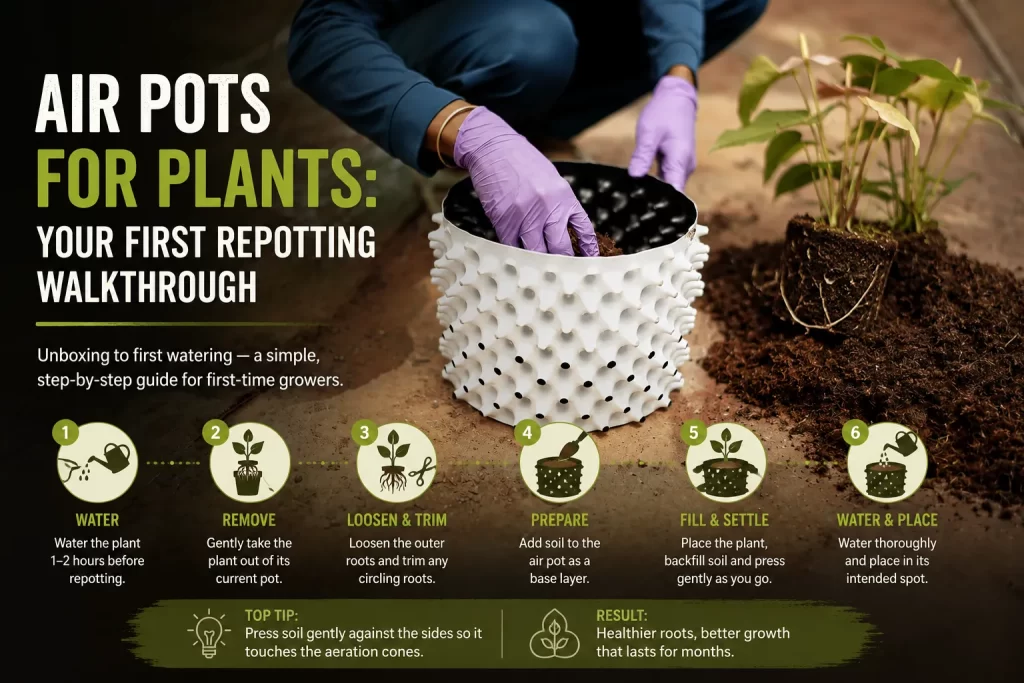
Potting an air pot is much like any container, with two small habits that make the most of the design:
- Use a free-draining medium. A mix that holds structure and drains, rather than a dense, heavy soil, lets air reach the root tips at the wall, which is the whole point.
- Fill and firm gently. Add medium in stages and settle it lightly so there are no big air gaps at the centre, while keeping it loose enough to breathe.
- Position the plant at the same depth it grew at before, then top up around the root ball to the same level.
- Water in thoroughly after potting to settle the medium around the roots. Expect water to drain from the sides as well as the base, that’s normal and shows the pot is working.
- Set your watering rhythm by feel for the first week or two: check the top of the medium, water when it’s drying, and you’ll quickly learn how often this plant needs it in an air pot.
Sizing air pots by plant and stage
Right-sizing matters: too small and the plant outgrows the medium quickly; too large and the medium can stay wet in the unused volume. Use plant stage as your guide. The RightPot RP range below maps common stages to sizes.
| Stage / plant | RightPot size | Capacity | Typical use |
|---|---|---|---|
| Seedlings, cuttings, starters | RP-01 | 3 L | Propagation, first potting |
| Small saplings, herbs | RP-02 | 6 L | Chillies, basil, young stock |
| Medium saplings, vegetables | RP-03 | 10 L | Tomatoes, mid-stage ornamentals |
| Wide, shallow-rooted plants | RP-05 | 12 L | Strawberries, spreading plants |
| Fruit tree saplings | RP-06 | 20 L | Mango, citrus, guava (2–3 yr) |
| Mature / long-term container | RP-07 | 28 L | Established fruit trees, large ornamentals |
If you’re unsure, size to where the plant is headed over the next season rather than where it is today, and step up as it grows. RightPot’s range covers seedling to specimen, so you can keep the same air-pruning benefit at every stage.
Key Takeaways
- Air pots work on every plant – the benefit is biggest for anything held in the pot long enough to circle.
- Start with saplings, tap-rooted and long-cycle plants – that’s where circling does lasting damage.
- Indoors changes only one thing – the medium dries faster, so water by feel and use a tray.
- Size to the next stage, not just today – and use a free-draining medium so the pruning mechanism can work.
FAQs: air pots for plants
1. Can I use air pots for indoor houseplants?
Yes. Air pots suit houseplants well, especially ones kept for years that would otherwise circle. Expect to water a little more often because of the extra airflow, and stand the pot on a tray to catch drainage.
2. What soil or medium is best for air pots?
A free-draining medium that holds its structure works best, so air reaches the root tips at the wall. Heavy, dense soil that compacts and stays wet works against the design.
3. How do I know what size air pot to buy?
Match the pot to the plant’s stage and where it’s heading next season. Seedlings start around 3 L, saplings sit at 6–10 L, and fruit tree saplings typically want 20 L and up.
4. Do I need to change how I fertilise in an air pot?
Your existing feeding routine transfers over. Because the medium drains freely, feed consistently rather than heavily, and adjust to how the plant responds.
Put an air pot to work
The best way to judge air pots for plants is to pot up one plant you care about and watch how it grows and how the roots look at the next repot. Talk to the RightPot team about the right size for what you’re growing, and start with a single size before you scale up your setup.