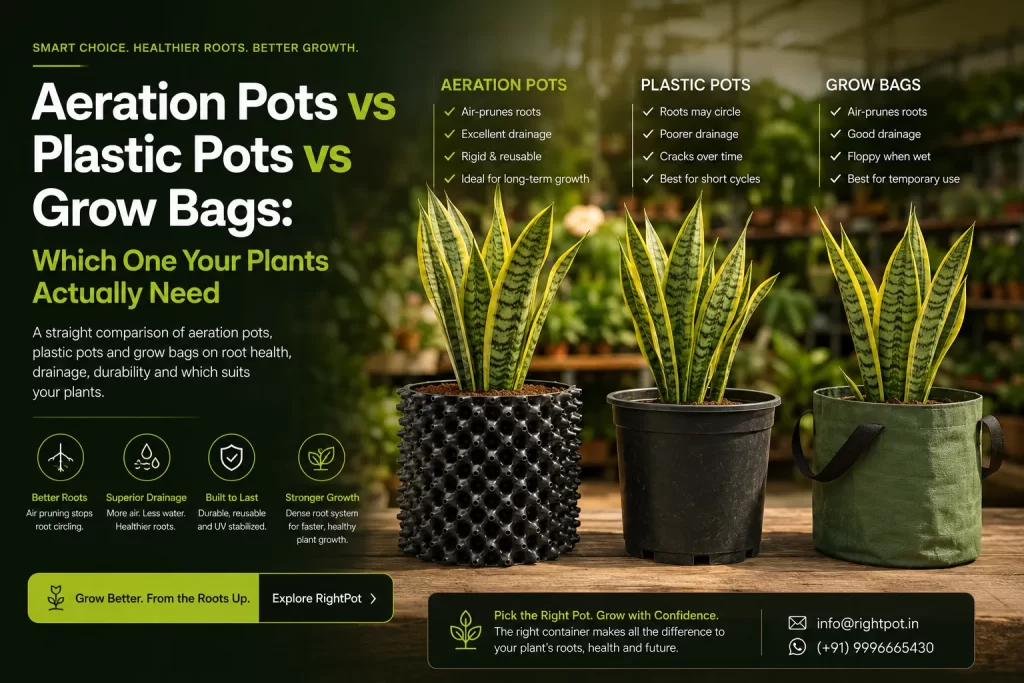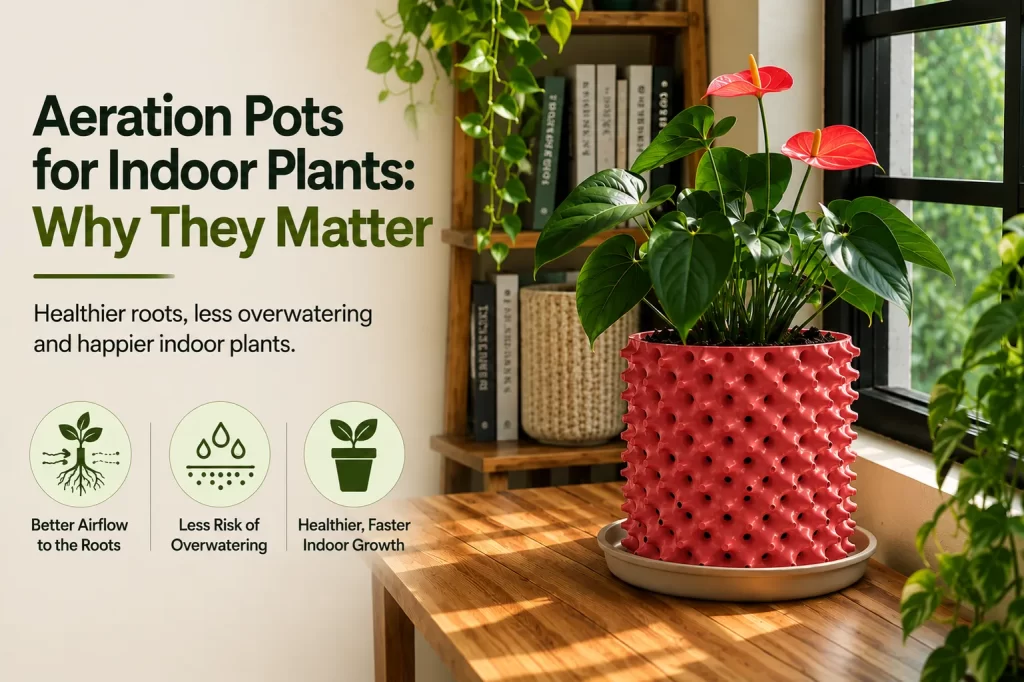
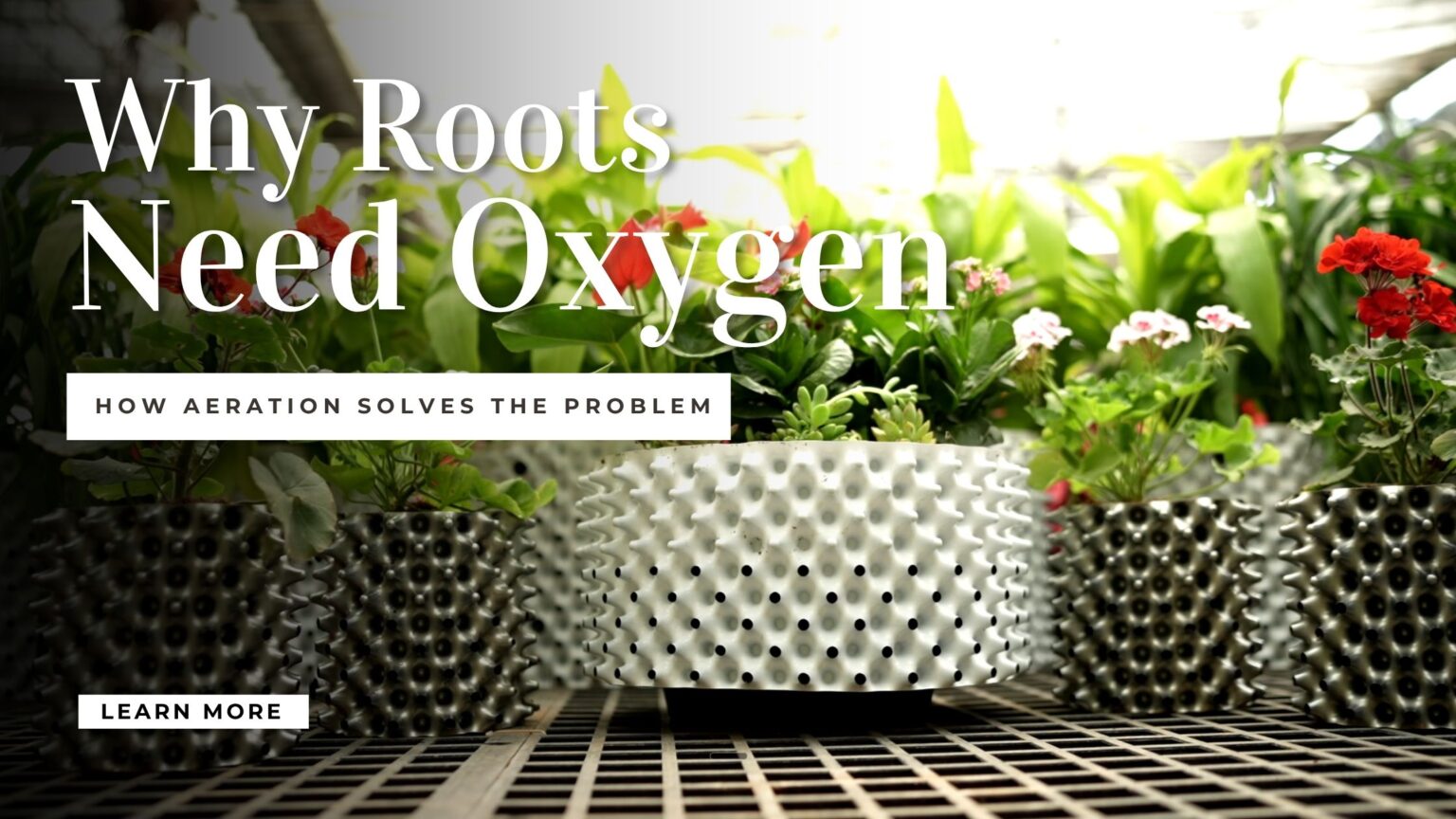
QUICK ANSWER: Aeration pots are containers designed to deliver oxygen to the root zone from all sides – not just through drainage holes at the bottom. Roots require oxygen for active nutrient transport; without it, they cannot absorb minerals even when those minerals are present in the soil. Standard plastic pots create oxygen starvation and force root circling. Rigid aeration containers with active cone openings – like RightPot’s RP and RPP series – solve both problems simultaneously, producing 300+ lateral root tips versus 3–5 in a sealed pot, and delivering 20–25% faster plant growth as a result.
Most container gardening advice focuses on what goes into the pot: the right soil mix, the right fertiliser, the right watering frequency. The pot itself is treated as neutral – a vessel that holds growing medium and drains when watered. That assumption is wrong, and it quietly costs growers – commercial and home alike – in stunted plants, unexplained yellowing, and poor transplant survival.
The container is not neutral. It is either actively supplying oxygen to the root zone or actively restricting it. Aeration pots are designed around this biological reality. Understanding why root aeration matters at a cellular level – and how different container types deliver or deny it – is the foundation for making better decisions about every plant you grow in a container.
Why Plant Roots Need Oxygen – The Biology Most Growers Skip
Roots need oxygen for the same reason every living cell does: energy production. The process of absorbing nutrients from soil is not passive. Roots actively pump minerals – nitrogen, phosphorus, potassium, iron, calcium – against concentration gradients, from lower concentration in the soil water into higher concentration inside the root cell. This active transport requires ATP, and ATP requires oxygen.
When root oxygen levels drop below a critical threshold – which happens quickly in sealed, waterlogged, or compacted growing media – this active transport slows and eventually stops. The plant cannot absorb nutrients efficiently even when the fertiliser application is correct and the soil mix is ideal. This is why oxygen starvation is so commonly misdiagnosed: the symptoms (yellowing leaves, stalled growth, poor root development) look exactly like nutrient deficiency or overwatering. The actual cause is buried in the container design.
A key distinction: roots don’t just absorb water passively. They actively select which minerals to take up, regulate water absorption, and store carbohydrates. Every one of these functions is energetically costly. An oxygen-starved root system is running on empty – visibly struggling for reasons that have nothing to do with what the grower is feeding it.
Healthy roots also respire – they take in oxygen and release carbon dioxide. In a sealed plastic container with minimal airflow, CO2 from root respiration accumulates in the growing medium, displacing oxygen and creating increasingly anaerobic conditions over time. This is a self-compounding problem that gets worse the longer the plant is in a sealed container.
What Standard Plastic Pots Do to Root Oxygen
A standard plastic pot supplies root oxygen through one mechanism only: drainage holes at the bottom. When the grower waters, excess water flushes out, pulling fresh air behind it. Between waterings, air exchange happens only at the soil surface and around the drainage holes. The vast majority of the root zone – every centimetre of growing medium against the solid plastic walls – receives no lateral air exchange.
This creates two problems that compound each other. The first is oxygen depletion in the bulk of the growing medium, particularly in the lower and middle portions of the container where drainage is slowest. The second is root circling. Roots grow outward seeking water, nutrients, and oxygen. When they hit a solid plastic wall with no air, they do not stop – they curve along the wall, continuing to grow in the only direction available. After 8–12 weeks in a standard container, most plants have roots spiralling along the interior walls. These roots consume energy circling rather than building productive feeding networks, and they create structural girdling that persists even after the plant is transplanted to open soil.
Oxygen Starvation Symptoms – What You See vs What Is Actually Happening
| What You See | What Growers Usually Blame | What Is Actually Happening |
|---|---|---|
| Yellowing leaves despite adequate watering and fertilising | Nutrient deficiency – iron, nitrogen, or magnesium | Root oxygen starvation slows active nutrient transport; roots cannot absorb minerals efficiently even when present in the growing medium |
| Plant growth stalls after first 6–8 weeks in container | Too small a pot, wrong soil mix, or insufficient light | Root circling has begun; roots are consuming energy circling the walls rather than building fibrous feeding networks |
| Soil stays wet far longer than expected between waterings | Overwatering, wrong soil, or poor-quality compost | Compacted, oxygen-depleted growing medium has lost its drainage structure; anaerobic pockets forming around roots |
| Transplant failure or slow post-transplant recovery | Weather, planting depth, or shock from handling | Root-bound spiral roots cannot expand into new soil; the plant must rebuild root architecture from a damaged starting point |
| Persistent root rot despite correct watering frequency | Disease, fungal pathogen, or bad batch of soil | Anaerobic conditions in oxygen-starved root zone create exactly the environment root rot pathogens need to thrive |
These misdiagnoses are extremely common in commercial nurseries and home growing. The container is rarely the first suspect – but in sealed plastic pots, it is often the primary cause.
How Aeration Pots Restore Root Oxygen
An aeration pot solves the oxygen problem structurally – not through soil amendments or watering adjustments, but by changing the container’s physical relationship with the air around it. Instead of solid walls that block airflow, aeration containers have openings throughout their walls that allow oxygen to enter the root zone from every direction simultaneously.
RightPot’s rigid aeration pots achieve this through strategically placed cone-shaped openings. Each cone guides a root tip outward toward air. When the root tip emerges into open air, it desiccates – this is air pruning, a natural plant biology response. The plant stops extending that root and instead branches laterally from directly behind the pruned tip, producing multiple new feeder roots. Each of those branches grows toward the next opening, prunes, and branches again. The cycle repeats throughout the plant’s time in the container, filling the growing medium with a dense, fibrous root network.
The oxygen benefit operates in parallel. Because the cone openings allow continuous air exchange across the entire wall surface, the growing medium maintains far higher dissolved oxygen levels than a sealed container. Studies comparing aeration containers to sealed plastic pots show dissolved oxygen levels in the substrate can be up to 300% higher – the difference between an aerobic root environment where nutrient transport functions at capacity, and a progressively anaerobic one where it does not.
Active vs Passive Aeration: Not All Aeration Pots Work the Same
Not every container marketed as an aeration pot delivers oxygen in the same way or at the same intensity. There are two fundamentally different mechanisms – passive and active – and understanding the difference explains why some container types produce more dramatic results than others.
Passive Aeration – Fabric Grow Bags
Fabric grow bags provide root aeration through breathable walls that allow oxygen and moisture to pass through slowly. The air pruning effect is real but indirect – root tips encounter slightly drier conditions near the fabric surface and self-prune. Oxygen exchange improves significantly versus sealed plastic. For many home growing applications, fabric grow bags perform very well.
The limitation: fabric walls provide diffuse, uniform permeability rather than targeted aeration zones. In India’s monsoon season – with 3–4 months of sustained high humidity and frequent heavy rainfall – the passive diffusion mechanism slows significantly when ambient air humidity approaches saturation. Fabric walls that are continuously wet provide less effective soil aeration than their dry-climate performance suggests. Fabric also degrades in 2–4 years and collapses under load when wet, altering container geometry.
Active Aeration – Rigid Cone-Based Containers
Rigid aeration pots with cone-based openings – RightPot’s design – create active, directional aeration zones. Each cone opening is a discrete air channel that guides root tips outward and maintains a consistent air gap regardless of external humidity. The structural geometry does not change when wet, which means performance is consistent across India’s monsoon season in a way that fabric containers cannot match.
The rigid structure also allows the containers to stack 15 units high when empty, handle daily nursery transport without deforming, and allow clean transplanting – the fibrous root ball slides out as a cohesive unit without soil spillage or root disturbance. For commercial operations running 10,000+ plant cycles, these operational advantages compound across every growing season.
Aeration Container Types: Oxygen Delivery, Performance, and Operational Comparison
| Container Type | Oxygen Entry Points | Drainage Quality | Root Circling Prevention | Lifespan | Best For |
|---|---|---|---|---|---|
| Standard plastic pot | Bottom holes only | Poor | None | 2–3 years | Short-cycle low-value crops |
| Terracotta / clay pot | Porous walls (slow) | Moderate | None | 5+ years (if not dropped) | Houseplants, low-moisture crops |
| Fabric grow bag | All walls (passive) | Excellent | Partial (soft walls) | 2–4 years | Home growers, short cycles |
| Rigid aeration pot – RightPot | Active cone openings (360°) | Excellent | Full (air pruning triggered) | 5–7 years | Commercial nurseries, fruit trees, long cycles |
| Slotted plastic container | Slatted walls | Good | Partial | 3–5 years | Liner production, propagation trays |
Lifespan figures reflect normal commercial nursery use in Indian conditions. Oxygen entry point quality directly affects root branching density and transplant survival rate.
The Compounding Benefits Beyond Root Oxygen
Root aeration is the mechanism. The benefits extend well beyond it. When roots receive consistent oxygen, absorb nutrients at full efficiency, and develop without circling, every other plant metric improves in sequence.
- 20–25% faster top growth: More efficient roots drive more vigorous vegetative development. Independent horticultural research documents this across multiple species. For commercial nurseries, the implication is a shorter cycle to sale-ready size.
- 92–96% transplant survival: Plants grown in aeration containers arrive at transplant with 300+ active root tips in a fibrous ball ready to expand immediately. Root-bound plants from sealed pots arrive with spiralling roots that must re-establish before growth resumes – a process that takes weeks and carries high mortality risk.
- Reduced disease pressure: Oxygenated soil aeration prevents the anaerobic conditions that root rot pathogens require. Miracle Farm documented a 40% reduction in transplant mortality after switching from poly bags to RightPot – a result driven partly by the elimination of the waterlogged anaerobic conditions in which root disease thrives.
- Longer productive container time: Plants in aeration pots can remain in the same container for 6–12 months longer without quality degradation. Because root circling never begins, there is no ‘root-bound deadline’ after which quality drops. This gives commercial nurseries inventory flexibility and eliminates the pressure to sell before quality falls.
Frequently Asked Questions
Q: What exactly is an aeration pot, and how is it different from a regular pot?
A: An aeration pot is a container with wall openings that allow oxygen to enter the root zone from all sides – not just through bottom drainage holes. This delivers consistent root oxygen throughout the growing medium, prevents root circling through active air pruning, and eliminates the anaerobic conditions that cause root rot. Standard plastic pots are sealed on all sides and supply oxygen only through bottom drainage holes, leaving the bulk of the root zone oxygen-depleted.
Q: Can’t I just add perlite or make soil amendments to improve root aeration?
A: Soil amendments like perlite, cocopeat, and pine bark improve drainage and soil aeration within the growing medium – and they are still recommended alongside aeration containers. But they do not solve the structural problem: a sealed container wall that blocks lateral air exchange and forces root circling. Amending the growing medium improves the environment roots grow through; the container determines whether those roots can reach air at all.
Q: Are aeration pots suitable for Indian growing conditions – particularly the monsoon?
A: Yes, and they are specifically advantageous during monsoon season. Rigid aeration pots like RightPot drain freely through their cone openings regardless of rainfall intensity, maintaining root oxygen levels even when containers are repeatedly saturated. Fabric grow bags – another aeration container type – lose some of their passive diffusion efficiency when continuously wet during heavy monsoon periods. RightPot’s UV-stabilised polypropylene also resists degradation across India’s full temperature range, from Rajasthan’s 48°C summers to Himachal Pradesh winters.
Q: How soon do plants in aeration pots show improvement compared to standard containers?
A: Root development changes are visible within 2–4 weeks – check the wall openings and you will see white, healthy root tips reaching toward air rather than circling inward. Above-ground growth acceleration is measurable within 6–8 weeks. The most commercially significant improvement – transplant survival rate – is documented after the first full growing cycle. DS Group and Miracle Farm both observed the difference within their first season of using RightPot aeration containers.
Q: Do aeration pots need any special growing medium or maintenance?
A: No special medium is required, but well-draining mixes (cocopeat + perlite + compost) work best because they stay aerated between waterings. Avoid dense, clay-heavy mixes that compact and block the cone openings. Between growing cycles, clean with soap and water for the same crop family, or soak in a 1:10 bleach solution when switching crop types. RightPot aeration pots stack 15 units high when empty and store flat, making between-cycle management straightforward even at commercial scale.
Q: Which RightPot size should I start with for fruit trees in an aeration pot?
A: RP-06 (20L, 13.5″ x 11″) is the starting point for most commercial fruit tree applications – mango, citrus, guava, and pomegranate saplings in 24–30 month cultivation cycles. For 12–18 month production, RP-03 (10L) is sufficient. For premium 36+ month cultivation where root volume directly justifies sale price, RPP-15 (38L) delivers the space needed for deep lateral root development. All sizes deliver the same air pruning aeration mechanism.
The Container Is the Starting Point – Not an Afterthought
Root oxygen is not a niche concern for specialist growers. It is the foundation of every plant’s ability to feed itself, build structure, and survive transplant. Standard plastic containers do not supply it adequately – and the symptoms of that failure are routinely misattributed to soil problems, fertiliser choices, and watering errors.
Switching to aeration pots does not require changing the growing medium, the fertiliser programme, or the watering schedule. It requires changing the container. Everything else – faster growth, stronger roots, higher transplant survival, fewer disease problems – follows from that single structural decision.
Request a trial order or sizing consultation: Contact RightPot at info@rightpot.in or WhatsApp (+91) 9996665430. No minimum order. Our team will recommend the right aeration container size for your specific crop and cultivation timeline.
Additional Resources on Root Health and Plant Nutrition
For growers interested in learning more about root health, plant nutrition, and commercial cultivation practices, additional horticultural resources are available from the National Horticulture Board (NHB) and the Indian Council of Agricultural Research (ICAR). These organizations publish research-backed guidance on soil management, root development, nutrient uptake, and best practices for Indian growing conditions.